
‘What folks want America to be’: Immigrants in Atlanta react with fear and ambivalence to Trump’s historic reelection
The former president campaigned on anti-immigrant promises—but his opponent alienated Muslim and Arab voters with her stance on Gaza. For many, it was a complicated choice.
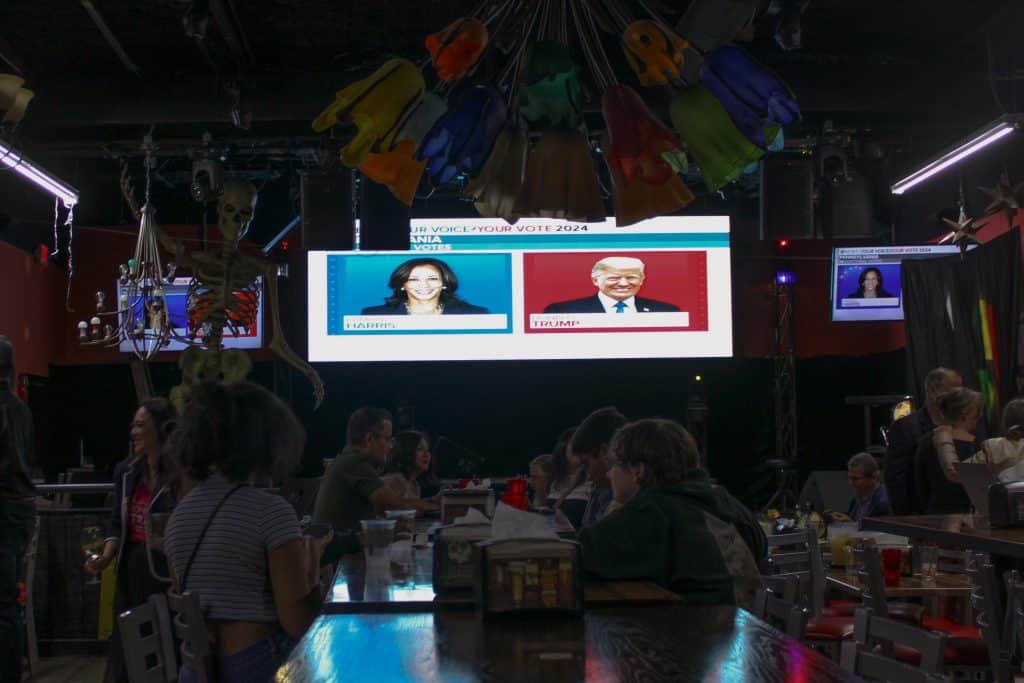
Bridgette Simpson spent election night on the south side of Atlanta, dancing at a watch party hosted by Family Values @ Work, a grassroots organization that promotes economic, racial, and gender justice. Between songs, though, Simpson held back tears while discussing the prospect that Donald Trump would be elected to a second term as president.
Simpson is a 44-year-old Jamaican immigrant living in Georgia since the late 1990s; her father was deported to Canada during Trump’s first term, and she said she and her mother, who also lives in the area, feared the mass deportations Trump promised on the campaign trail. “I think this new version of what folks want America to be doesn’t include me,” said Simpson, the executive director of Barred Business, which supports formerly incarcerated people. “It doesn’t include my mom.”
On Wednesday morning, after the election was called in Trump’s favor, Simpson described herself as “devastated.”
She was one of hundreds of thousands of immigrants in Georgia who woke up Wednesday to face the prospect of another Trump term. The results, following a close race, came after an election season characterized by escalating violent rhetoric from Trump and his running mate, Senator J. D. Vance, which included claims of immigrants eating pets, terrorizing neighborhoods, and voting illegally—none of which were true. Trump has also vowed to carry out the “largest domestic deportation operation in American history,” targeting the estimated 11 million undocumented immigrants currently living in the U.S.
Sam C., a first-generation immigrant with parents from Vietnam and Taiwan, said he worked in the hospitality industry alongside many undocumented colleagues. “Seeing them in fear of what could happen is very distressing,” said Sam, who didn’t want to give his last name. He added that Arab friends of his worry, too, about the reenactment of Trump’s first-term ban on travelers from Muslim-majority countries. “It’s easy to understand why they’re so scared,” he said.
The results also came amid U.S. support for Israel’s brutal bombardment of Gaza and Lebanon, a war that has alienated the Democratic Party from Muslim and Arab American voters—formerly reliable constituencies. Soraya Burhani, who founded Georgia Muslims and Allies for Peace, said that, after weeks of going to local mosques to register voters, she wasn’t completely surprised by the outcome. “I normally vote, but this year I’m not going to vote,” she heard from people she canvassed. A Buford resident who moved to the metro area ten years ago from Malaysia, Burhani told 285 South in October that she herself had previously been a Democrat, but now was unsure what to do with her vote. “I’m greatly disheartened,” she said. “It’s painful.”
Burhani said many of her Muslim friends shared her distress: For the past year, they had organized to demand a ceasefire and an end to military aid to Israel, only to be met with silence from Democratic candidate Kamala Harris’s campaign and the Democratic Party. In the last few weeks of the election, Trump had seized on the disconnect between Arab and Muslim voters and Democrats, meeting with imams and other Muslim leaders at a rally in Michigan—a state Trump won by, at press time, 80,000 votes. About 200,000 Arab Americans live in Michigan.
“For the last week, I had prepared myself for this win,” said Tanjina Islam, the vice chair of membership for Gwinnett Democrats and executive director of Voices of Muslims. “But I was hoping some other state would come up with a magical number.” Georgia was called for Trump a little after 1 a.m on Wednesday. Another consequential call came an hour later, when the AP declared that Trump had also won Pennsylvania, thought to be crucial for Harris’s chances. Joe Biden carried that state, as well as Georgia, in 2020.
***
Some voters whom 285 South spoke to were more sanguine on Trump’s comeback. Nicole, who was voting in Doraville on Tuesday and only wanted to give her first name, comes from a family from Ecuador; she expressed frustration over seeing housing and healthcare benefits given to newly arriving immigrants and not to undocumented acquaintances of hers who have been in the country for years. Some of her friends are Dreamers, brought to the U.S. as children by their parents. They “were never given papers, they couldn’t access college, they couldn’t access any government aid, financial aid. Why?”
Voting for the first time for a Republican, Nicole was one of scores of Latinos in America who made up Trump’s base of support this year, when he won a larger share of the Latino vote than in 2020. Many cited rising costs of food and housing, as well as concerns over immigration, as reasons for supporting the Republican ticket. On Wednesday morning, Nicole told 285 South she’d expected Trump to win, sensing it from the ambivalence that her Black and Latino friends expressed toward Harris. She hoped he would fulfill his campaign promises. “Starting off, deport them,” she said. “Deport the people who don’t have to be here.”
Others working with immigrants and refugees, though, are gearing up to anticipate, and oppose, the crackdowns they expect to come with another Trump presidency. Aceli Zenil, a co-founder of Amigos de la Comunidad, which works to support low-income and undocumented families in the Buford Highway area, said her daughter is in seventh grade, and fears her parents being taken away: “She is worried that we’re going to get deported and she’ll be left alone.”
Serene Hawasli Kashlan, the legal director for the nonprofit Asian Americans Advancing Justice, expects to see a “weaponization” of the immigrant detention system under Trump. Immigrants here tenuously—under DACA, for instance, or with Temporary Protected Status, which is available to migrants whose safety is threatened in their home countries—may find themselves increasingly vulnerable. “Those statuses could expire, and they’d be also susceptible to deportation,” she said.
“We suspect that Trump will end programs that are meant to keep families together,” she added. Detainees already have limited access to legal representation, a problem she thinks will only get worse. She also expects to see “an increased use of profiling, whether it’s actual or perceived, based on race, national origin, language.”
Noting that one in seven undocumented immigrants in the U.S. is originally from Asia, Hawasli Kashlan said, “Mass deportation terrifies the community, devastates the community, causes fear and insecurity.”
Within the broader category of immigrants to the U.S., Trump’s return may also have dire implications for refugees—people arriving in this country fleeing violence or persecution elsewhere. Aimee Zangandou, for instance, came to the U.S. as a refugee from Rwanda in 1997. She’s now the executive director of refugee and immigrant services at Inspiritus, one of the four main refugee resettlement agencies in Georgia. In the past year, Inspiritus has welcomed more than 1,300 refugees to the state—a significant increase from Trump’s first four years, when refugee resettlement reached historic lows. In the last year of Barack Obama’s presidency, the U.S. welcomed nearly 85,000 refugees; in the last year of Trump’s, that number was just shy of 12,000.
“We are heartbroken,” she said, speaking over the phone to 285 South. “During [Trump’s] first term, there was a great effort to dismantle the refugee resettlement program. We are really concerned about how many refugees could be admitted to the U.S. for the next four years.”
***
“We’re going to have to defend our community and protect our community,” said Kyle Gomez-Leineweber, director of public policy and advocacy at the GALEO Impact Fund, which supports Latino candidates for public office. “But we’ve always done that.”
Others have also emerged from the election feeling galvanized. Toward the end of the day on Tuesday, Burhani—the founder of Georgia Muslims and Allies for Peace, whose training is in medicine—took a break from volunteering at a polling site in Clarkston to use the restroom in a nearby public library. There she encountered another Muslim woman, wearing a hijab, with her three children.
“I said, ‘Hi, sister,’” Burhani said. “‘I just want to ask you: Did you vote yet?’”
The woman hadn’t, but responded warmly to Burhani, who kept the conversation going.
“I said, ‘So are you a voter?’ She said, ‘Yeah, I vote every time.’ But there’s also a lot of people at masjid who have told me exactly the same thing: Not this year.” The woman in the bathroom said something similar, something Burhani had heard many times: “I don’t know who to vote for.”
Late Tuesday night, as the outcome of the presidential race started to become clear, Burhani went to bed not expecting to want to get out of it the next morning. But when she woke up, she said, she had a renewed sense of energy: She had learned a lot about political organizing, and she knew there was a lot left to do. “We have to work on this—like we have to invest in this, including me,” she said. “Physically, mentally, all of it.”

Authors


Related Articles
Man confirmed dead in ICE custody at Stewart Detention Center
30th confirmed death in ICE custody nationally makes current federal fiscal year the deadliest in the organization’s history.
Amid warehouse job cuts and an end to food stamps, many families in Clarkston face an uphill battle
Rohingya families open up about the cost of living, layoffs
At the intersection of immigration and healthcare, stories “humanize what the systems can obscure”
Healthcare providers and community advocates came together to make space for stories about immigrant communities harmed by the U.S. healthcare system.