Welcome Corps relies on private citizens to support arriving refugees
The State Department program, launched in 2023, might already be in jeopardy, with Donald Trump returning to the White House.
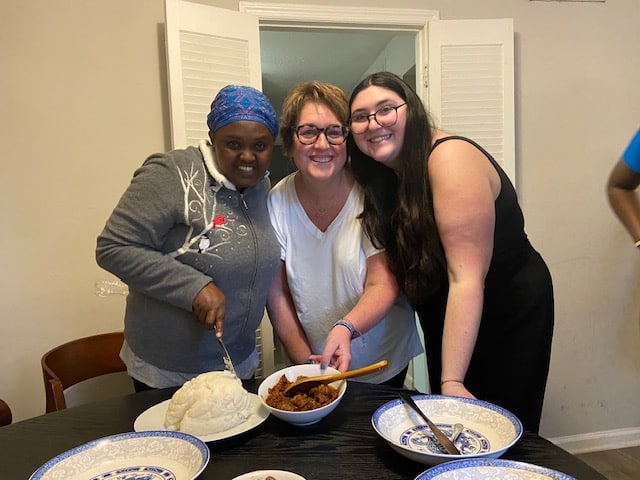
Allen and her six-year-old son, Joshua, celebrated Thanksgiving this year with their new extended family in the U.S.—a handful of volunteers, and their family and friends, who’ve been assisting the pair as they’ve transitioned into life here. Everybody brought a dish to pass: turkey, mac and cheese, sweet potatoes. It’s a tradition she’s still getting accustomed to—Thanksgiving isn’t a holiday in Allen’s native Democratic Republic of Congo (DRC).
Today, Allen’s home is a one-bedroom apartment in Clarkston that has a toilet and a shower—a stark contrast to the tiny concrete room where she lived for seven years in Nairobi, Kenya, after she left the DRC, sharing an outhouse with 30 others and bathing herself with a sponge and water. “I love being in America,” Allen said. “Best thing about America is the people.”
The 34-year-old received help resettling in Atlanta through the Welcome Corps, a State Department program that empowers ordinary American citizens to support people fleeing violence or persecution. “This is such an easy way to make a positive difference in the world,” said Leanne Rubenstein, who led the efforts to welcome Allen to Atlanta, raising funds to support her and Joshua and helping them get settled.
“All of them, they loves me and they love my baby,” Allen said.
Modeled after a Canadian program, Welcome Corps was launched by the Biden administration in 2023 to supplement traditional resettlement efforts coordinated by nonprofit agencies; it followed a similar 2021 initiative geared toward people arriving from Afghanistan following the U.S. military withdrawal from that country.
Allen and Joshua are two of 64 refugees resettled in Georgia under the program’s auspices, and among 3,000 people resettled nationwide through Welcome Corps since 2023, according to a State Department spokesperson. Their arrival here, and the launching of the Welcome Corps program, was part of a larger effort by the Biden administration to rebuild the U.S.’s refugee system after resettlements dropped to historic lows during Donald Trump’s presidency. Now, though, with Trump set to return to the White House, the U.S.’s commitment to refugee resettlement is again in doubt—and the future of the Welcome Corps may be in jeopardy.
Allen’s journey to Clarkston
Decades of political instability and violence in the DRC have led to millions being displaced, with women and girls particularly vulnerable. For Allen, who didn’t want her last name published over concerns about privacy, the last straw was a bomb that exploded at the school where she was a student in 2016, convincing her and her cousin that it was time to flee.
Leaving by boat, they made it to the Ugandan border—where, without money, food, or passports, they were stranded for a week at a bus station, fending off predatory men. “Many bad people,” Allen said. The pair were able to hitch a ride to Kenya, where a Congolese woman gave them shelter and guided Allen to the United Nations, where she received refugee status—and applied for resettlement in the U.S.
While waiting, Allen started selling cut-up fruit at a roadside stand to get by, and was living in cramped, unsanitary quarters. “I was so tired,” she said. Finally, somebody from a U.S. government refugee agency let her know that she could be resettled in the U.S. through a new program called the Welcome Corps—and that a group of sponsors was waiting for Allen and her son, who was born in Nairobi, in Atlanta. “I said, ‘Where is that group? Where is that paper? I sign it very quickly,’” she recalled. Two weeks later, Allen and Joshua were on an airplane.
After Allen’s case was processed overseas, she’d been matched with Rubenstein’s support group, which had applied to participate in the Welcome Corps and received vetting, training, and certification. Each Welcome Corps sponsor group comprises at least five people, and raises a minimum of $2,425 per refugee to cover basic living expenses for the first three months. Rubenstein, the codirector of the Decatur-based nonprofit Compassionate Atlanta, initially found 10 coworkers, family, and friends to help in the effort, including descendants of Holocaust survivors.
That connection is part of what motivated her: The U.S. was notoriously slow to admit Jewish refugees from Germany during the Holocaust, leaving hundreds of thousands on the waiting list—a history critics invoked during the first Trump administration, especially because of his so-called Muslim ban. “When I think about the Holocaust, and I think about, what if we were able to save people from the death camps—how different some lives would be, and how many lives would be saved,” said Rubenstein, who is Jewish. “That’s exactly what I think Allen’s case illustrates, that just a group of regular people can get together and actually and literally save a life and create safety for a family.”
Rubenstein and her group ended up raising $10,000. They helped Allen find and furnish an apartment and enroll Joshua in school; they took her to doctor’s visits and helped her shop for groceries, complete benefits applications, and pay bills. Rubenstein’s niece found a washer and dryer on Facebook Marketplace, while another team member worked with Allen on her résumé, and yet another friend donated her grandmother’s treasured dining room table, which she’d held onto for a decade. Within six months, she had a job and was fully independent.
But before the group did any of that, Leanne and her sister greeted Allen and Joshua at the airport. “They hug me, and I forgot everything,” Allen told 285 South. “They make good picture on my heart.”

The uncertain future of Welcome Corps
Since its launch, public interest in the Welcome Corps has been overwhelming. Some 140,000 sponsors have already applied, with the capacity to resettle as many as 84,000 refugees. It’s been hard to keep pace with the demand: As a young program, Welcome Corps is still building capacity to meet the record number of applicants. “It takes time to build the infrastructure, the policies, and the processes,” said Anne Sweeney, director of Welcome Corps at Community Sponsorship Hub, which implements the Welcome Corps program with the help of a consortium of nonprofit agencies. During the resettlement process, both the sponsors and refugees receive ongoing support and oversight from one of those nonprofits.
The Welcome Corps has been part of an effort to strengthen the U.S. refugee resettlement system, which languished under Trump: In 2020, the former president’s administration admitted fewer than 12,000 refugees, the lowest number on record to that point (admittances were lower in 2021, largely due to the Covid-19 pandemic). By contrast, in fiscal year 2024—which ended in September—100,000 refugees were resettled in the U.S., the most in three decades. For the current fiscal year, the administration set a goal to resettle 125,000 people.
That resurgence could be short-lived, though. Trump’s vows to “suspend refugee resettlement,” matched with his anti-immigrant rhetoric and promises of mass deportation, have advocates worried. “We believe that the incoming administration plans to temporarily halt refugee resettlement and then dramatically reduce the number of refugees coming through the program,” said Paedia Mixon, CEO of the Atlanta-based refugee-support nonprofit New American Pathways, in a statement. “This will mean significant cuts in federal funding to refugee service organizations and programs like Welcome Corps. We are concerned that these cuts will not only impact the ability to serve incoming refugees, but also limit the ability of refugee service organizations to meet the needs of refugees already here.”
Between now and January 20, many resettlement agencies are preparing for increased refugee arrivals. And the State Department expects the number arriving through the Welcome Corps to grow significantly into fiscal year 2025—to 10,000 people, according to a State Department spokesperson. Of the Welcome Corps’ 3,000 resettlements to date, 40 percent have happened in the past 10 weeks, since the beginning of the 2025 fiscal year on October 1.
Sweeney remains hopeful about the Welcome Corps’ prospects. “We expect this program to endure,” she said. “It’s a program that was really driven by the demand of the American public.”
Back in Clarkston, Allen has been busy. Working at a discount department store, she just completed Georgia’s certified nursing assistant’s training and looks forward to a new career. “I love to give people care,” she said.
“What a gift it is, if we have somebody in our family who needs extra care, knowing someone like Allen . . . would be the one to take care of that person,” Rubenstein said. “So, her success is tied to the success of all of us.”
More information on becoming a Welcome Corps sponsor here.
Related Articles
Senator Warnock alerts of “serious concerns” around healthcare access, after visit to Stewart Detention Center
Including, for pregnant women.

Georgia passed a law targeting undocumented immigrants who commit crimes, after a high-profile 2024 murder. It may not be doing much for public safety.
In diverse Gwinnett County, HB1105 has become a quiet tool for the Trump administration to advance its immigration crackdown.
“Are you concerned about yourself and your neighbors?”
As food insecurity grows among Georgia’s immigrant and refugee communities, one mutual aid group is operating under the radar to support their neighbors