How laws affecting immigrant communities are faring in this year’s legislative session
The Georgia General Assembly recently passed Crossover Day, a critical deadline for legislation to have any chance at becoming law. Here are the bills that local immigrant advocacy orgs have their eyes on.

Earlier this month, the Georgia General Assembly passed a critical milestone with Crossover Day—the point in the annual legislative session when bills must pass out of either the House or the Senate to have a meaningful chance at becoming law. This year, local organizations representing immigrant communities are keeping a close eye on legislation affecting free speech, religious liberty, voting rights, and more. They’re also tracking “zombie bills”—laws that don’t survive on their own, but may be added as amendments to other bills that did survive Crossover Day.
Here’s what’s on the radar of local immigrant advocacy organizations we spoke to:
Bills that survived Crossover Day
- Senate Bill 21, which targets “sanctuary cities,” is now the main piece of legislation that many immigrant organizations are tracking. The bill would strip local governments from protection from civil lawsuits if an undocumented person commits a crime within their jurisdiction—if those governments don’t cooperate with federal immigration agents. Opponents say the bill is frivolous (there are no sanctuary cities in Georgia) and potentially harmful. Kyle Gomez-Leineweber, director of policy and advocacy for the Latino nonprofit GALEO Impact Fund, said it would lead to an underreporting of crime: “People, especially in our community, would be more afraid to reach out to law enforcement when they’re being abused or victimized, have experienced crime, or witnessed a crime.” CASA, another local organization working with immigrants in the state, is organizing a petition urging elected House of Representative officials to reject the bill.
CASA, another local organization working with immigrants in the state, is organizing a petition urging elected House of Representative officials to reject the bill.
- Senate Bill 61, one of several proposals responding to a recent mass shooting at a Barrow County high school, makes it possible to prosecute children as young as 13 years old as adults if they commit “terroristic acts” in school. Civil rights groups worry the measure would disproportionately affect minority students. “We know that these kinds of terminologies . . . lead to a lot of profiling, which we already see for Black and brown and Muslim students, and we think that that’s going to aggravate the situation,” said Azka Mahmood, the executive director of the Council on American-Islamic Relations’ Georgia chapter (CAIR-Georgia).
- House Bill 268 proposes the creation of a database of students considered a threat to schools, and a new Office of Safe Schools housed within the Georgia Emergency Management and Homeland Security Agency. Critics have cited cybersecurity and data privacy risks, with some warning that it could lead to the surveillance and targeting of Muslim students.
- Senate Bill 177 requires foreign-supported political organizations from “hostile foreign countries” (Russia, China, Iran, and North Korea) to register with the State Ethics Commission. It’s opposed by groups including Project South, CAIR-Georgia, and the Georgia ACLU, which fear it will criminalize First Amendment–protected political advocacy, particularly the Palestinian solidarity movement.
- Senate Bill 36, aka the Georgia Religious Freedom Restoration Act, would “ensure Georgians are able to exercise their religious faith without unfair federal, state, and local government intrusion,” according to sponsor Sen. Ed Setzler. Opponents say it would essentially permit discrimination—against LGBTQ+ people, people of color, workers, religious minorities, and others—under the guise of religious freedom.
Bills that didn’t survive Crossover Day
- House Bill 18 would have required students wishing to participate in dual-enrollment programs (accessing college classes while still in high school) to be legal Georgia residents—basically excluding undocumented students.
- House Bill 82, the Georgia Guest Worker Act, would have created a program allowing citizens of other countries to work temporarily in the state to fill labor shortages.
- Senate Bill 142 would have made it easier for international medical graduates to practice medicine in Georgia.
- Senate Bill 120 would have stopped public funding to any K-12 public school, college, or university that supports diversity, equity, and inclusion programs.
- House Bill 602 would have denied financial aid to students who violate college codes of conduct, but advocates said it would also have targeted students involved in protests, particularly with regard to Israel’s war in Gaza. Though the bill did not cross over, CAIR-Georgia is still tracking it: “We believe that it can become a zombie bill,” said Azka Mahmood.
Author

Related Articles
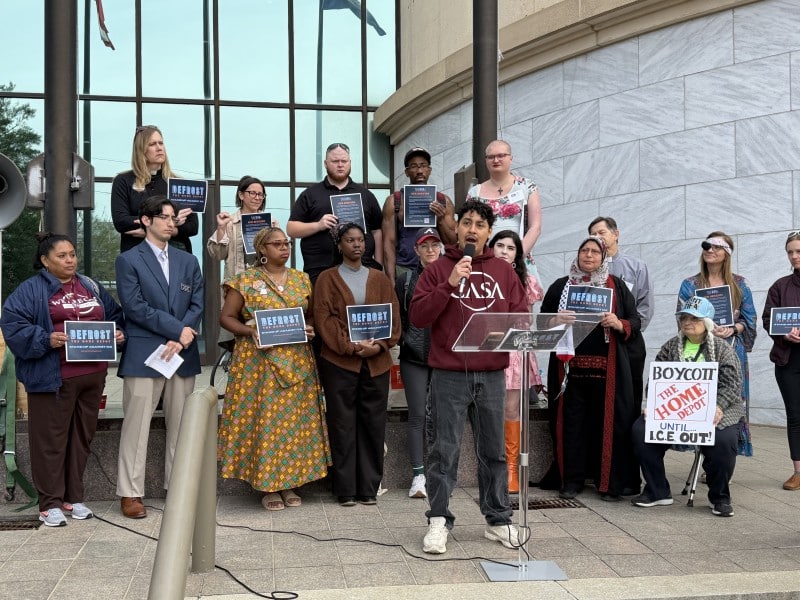
Atlanta advocates demand: “Get ICE out of Home Depot now”
As popular spots for immigrant day laborers to find work, Home Depot locations across the country have been repeated targets of ICE raids. Now advocates are pressuring the Atlanta-based company—an official sponsor of the upcoming World Cup—to take a stand.
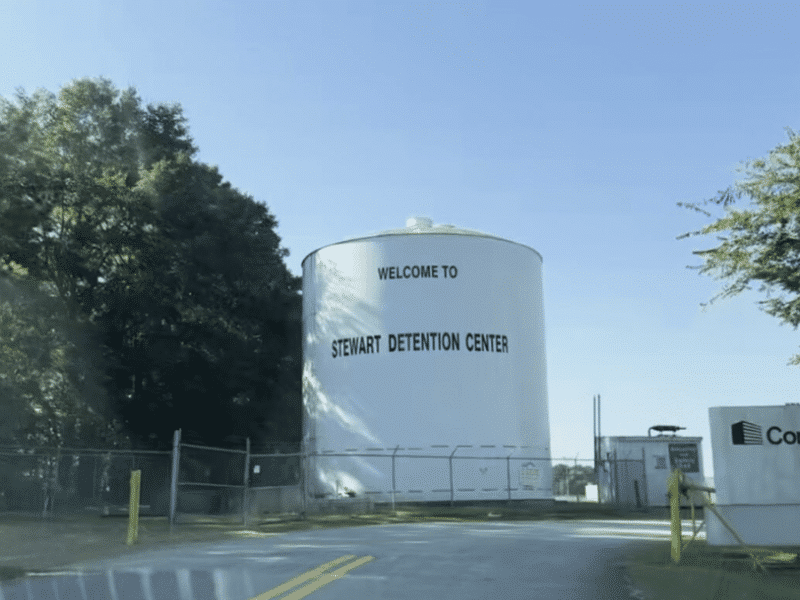
Woman who assisted in federal abuse investigation, arrested at Atlanta airport and deported days later
“A slap in the face,” her attorney says describing her client’s situation, who had a pending U-visa application