
Underage immigrants traveling alone to the U.S. need legal support—but federal funding cuts are making lawyers harder to get
As the government’s Unaccompanied Minor Program comes under threat, immigrant-serving legal orgs in Atlanta are figuring out how to adapt.
When she was 17 years old, Ana made one of the biggest decisions of her life: She moved to the United States. Ana had been sexually abused twice in her home country, Guatemala—the first time by a family member when she was just 15, and the second time by a stranger—and decided to make the trip because she felt unsafe in her hometown. Her 11-day voyage involved walking, riding on strangers’ cars and taking the subway in different countries from Guatemala to the U.S. in Arizona, where she surrendered to immigration authorities and entered the country as an unaccompanied minor. Ana finally landed in Georgia when an extended cousin in Peachtree City came forward to take care of her.
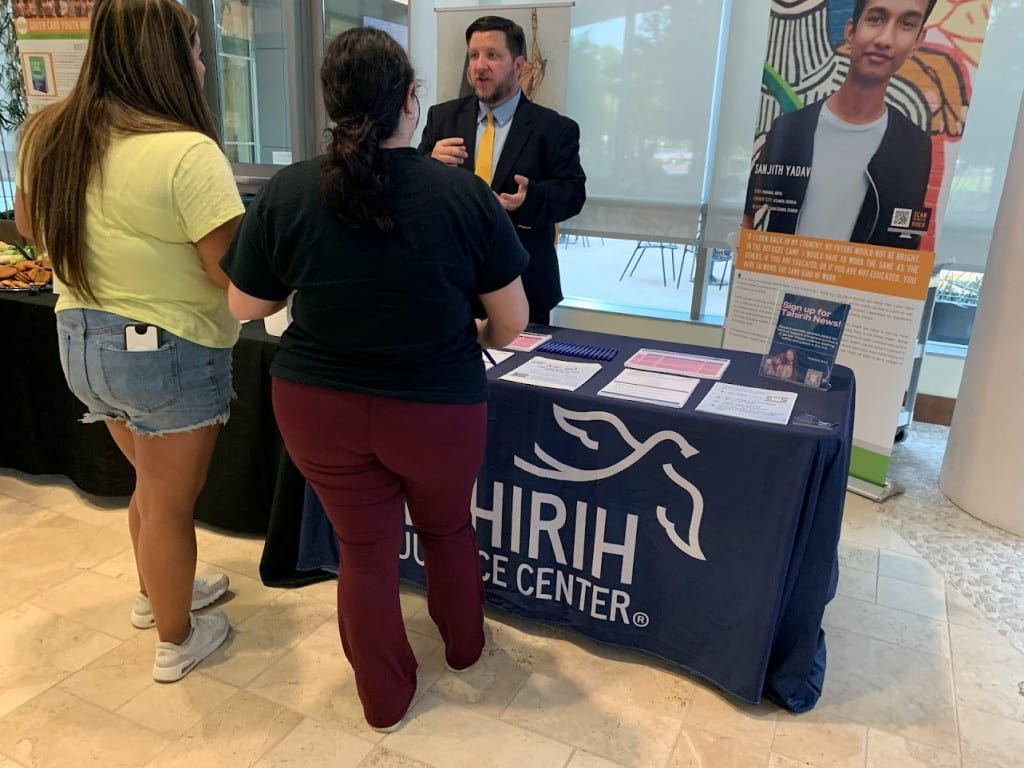
When underage immigrants enter the U.S. without a parent or guardian, they’re taken into custody by the Office of Refugee Resettlement, part of the Department of Health and Human Services; they can then be placed with vetted sponsors, often family members or friends, while they await immigration proceedings. In Atlanta, Ana was able to get legal support through the Tahirih Justice Center, a national nonprofit, with a local office, that serves immigrant survivors of gender-based violence. The organization currently represents 146 local clients with active immigration cases, including Ana, who’s now 19 (and, in this story, using a pseudonym to protect her privacy). Among those clients, 60 are minors or were minors when the organization started representing them.
That work, though, is under threat: By September, the nonprofit says, it’ll run out of funds to represent clients like Ana. This spring, the federal government slashed funding to HHS’s Unaccompanied Minor Program, which provides legal representation to underage people with immigration claims—about 26,000 cases around the country. In Georgia alone, more than 4,000 unaccompanied minors were released to sponsors in 2024. The lawyers don’t just help facilitate asylum claims like Ana’s; they also help protect young people from trafficking and abuse.
“We’ve had to pause intakes for unaccompanied minors at the moment, until we can figure out what we can do to fund the work in the future,” said Vanessa Wilkins, Tahirih’s executive director.
Kids in Need of Defense, which also provides legal counsel to unaccompanied kids, was another organization hit by funding cuts—and is now having to figure out how to reconfigure its work to keep supporting its clients, said spokesperson Megan McKenna in an email: “We are transferring to a national model in which we are reducing the number of brick-and-mortar offices we have as a result of the cuts, but retaining as many cases as we can.” Some federal funding was reinstated through September, but KIND doesn’t know yet whether it will close its Atlanta office. The organization is always on the lookout for immigration attorneys to volunteer to take cases pro bono, Megan added.
Thousands of children in need of legal support
Arriving in the U.S. in 2023, Ana was originally placed in removal proceedings, said Collin Mickle, who leads Tahirih’s Atlanta legal team. He and his colleagues helped get Ana’s deportation case dismissed, then filed an application for asylum on her behalf, while assisting Ana in obtaining a work permit while her asylum case is pending. “I’m very happy that they assigned me precisely to him, because he’s very good to me,” Ana said about Collin.
According to an estimate from KIND, about half of unaccompanied minors don’t have such legal representation. That means representing themselves in court—and facing a process for staying in the country that can be deeply confusing and hard to navigate. In Atlanta, for instance, one immigration court is located in the same building as the field office for Immigration and Customs Enforcement. Maria Rodriguez, an attorney in KIND’s Atlanta office, knew a child who went to his immigration court hearing but was accidentally directed to the ICE waiting room; after hours of waiting, he was told by staff that he had been ordered removed from the country because he’d missed his hearing.
“That’s something that wouldn’t have happened if he had had an attorney,” Maria said. The child ultimately got in touch with KIND, whose attorneys reopened his case, and he was able to stay in the country. “But something simple like that, because logistics can be very difficult for a child to maneuver, can have really detrimental consequences.”
Many children in the country are eligible for various legal statuses, including asylum, U visas (available to victims of certain crimes), and T visas (for victims of trafficking). But without an attorney who specializes in immigration law, they don’t know what’s available to them. If they can’t find pro bono representation, moreover, costs can be prohibitive. “It’s very hard, unfortunately, for a child to be able to find an attorney,” Maria said. “There are multiple reasons: being new to this country, just trying to acclimate themselves to a new place, which can be very difficult.”
In Ana’s case, Tahirih connected her with a social worker who regularly checks in on her and offers her support with everything from rent to finding healthcare providers and work opportunities. She currently works at a Thai restaurant in midtown Atlanta, a job she enjoys because it keeps her busy. “They have done so many things for me, from small to big ones [and] I’ve felt supported by them,” she told 285 South in Spanish.
Since taking office in January, President Trump has issued a series of executive orders targeting immigrant and refugee communities, including the suspension of the refugee admissions program. In roughly the same time frame, the number of unaccompanied minors encountered by federal authorities at the southern border has decreased significantly, from 6,827 entering the U.S. in December 2024 to just 829 in April of this year. Even as the number of arrivals has dropped, though, the demand remains: Children who resettled in Georgia last year—or, like Ana, in years prior—continue to need legal support.
“The broader story is that, because of these funding cuts, there are fewer and fewer people doing this work at a time when the need is becoming more and more urgent,” said Tahirih’s Collin Mickle.
While Georgia may not receive the same number of unaccompanied children as places like New York and California, minors from surrounding states, including Alabama and Tennessee, often end up in immigration court in Atlanta—and need a local attorney to assist them. The need is especially acute in rural areas, said Maria Rodriguez: “There are not a lot of organizations that have capacity to go out there, and not a lot of attorneys that have the expertise out there to do these types of cases.”
For now, a federal judge in California has ordered the temporary reinstatement of funding for legal services for unaccompanied migrant children–meaning the unaccompanied minor program funding will be restored until September 29 of this year, and after that it is uncertain if it will be reinstated. So, local nonprofits are taking their own steps to secure their operations. At Tahirih, a lot of the work for unaccompanied minors has been done by Theresa Cephas, a specialist whose position is funded through Immigrant Justice Corps, which places young immigration attorneys in the offices of nonprofits that need their expertise—and is another of the scores of organizations to have its livelihood threatened. Tahirih recently started fundraising to cover the costs of Theresa’s work, while working on contingency plans in the event that her position is cut entirely, including possibly transferring her cases to another immigration attorney.
Ana now lives alone in the Atlanta area; with her work permit that allows her to work, she’s able to pay for rent, food, and transportation, and she sends money back to her parents and siblings in Guatemala. Paying a private attorney would be impossible; if she hadn’t received help from Tahirih, she said, she would probably have given up on her asylum claim already: “They’ve been a huge support in my life.”
Author

Related Articles
“We believe that God will make a way for us, whether here in America or somewhere else”
As Temporary Protected Status for Haiti expires, a Lawrenceville pastor is comforting his community, amid reports of self deportations and job cuts

“I didn’t expect it to happen in my family.”
A flurry of homemade videos points to a summer uptick in immigration arrests in the Atlanta area
Venezuelan man dies in immigration custody in Georgia
45-year-old Jesus Manuel Arenas-Silvia is the third person to die in ICE custody in Georgia this year.