“287(g) counties start becoming deportation pipelines,” an advocate in Georgia says
The controversial program empowers local law enforcement to act on behalf of federal immigration authorities—and, critics say, increases the likelihood of detention and even deportation for people pulled over for minor traffic stops. Its use in Georgia is growing.
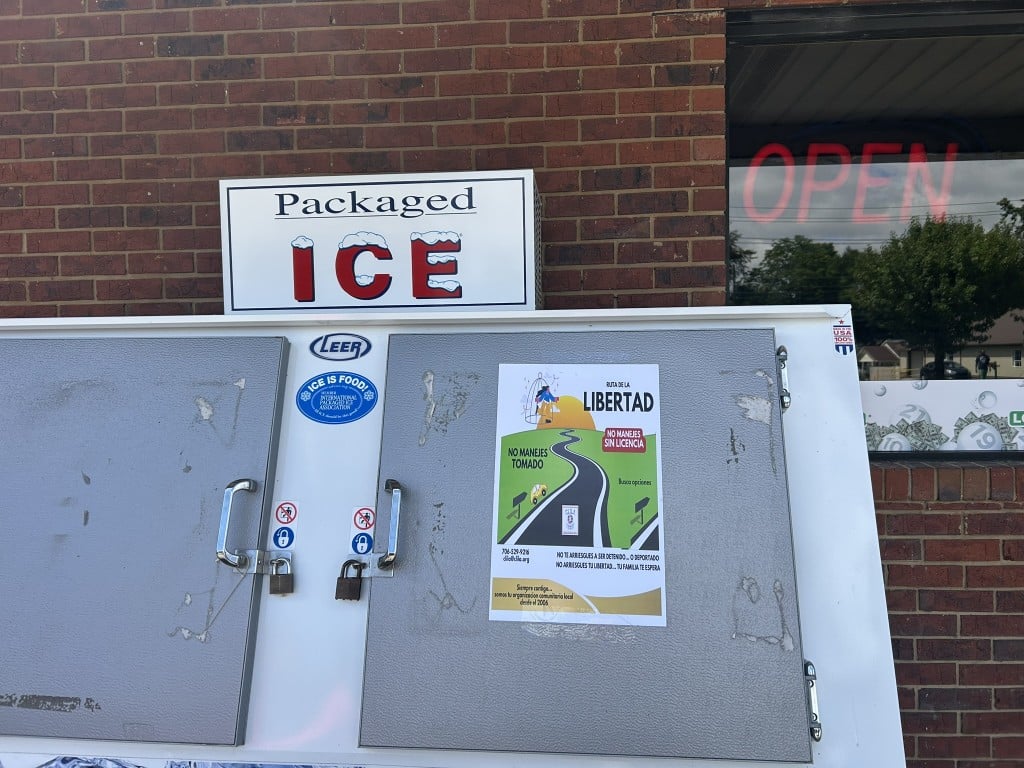
In Dalton, around 90 miles northwest of Atlanta, immigrant advocates have been knocking on doors and posting constantly on Facebook since the beginning of this year. They’ve even purchased a radio ad. Their goal: educate community members on how to safely move around – getting to work, running errands, taking their kids to school – without getting detained. That’s because in Georgia, those without legal residency status aren’t able to get driver’s licenses, and simple tasks like these can put them at risk of getting pulled over—putting them at risk of detention and possible deportation.
Coalición de Líderes Latinos—a Latino advocacy group in Dalton, which is in Whitfield County—first launched this educational campaign called Ruta de la Libertad, or Route to Freedom, back in 2009. More than a decade later, the organization relaunched the campaign as they hear more people are ending up in immigration detention following a traffic stop.
Between February and June of this year alone, the organization has learned of at least 35 people who ended up in detention in Whitfield County, followed by a transfer to an immigration detention center. Last year, the group documented just two people. The rise in numbers, said America Grunner, the Coalición’s executive director, is because of the local sheriff’s department’s participation in the 287(g) program, and is part of the Trump administration’s nationwide immigration crackdown.
In Whitfield County, where nearly 40 percent of the population is Hispanic or Latino, the local sheriff’s office first entered a 287(g) agreement back in 2008—an arrangement in which local law enforcement agencies collaborate with federal Immigration and Customs Enforcement (ICE) officers to police undocumented people in their communities.
The increase in arrests America is seeing locally is in line with national trends, as the Trump administration leans on 287(g) and local law enforcement to support his goals of mass deportation. 287(g) agreements between local agencies and the federal government have skyrocketed by 419 percent since Trump took office, with 700 agreements now in effect across 40 states.
Since 2009, the Coalición de Líderes Latinos has run the Route to Freedom campaign on and off, depending on the immigration priorities of the presidential administration in power; the campaign was dormant last year under the Biden Administration, because there were so few reports of people being placed in detention after a traffic stop.
Arrests related to 287(g) agreements don’t attract the same kind of national attention as, for instance, workplace raids—which some advocates say makes them a more insidious form of immigration enforcement. In Dalton, “immigration officers haven’t come to do mass arrests or take people off the street,” America said. “But we’ve had too many arrests because of 287(g).”
Here’s what you need to know about how this federal program works in Georgia.
What is 287(g), and what does it do?
The program gets its name from Section 287(g) of the Immigration and Nationality Act, a provision signed into law in 1996 as part of a larger package of immigration reforms. The program allows the Department of Homeland Security to enter into formal agreements with state or local law enforcement agencies so that they can perform some functions of federal immigration agents. Officers in participating agencies receive training on performing immigration enforcement operations.
Local agencies can enter into three different kinds of arrangements:
The jail enforcement model deputizes police officers to interrogate noncitizens who have been arrested and ask them about their immigration status. The officers may issue immigration detainers—administrative requests from ICE to law enforcement agencies to hold noncitizens for up to 48 hours after they are due to be released.
Under the warrant service officer model, ICE trains state or local law enforcement officers to execute ICE warrants and arrest people on their behalf. This allows officers to perform the arrest functions of immigration officials within the law enforcement agency’s jails or correctional facilities.
With the task force model, state and local law enforcement can carry out immigration enforcement activities during their day to day duties, for example, asking for the immigration status of a person during a traffic stop. ICE calls it a “force multiplier”.
Which counties in Georgia have 287(g) agreements?
In addition to the Whitfield County Sheriff’s Office, 25 other Georgia counties have 287(g) agreements, with four more in the process of entering into one. Statewide, the Georgia Department of Public Safety – i.e. Georgia State Patrol – is part of a 287(g) agreement (the task force model), as is the Georgia Department of Corrections (the jail enforcement model).
Under Georgia House Bill 1105, passed in 2024, police and sheriffs’ departments across the state are required to request 287(g) agreements with ICE and allows the state to withhold certain state funding or state-administered federal funding from local governments if they do not comply. The law – notably – doesn’t specify whether departments have to sign those agreements. Still, since the law was approved, the number of counties applying to such agreements has skyrocketed, according to a report of Asian Americans Advancing Justice Atlanta.
285 South contacted police departments in the metro Atlanta area about their participation in 287(g), and here’s what we learned:
- Forsyth County: Warrant Service Officer Agreement
- Hall County: Jail Enforcement Model. Derreck Booth, public information officer for Hall County, said the county is part of the 287(g) agreement as required by state law HB1105. From January 1 through April 1 of this year, the county received 68 immigration detainers for prisoners held in the county jail, according to an official quarterly report.
- DeKalb County: The DeKalb County Police Department (DKPD) does not participate in 287(g) agreements nor are they collaborating with immigration enforcement operations, according to a spokesperson from the department.
- Fulton County: FCPD said they notify ICE when someone has satisfied all criminal charges and give them 24 hours to pick the individual up, with the exception of receiving an administrative message advising them to place a hold on the person.
- Gwinnett, Cobb, and Atlanta Police Departments did not respond to our request for comment.
What do Georgia advocates say about 287(g)?
One problem with these agreements, said Gigi Pedraza of the Latino Community Fund–Georgia, is that when officers come to a community to enforce a warrant for someone with a criminal record, they may also take undocumented people who happen to be nearby, in what’s known as collateral arrests.
And, said Gigi, people who have been in deportation proceedings for a while and who have not committed a crime, have also been taken by federal agents. Immigration officials have also been in courtroom hallways in Atlanta waiting for people to show up for their court appointments to check their documents, according to local media reports.
“287(g) counties start becoming deportation pipelines,” said Azadeh Shahshahani, legal and advocacy director at Project South, an organization focused on eliminating poverty and racism in the South. For example, she explained, a person might get pulled over by a local police officer, then taken to jail for a traffic violation. Under the jail model enforcement of 287(g), local officers would inform ICE about the person being held, and ICE could issue a detainer for the person, initiating the deportation of the individual.
“Right now there is a heightened atmosphere of repression; but that has been the case in Georgia since 2007, which is when the first 287(g) agreements started going into effect, so we’ve seen that reality on the ground for a very long time,” Azadeh said.
For instance, people detained for a minor traffic violation may remain in custody of local law enforcement after ICE agents request the local department to hold the person until they can come and pick them up.
“Sometimes, if the person has an ice detainer issued, they’ve been holding them for extended periods of time with no judicial warrants, and that is unconstitutional and it is illegal to do that, and yet, we see counties across Georgia continue to do that,” Azadeh said.
During the first Trump Administration, Azadeh recalled, some localities had “non-detainer” policies, aimed to send a message to the communities that they would not be collaborating with ICE. But that has not happened during Trump’s second term.
To avoid any encounters with federal immigration agents, Gigi recommends that people not drive, unless they have driver’s license; if you do drive, don’t drink; respect the speed limits; have an emergency contact, ID and copies of your IDs in a safe place; and have the number of your consulate to call in case you get arrested.
Also, “if you are a passenger, and you are not under suspicion of having committed a crime or aided in a crime, you should not be detained or arrested.”
What’s new about 287(g) under the Trump administration?
On the day he was inaugurated to a second term, having campaigned on promises of harsh immigration enforcement, President Trump signed Executive Order 14159, “Protecting the American People Against Invasion”—which instructs the Secretary of Homeland Security to enter into 287(g) agreements with state and local law enforcement officers.
Nationally, hundreds of local law enforcement agencies have entered into agreements with federal agents since Trump returned to office. As of April 14, 2025, ICE had signed more than 450 MOAs for 287(g) programs across 38 states, according to the nonprofit National Immigration Forum.
Similar to HB1105 in Georgia, states like Florida, Virginia and Texas have passed laws directing local law enforcement to enter into 287(g) agreements.
How have communities and businesses responded in Georgia?
Hispanic residents in Hall County are living with more caution because they are aware that they live in an area that has a 287(g) agreement, said community organizer Ulyssa Soto, who works with the Latino Community Fund–Georgia. As soon as Trump came into office, people stopped hanging out at a local “placita” (plaza). “They didn’t know if it was just strictly going to be [arrests] for those people with warrants, or if it was going to be everyone,” Ulyssa said. And, although people resumed meeting there, they are much more cautious since they are seeing more police presence in the streets, she said.
She also said community members are eager to learn about what their rights are.
“I try to restock [red cards or pamphlets] at businesses at least once a month,” Ulyssa said, referring to the pocket-sized cards that inform individuals of their rights when interacting with immigration officials. She hands them out when she does health screenings with the Latino Community Fund—at least weekly—and every time she comes across a day worker. She’s not the only one educating folks, she said: “I will say that I have seen an increase in young Latinos wanting to be a part of anything that has to do with educating the community on Know Your Rights.”
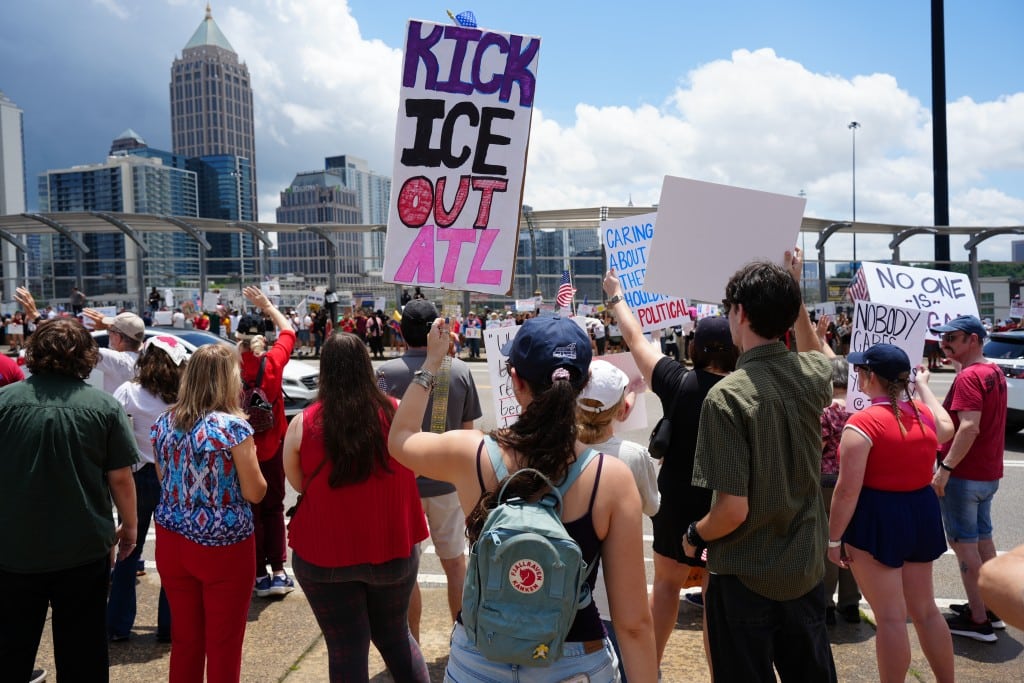
In other parts of the state, businesses are also feeling the strain of 287(g) agreements and immigration operations—even if they’re in a jurisdiction that is not officially in an agreement with the federal agency. For instance, in South Georgia, farm owners have told the Latino Community Fund that their personnel are not showing up to work out of fear, Gigi said.
Immigration operations, like a recent one in Marietta that resulted in the arrest of 12 people working at a nail salon, have sent a chilling effect to immigrant workers across industries. “Several small businesses that we work with that are heavily supported by immigrants, over half of their customers didn’t show up in the following days and staff didn’t show up,” Gigi said.
In Plaza Fiesta, on Buford Highway, businesses are suffering: “People are still afraid, so this is a reality that we’re seeing,” Gigi said. “It’s not just immigrants or immigrant businesses—this affects everyone we know. Some construction businesses have also reported that people don’t want to go work.”
In Dalton, widely known as the “Carpet Capital of the World,” America has also heard from Hispanic business owners that their customers are showing up less frequently, and that in big chain supermarkets, shelves remain full as fewer Hispanics are buying groceries there.
Although many people may find it discouraging to change their way to move around as advised by the campaign, by telling people to not drive without a license, America said, she doesn’t want them to feel like they have given up. “On the contrary, is taking the power and making the decision to not get arrested, at least not while driving.”
Author

Related Articles
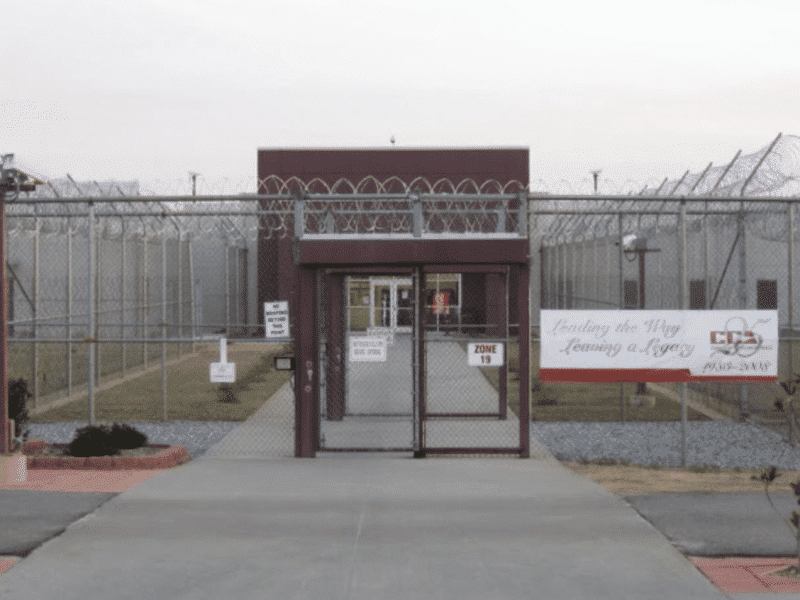
After a sewage eruption at Stewart Detention center, some detainees are still not drinking the water
“The smell is still there, it’s lingering,” said one advocate, who’s been reporting on conditions
This Georgia resident was planning his wedding. Now, he’s on hunger strike in Folkston, fighting for his release from ICE detention
Around 500 people at the Folkston detention facility continue their hunger strike, protesting health and safety conditions, and prolonged detention
Kashmiri filmmaker and GSU alum behind Atlanta-filmed ‘Saffron Kingdom’ released after unlawful detention
The arrest comes as the Trump administration has ramped up immigration crackdowns across the U.S. — and its use of detention against pending cases, like Sheikh’s.