A massive Mexican fabric installation lights up the skies over Brookhaven
This is the last week to see Cielo Tejido, or “Woven Sky,” an art project that began with one woman making scarves for her grandchildren. It grew to include more than 200 weavers—and made it into Guinness World Records.

It started as a simple hobby. In 2014, Paloma Ron had been weaving scarves and pillowcases for her grandchildren for years. But when she wound up making more than anybody was able to wear, the family—Paloma’s daughter, Lorena Ron, and her granddaughter, Lorena Velasco—decided to put the colorful fiber creations to another use. As the annual celebration of El Señor de la Misericordia approached, they took the red and yellow woven pieces Paloma had made and decorated trees in the streets of Etzatlán, the small town in the Mexican state of Jalisco where the family lives. (The Lord of Mercy, whom the festival honors, is Etzatlán’s patron saint.)
The public art project continued to grow. With time, more women joined, from all sorts of socioeconomic backgrounds: “There are housewives. These are those who work in offices, there are those who work in stores and knit while they don’t have a customer,” Velasco says. Every week the women gathered yarn, knit at home, and then returned with another finished piece. “The teachers knit a little while they go on the road and come back, and the grandmothers knit while they’re watching telenovelas.”
The weavers began decorating bigger spaces—buildings, bridges—with giant flowers and other complicated patterns. By 2019, they decided to bring the art installation to the skies: The local government gave the women the material to build a piece that would cover the streets of Etzatlán like a canopy. Learning about the project, one weaver’s son nominated the initiative for a Guinness World Record—sparking a laborious, nine-month process during which more than 200 women came together to create an installation that would ultimately span over 2,800 meters. Guinness recognized it, though it first needed to create a category: “largest crochet canopy.”
Having since been displayed internationally and across the U.S., another version of that canopy currently hangs over the Peachtree Creek Greenway, mounted as part of the Brookhaven International Festival. Located near the trailhead at 1801 Corporate Boulevard, it’ll be on view through the end of October.
“It fills us with pride,” Velasco says. “You can do really big things, starting with something really small.” Velasco is the project manager of the exhibit, called Cielo Tejido—“Woven Sky”—while her mother, Lorena Ron, is the director and designer. The pair transported the 656-foot installation from Mexico and oversaw its installation in Brookhaven, sewing about 3,600 hexagonal pieces over the course of four days into what looks like a rainbow soaring over the greenway bridge.
It’s been rewarding to receive positive feedback from all across Atlanta, Velasco says—but especially warming to find fellow Mexicans living in the area who recognize their work: “It was a really nice welcome.” An Atlanta resident originally from Mexico approached the artists as they were sewing and offered to help; it turned out a worker installing the poles that hold the weaving up had previously seen Cielo Tejido when it was displayed in Queretaro, Mexico. He later brought his entire family back to see the installation and meet the artists.
A support system for Mexican women
Woven Sky is ongoing; the weavers continue to create pieces that are now shipped internationally for exhibition. For women in Mexico, Velasco says, the work has provided an opportunity to come together and share emotions through art. The three generations behind the project—today, Paloma Ron is 93 years old—aren’t especially strict about the patterns they ask women to create. Some weave tight patterns, others looser. In the end, Velasco tells 285 South, it’s about reflecting the diversity of the artists: Viewers of the installation “should have the opportunity to feel and imagine all the stories behind each crochet.”
“Each woman is reflected in each hexagon—what she is experiencing that day is reflected in each stitch,” she says. “We are different, but we can still do work that reflects the beauty of all of us together.”
“Each woman is reflected in each hexagon—what she is experiencing that day is reflected in each stitch. We are different, but we can still do work that reflects the beauty of all of us together.” – Lorena Velasco, Project Manager, Cielo Tejido
The women also receive an income to help sustain themselves—like Anita, a 52-year-old mother whose sons disappeared last year. She thinks they were taken by drug cartels. She’s been able to find the body of one of them, but the other is still missing. Each week, Anita weaves with the women from Etzatlán and gathers enough money to travel around the country and continue her search.
“How wonderful that we can be her tool to continue searching for her son. But at the same time, it is very painful,” Velasco says. “She has found in knitting a bit of peace, support, and sustenance to be able to go and do the searches every time.”
Author
Related Articles
“I cannot sit around doing nothing.”
With internet access severely restricted in Iran, solidarity rallies and social media campaigns have popped up around the Atlanta metro.
“Everybody has a ‘Raani’ in their house”
At Raani Coffee on Moreland Avenue, Praveena Sundarraj honors South India’s coffee traditions—and builds a new kind of “third space” for coffee aficionados and their parents
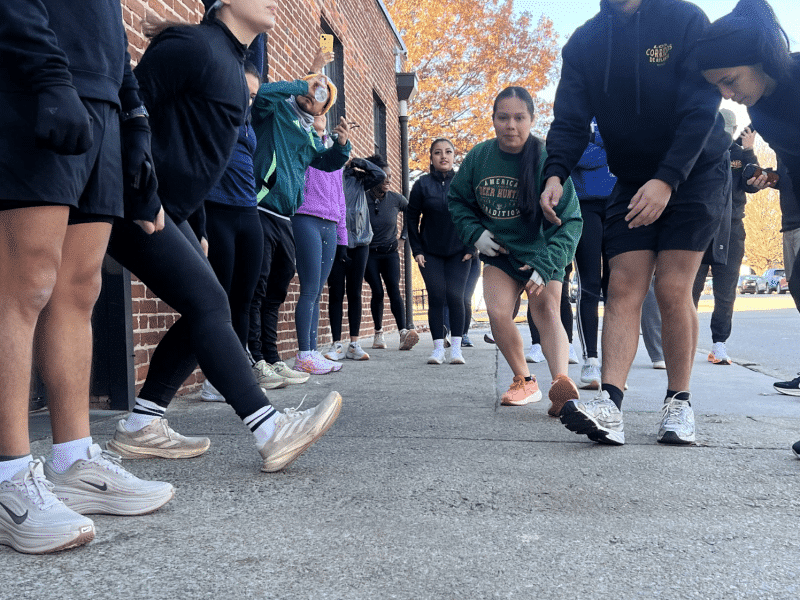
These Latinos are running for a cause: each other
Los Corridos, an Atlanta based run club, pivots to support community, alongside jogs on the Beltline