‘Now we’ll be able to educate and mobilize more of the community…it’s growing and so are we.”
The Georgia Latino Alliance for Human Rights opens new office in Chamblee, plans to hire organizers and focus on civic engagement.
Geovani Serrano didn’t know he could get on an airplane until he was 24 years old. It wasn’t until he began working with the Georgia Latino Alliance for Human Rights (GLAHR), that he learned that being undocumented in the U.S. didn’t stop you from flying.
“I was so afraid, you know, so limited but (they) educated me and told me I could fly with my Mexican passport and for the first time in my life I left Georgia.”
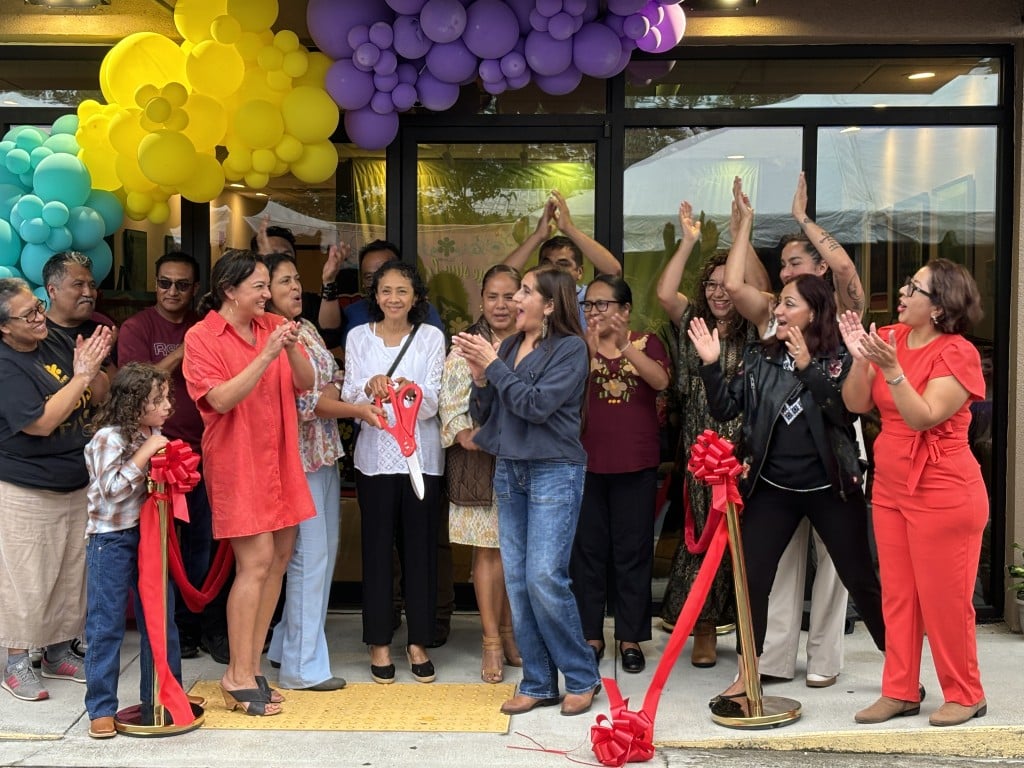
On Saturday, Geovani joined more than 100 others for a ribbon-cutting to celebrate the new office of the Georgia Latino Alliance for Human Rights (GLAHR) in Chamblee. Banda, a traditional form of Mexican music, boomed from the parking lot, while families gathered enjoying pozole, a traditional Mexican soup inside the freshly painted space.
It was a milestone moment for the organization, which started out with just a handful of volunteers in 1999. Ever since then, GLAHR has been working to educate Latino immigrants on their rights.
“Es un símbolo de resistencia,” Carlos Medina, lead community organizer for GLAHR told 285 South. This building is a symbol of resistance.
“Ahora podremos educar y movilizar más a la comunidad…está creciendo y nosotros también” he said. Now we’ll be able to educate and mobilize more of the community…it’s growing and so are we.
GLAHR now has nearly 30 people on staff, a political arm, the GLAHR Action Network, and 19 comités populares, or local organizing committees, mostly in rural areas, that work to raise political consciousness among Latinos, according to Adelina Nicholls, the organization’s executive director.
“If you go outside, you see people that have been coming since 1999,” said Adelina. Some people in the community, she said, still know her as “‘la señora de las licencias,” the lady of the licenses – an ode to her first campaign to get licenses for undocumented Georgians.
“I took that like a mission,” she said, and in 1999, worked alongside other organizers to collect more than 50,000 signatures. Those signatures were then delivered to then Governor Roy Barnes.
“And, of course, we didn’t obtain the driver’s licenses,” she said. But what they realized was how many people were out there, eager to join a movement for change. That included not only undocumented residents in the metro area, but also those living in rural Georgia, as well as immigrants who just wanted a way to get involved. “We were able to recognize who was out there.”
This year, she said GLAHR’s canvassers have knocked on more than 168,000 doors, encouraging citizens to register to vote even if they don’t speak English. And if they can’t participate in elections, educating them on what rights they have in the U.S.. They hope to reach 200,000 doors by the end of October.
For years, GLAHR has also been educating community members on how to protect themselves from deportation. The organization has advocated against 287g, a Department of Homeland Security program that deputizes local law enforcement to carry out the work of ICE agents. It’s still denouncing the program in the Georgia counties that still leverage it.
“It doesn’t matter if our community [members] mostly do not speak English, we do know what injustice looks like,” Adelina said.
Geovani has been working with GLAHR for five years. He said he’s experienced the impact of the organization firsthand.
“My dad, when I was in college, got detained,” he explained. “His blinker wasn’t working so basically he only had to pay their fine.”
Geovani realized after getting involved with GLAHR that the organization had advocated for a non-detainer policy in Doraville. That’s why, he said, his father wasn’t arrested.
This motivated him to educate himself on his rights and find ways he could exercise his political power. He learned that although he couldn’t vote in U.S. elections, he could cast a ballot in Mexico. His newfound knowledge spread to his younger siblings and parents, who are now active members of GLAHR too.
“They love it,” he joked. “They’re now connected to the politics back home, my parents are actually taking advantage of their vote.”

Adelina said a new headquarters is a sign of GLAHR’s longevity and a real investment from the community, carving a path for the next generation. “They give us a lot of strength, freshness. At some point I will pass the baton.”
She plans to hire more community organizers; the building means more space for volunteers and community meetings, too.
“Sometimes we don’t have the results we want, but we continue trying and trying and I think that the challenge now: to grow into a movement,” she said. “It’s taken almost 25 years, but I’m happy. I’m happy with that.”
Author

Related Articles
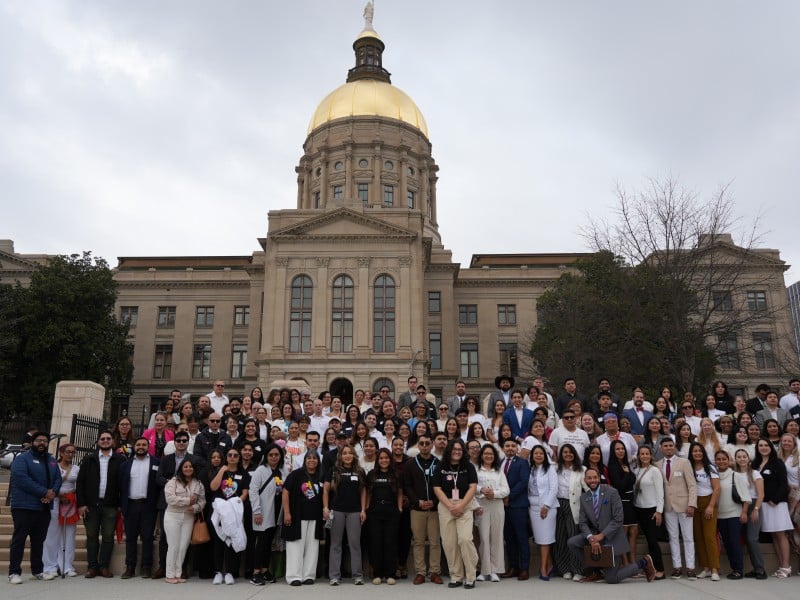
These are the bills impacting immigrants in Georgia that survived Crossover Day—or didn’t
Crossover Day is the make-or-break point for bills to have a chance of passing in each year’s legislative session. Here’s how a range of laws affecting immigrants fared.
Rodney Taylor struggles to use his wheelchair and prosthetic legs as health deteriorates in immigration detention, says family
Advocates and family members of Gwinnett County resident held at Stewart Detention Center, travel to Washington D.C. to raise the alarm on his case.