
An afternoon at the ICNA food pantry on Memorial Drive
We sat down with Abdul Basit to talk about his work fighting food insecurity and what it’s like to do his job in the midst of mass federal cuts.
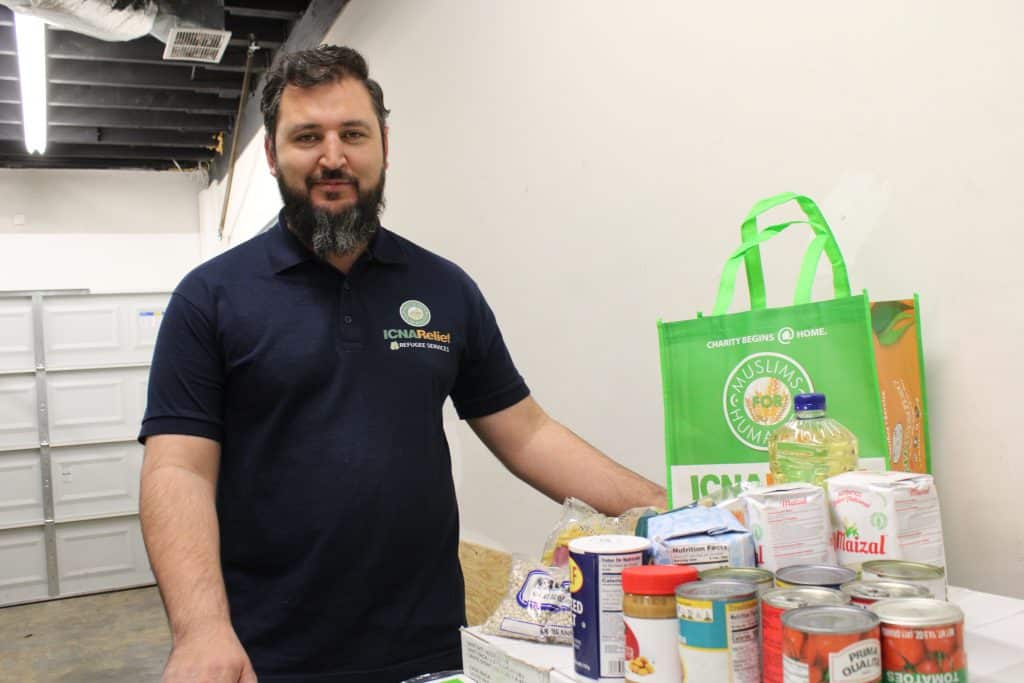
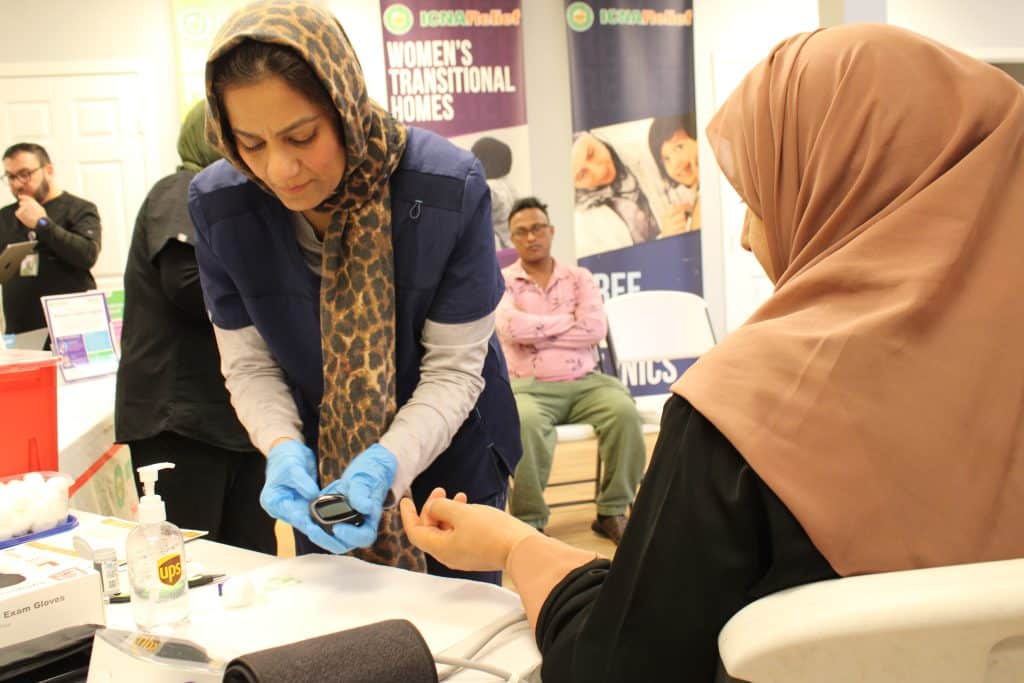
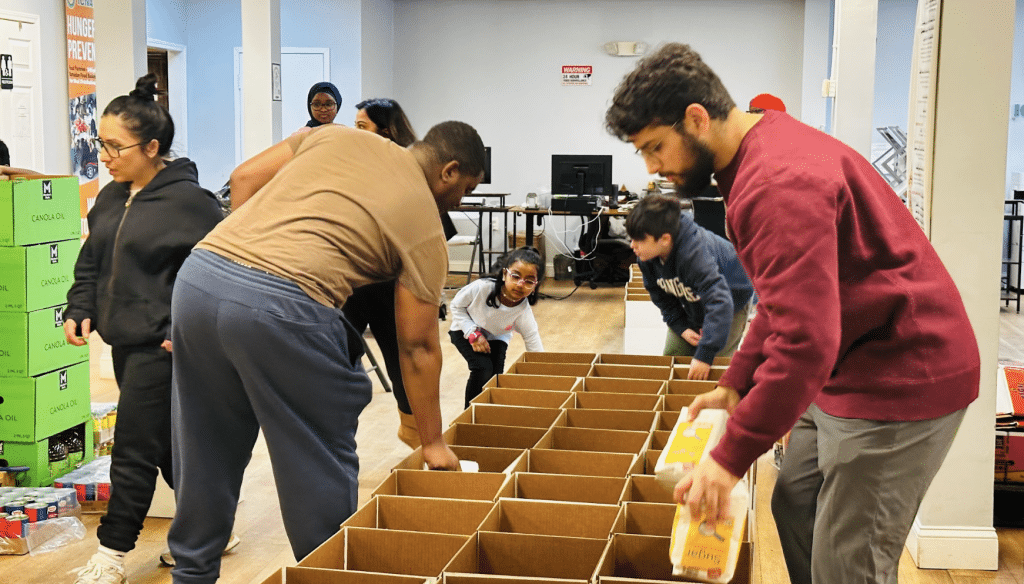
It’s Friday afternoon just after 3 p.m., and the ICNA Relief food pantry on Memorial Drive is officially open. For the next three hours, people stream in and out of the small white building, located beside a Caribbean cafe and a window-tinting shop. Some are picking up grocery boxes—filled with nonperishable foods like rice, navy beans, and canned pears—while others are volunteers, there to check people in, stock boxes, or run blood sugar checks at a makeshift health clinic that’s also a part of the food pantry.
Abdul Basit Khan manages the operation. Formerly a software developer for Salesforce, where he worked on projects for Home Depot, he joined the ICNA Relief team in Georgia nearly 10 years ago. He wanted to be somewhere, he said, “where I could be more in tune with my faith and in tune with serving the community.”
ICNA, which stands for Islamic Relief Circles of North America, is a nonprofit that has chapters across the country, and primarily focuses on providing humanitarian aid to “victims of adversities and survivors of disasters.” The organization’s website specifies that they support anyone, “regardless of their race, religion, or other identifying features.” In Georgia, the team runs a variety of programs, many of them tailored to immigrant and refugee communities, including the Memorial Drive food pantry and a free health clinic in Duluth; they also offer transitional housing support for survivors of violence in the area. On weekends, volunteers set up a food drive on Joseph Lowery Boulevard for unhoused people on Atlanta’s Westside.
Basit moved to the U.S. from northern Pakistan more than 30 years ago as an adolescent. His memories of that initial adjustment period, though, are still fresh. “Those are already difficult years, and then to deal with self-identity issues, and to not know where to fit in,” he said, was a challenge: “I feel for these kids because of that too, because they’re being thrown into an environment they’re not adjusted to.”
The past year—as it has been for many nonprofits—has been unlike any other. ICNA Relief’s Georgia chapter lost over $700,000 in federal funding in 2025, Basit told 285 South. That money supported direct financial assistance to Afghan and Ukrainian families, covering mostly utility bills and rent. While the organization does still receive some federal funding that supports what he described as “social adjustment programs”—things like financial literacy classes and driving lessons—the loss of the financial assistance money was a blow.
As more and more families—including most noncitizen immigrant and refugee families lose SNAP, or food stamps, because of new eligibility rules—food banks are increasingly critical. At the ICNA pantry on a recent Friday, all sorts of people came through to pick up food boxes. Here’s what Basit shared with us about what they’re seeing and hearing from community members right now.
This interview has been edited and condensed for clarity.
Can you describe what’s happening in the office/food pantry right now?
At three o’clock, we open our food pantry. It’s open Friday, Saturday, Sunday, so clients know those times they’re able to come if they need food. This is all nonperishable food. They’ll pick up 35 pounds to 45 pounds of food per month. They have a voucher, and they grab a ticket, and they go to the computer, they register them real quick. There are volunteers in the back that are organizing, packing the food and putting them into bags and all of that as well.
And then the clinic is running. The Duluth clinic is Thursday and Saturday. And here it’s Friday. So when clients come in, they see the clinic. [Volunteers] will talk to them. They’ll screen them to see what the issues are. Sometimes they may have them go back to Duluth for anything additional, but whatever they’re able to take care of here, they’ll take care of here.
What are the biggest needs that you’re seeing at the moment with the community members you serve?
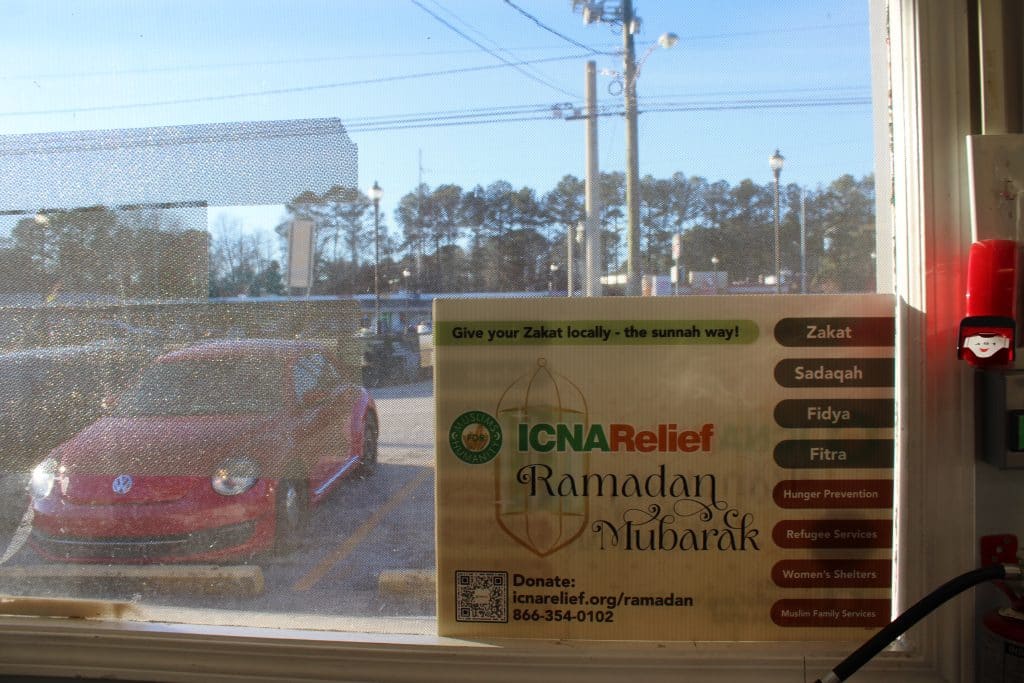
Hunger prevention has been the biggest program we have. The reason is, we’re able to get the masjids and the community to help us with that. So clients are coming to the food pantry. We do mobile distributions. We go downtown to feed the homeless off of Joseph Lowery Boulevard, and that’s prepared meals. And Ramadan food box, which is coming up right now. We will serve about 2,000 families this year. The food box is a little bit bigger for Ramadan. It’s more culturally appropriate. It has dates, basmati rice, flour, and stuff like that.
People come in for financial assistance as well. People have eviction notices. People have utility disconnections. And this one is a little bit tough, because a lot of times the amount that they need is very high. This might not be reflective of this year, but $843,414 is what we gave in financial assistance [in 2025]—this includes grant money.
The thing is that this includes the grant, and then Zakat al-Fitr [obligatory charity given during the month of Ramadan] was $79,376. A lot of families will start coming right as Ramadan starts and asking for Fitra money, and the community gives us some donations, and we try to leverage that and give it back to the community.
Who are the people you’re serving in this office?
I would say most of our clients, not all of them, but a lot of them have language barriers. These are families who are very traditional in a sense that they came from an environment that, whether that’s the Afghans or the Burmese—some of the Somali as well—they’re coming from a place where they don’t understand most of the society here, in the way everything runs. We see more Afghans at this point, but we still see Burmese, Rohingya, Somali, Ethiopian, Iraqi, Syrian—all of those families we do work with.
You have been with ICNA for almost 10 years now. In the current political climate, what are the biggest changes, if any, you’ve seen with the families you’re working with?
One of our health fairs had to be canceled because clients were concerned about ICE. There is a fear for sure.
And then every day, some news is coming out, right? Especially on the grant side, we have no idea what could happen. So we have to be prepared for that. For example, when the SNAP crisis happened [in November], we were ready for a good month and a half, stocked up. We prepared for it. We didn’t run out of supplies, and the clients increased tremendously. If typically, on a Friday, Saturday, Sunday combined, we may see about 300 families, that jumped to 400 or 500 families.
If you could wave a magic wand and just fix something in this work, what would it be? What’s your wish?
I think ICNA Relief has a huge potential. We’re only limited by the size of our facilities and being able to store enough supplies and all that. [We have] the potential to really expand. If we even focus on the hunger prevention side, we could really, really push on that side and try to curb hunger way more than it already has.
The cost of food has gone up tremendously. If we could even just reduce that, it will help the families so much more. Even the families making $60,000 or so, they’re still struggling. So imagine the ones that are making $30,000 or $40,000—they’re really struggling with food. So I think food insecurity is really the biggest aspect that I wish I could change. And then, of course, to build those partnerships better and stronger with the community, the masjids, and also kind of organize the financial assistance a little bit better so that we could not only help them in financial assistance, but also get them to financial stability in whatever way we can.
Sometimes issues happen in the community, and they’ll come here. They’ll treat it like their second home—they’re not embarrassed to come here. They don’t feel like their dignity is a matter of issue. So we don’t have those challenges. And I’m very happy with that, because that’s sometimes the biggest thing for our community. But if you come in, you’ll see we don’t have that issue at all.
What do you think it is that you all do that makes people feel that?
My biggest thing is that anytime our staff is doing anything, and any new staff comes in, I always tell them, don’t judge any client based on anything. Even if there’s a client coming in a Mercedes, do not judge because you don’t know what their situation is. There could be a family, for example—an Afghan family came and the U.S. government sold them a dream: Oh, buy a brand-new car with interest. These families fell into traps too. They didn’t know any better. We see it all the time. I teach the staff that it doesn’t matter who walks through that door. Ask them every question that you would ask if it was your immediate relative.
For people who want to help support immigrant and refugee communities, what would you say to them?
Honestly, the best suggestion I could make? Before anything else, I think people need to see what’s going on in person. They need to come out. I wouldn’t ask for money directly—you can only get so much if you just keep asking people for money. But if they believe in it, I think they should come volunteer their time. I think once they come and see everything, they will want to donate regardless. I would rather sell them the idea of coming here and serving the community.
Do you have enough volunteers at the moment?
It’s not too bad, but it’s getting better. Before we didn’t have the volunteer portal. Now that we have that, people can go to our website and sign up for a particular slot. So that’s been very helpful. And it’s easier for us to go out and just share the link with somebody and ask them to come because it’s more organized. Sundays are the more difficult days. We don’t have many volunteers coming in. Saturday is usually fairly good, but Sundays we could use some help.
What gives you hope right now?
We have so many stories. I went to a park [in Alpharetta] and, lo and behold, about 400 feet away under a tree in the park, a Muslim family was sitting. Three kids and [their mother] were just sitting there. And immediately I started asking questions. I was like, what’s going on? Why are they here? I didn’t see a car. I didn’t see nothing. This was more than three years ago. And I got really curious. I was like, something doesn’t seem right. They weren’t doing anything. They were just sitting in a very odd spot, too. It looked almost like they may have slept in the woods. So I finally got the courage to approach them and said, Hey, is everything okay? And they said, No, we’re homeless and we don’t have anywhere to go. And I became super emotional. I still think about it. I have two kids, and just thinking about those kids staying out there, I couldn’t imagine it. So I started making calls—somehow I gotta figure out how to help them.
I started calling the Muslim people who own apartments and stuff. Finally I got a hold of my older brother’s friend, and he had a place in Lawrenceville that he allowed them to move into. In the meantime, we found them a car donation. We started helping them with food, just trying to do whatever we can. And slowly, they were a little better taken care of.
We have so many—we’re talking about thousands and thousands of families that we’ve dealt with over the years. I wish there was a way to keep track. But that family, they were so thankful. I think that what it did for me is, I don’t know the whole part, I think it just gave me the motivation to continue to do what I do, with as many difficulties that we have in the nonprofit world, and the things that we have to deal with, and all of those things. And sometimes we deal with very tough clients. It’s not easy, and it’s not for everybody. If you’re not oriented in a way where you want to serve the community, it’s not for you. It’s really not for you, because you’re going to be tested.
Author

Related Articles
“I cannot sit around doing nothing.”
With internet access severely restricted in Iran, solidarity rallies and social media campaigns have popped up around the Atlanta metro.
“Everybody has a ‘Raani’ in their house”
At Raani Coffee on Moreland Avenue, Praveena Sundarraj honors South India’s coffee traditions—and builds a new kind of “third space” for coffee aficionados and their parents
These Latinos are running for a cause: each other
Los Corridos, an Atlanta based run club, pivots to support community, alongside jogs on the Beltline