
At a Cambodian temple in Lithonia, hundreds come out to honor loved ones who passed, and share painful memories of the Khmer Rouge
Cambodians from around Georgia mark the end of the Pchum Ben festival.
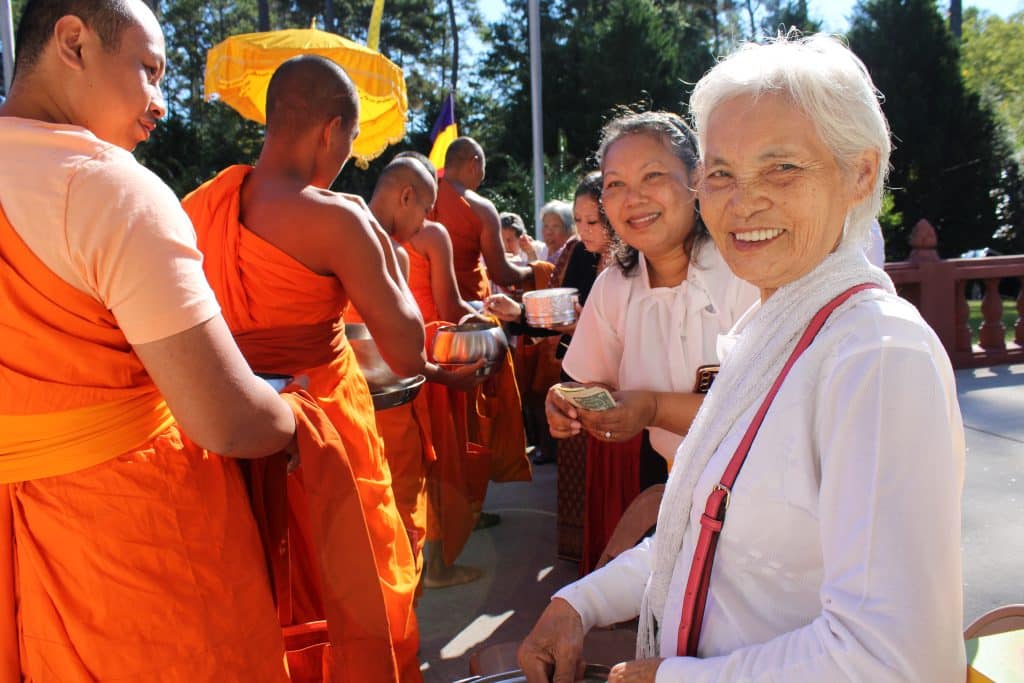
Chenda Wilson remembers the day she was separated from her mother. Men dressed in black, wearing hats and scarves around their necks, showed up at their house in the Cambodian countryside. “They took my sister and I to this place . . . you have to pull grass, pluck grass out from the ground, and everything,” she said. “If you don’t do it, they will beat you up.” She was six or seven years old, she said. It was a labor camp—one of many during the Khmer Rouge regime, which lasted between 1975 and 1979 and killed anywhere from 1.5 to 3 million people.
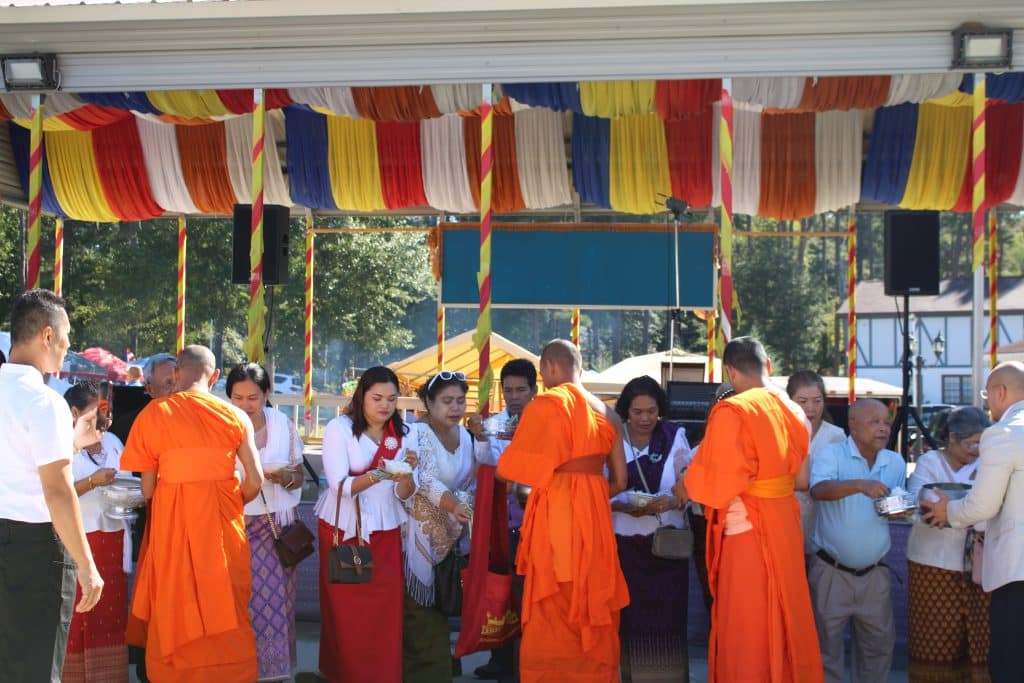
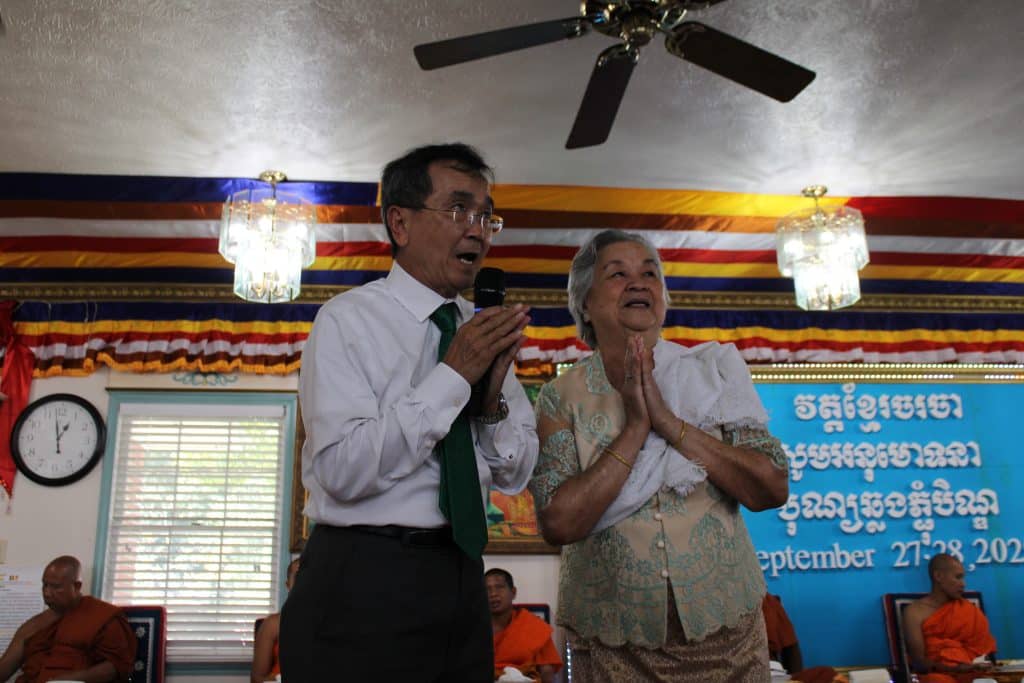
On Sunday, half a century later and almost 10,000 miles away from Cambodia, Chenda was in Lithonia, standing alongside her 93-year-old mom, Vendy Heng, spooning rice into the metal bowls of monks. They were joined by hundreds of other Cambodians at Wat Khmer, Georgia’s largest Cambodian Buddhist temple, for Pchum Ben, a Buddhist festival marking the end of a 15-day period in which Cambodian Buddhists honor their ancestors.
Cambodians from around the metro area, including Riverdale, Winder, and Stone Mountain, had driven to take part in the ceremony. Many of them were community elders who’d come to the U.S. as refugees in the 1980s, after suffering through the worst years of the Khmer Rouge genocide. The Marxist leader Pol Pot took power of the country in 1975, forcing Cambodians to labor in the countryside, targeting residents in the cities – part of an ambitious project to transform the country. Survivors at the temple told 285 South about the scars left behind from that time – one of the worst mass killings of the 21st century – families broken apart by the disappearances or killing of their loved ones. Community members at the temple are among the over 6,000 Cambodians residing in Georgia (according to Census numbers), though that number may be higher. Wat Khmer Georgia is just one of five Cambodian Buddhist temples in the state.
Chenda’s mom, Vendy, is a regular at the temple, which she helped found 40 years ago. “She’s the oldest member that’s still alive,” said Chenda. The Wat, or Buddhist temple in Cambodian, had always played a central role in Vendy’s life in Georgia, just as it had for centuries, for Cambodians in Cambodia. When the Khmer Rouge regime came to power, it destroyed one third of the country’s wats, and killed more than 60,000 monks.
Despite that attempt at annihilation, the rituals and teachings of Cambodian Buddhism appeared stronger than ever in Lithonia on Sunday.
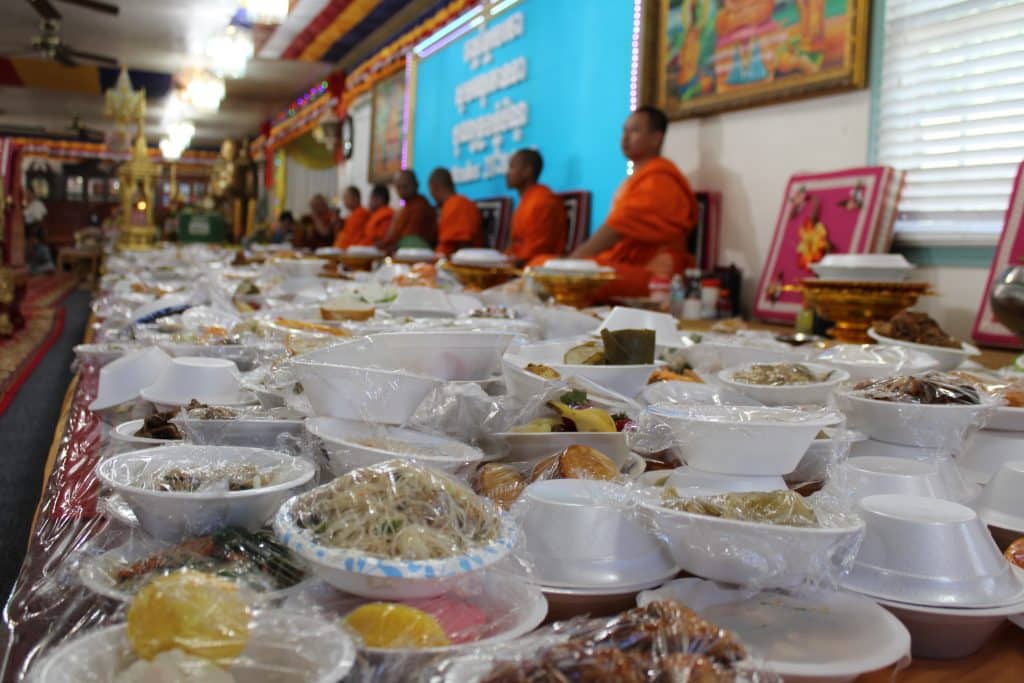
Chenda and Vendy were participating in central rituals of Pchum Ben – the offering of food to ancestors – along with doing good deeds so that karma can be passed along to their deceased loved ones. Chenda was remembering her father, who died in 2012 from kidney failure. Vendy had been cooking all weekend for the congregants and monks at the temple, and Chenda had brought bowls of sour soup and honeycomb cake as an offering for her father and other ancestors.
Chenda said her family (she’s one of seven children) doesn’t talk about what happened in Cambodia often, but she does think about how lucky and blessed they were. The family was separated when the Khmer Rouge came to power; her father was taken away first. “They beat him up so bad, damaged both his kidneys,” Chenda said. Her elder brother was taken next, and then she and her sister. Her father eventually escaped—thanks to the grace of one of the regime officials. When the official was a boy, her father had given him and his family a place to stay and food to eat.
Chenda and her sister were also able to escape the labor camp. In an act of kindness, a guard told them to flee and “find your parents,” she recalled: “So my sister and I, we just hold hands, and we just run.”
The family found their way back to each other at their family house. “My mom and dad’s always like, If anything go on, you just come to this place. We gonna wait for you no matter what.” They managed to escape Cambodia, and for several years, they lived as refugees in Thailand—where Chenda’s other siblings were born—before finally being resettled in Hapeville.
“We are a really fortunate family, all my sisters and brothers,” she said. “We came together as a family. Not everybody can do that.”
Thirty-three-year-old Malena Ly was also at the temple on Sunday with her father and grandmother, who were honoring Malena’s grandfathers. “I never got to meet my grandfathers,” said Maleny, who was born in Stone Mountain and has lived in Georgia all life. Both her grandmothers escaped the regime and came to the U.S. in the early 1980s. Her grandfathers, she said, “were killed during the genocide back then because they were military. They were policemen. They were higher-ranking, so they take those people first.”
Like Chenda, Malena said her parents and grandmothers don’t talk much about what happened in Cambodia. “It’s kind of like, not forgotten, but the wound is still there.”
These days, Malena teaches traditional Cambodian dance at the temple to younger kids. She also tries to impart some sense of their grandparents’ histories to the children, but it’s not easy. “I tell my kids, like they’ve gone through so much for us to have a life. So you need to appreciate every single moment you have with them while you still can, and just listen to their stories.”
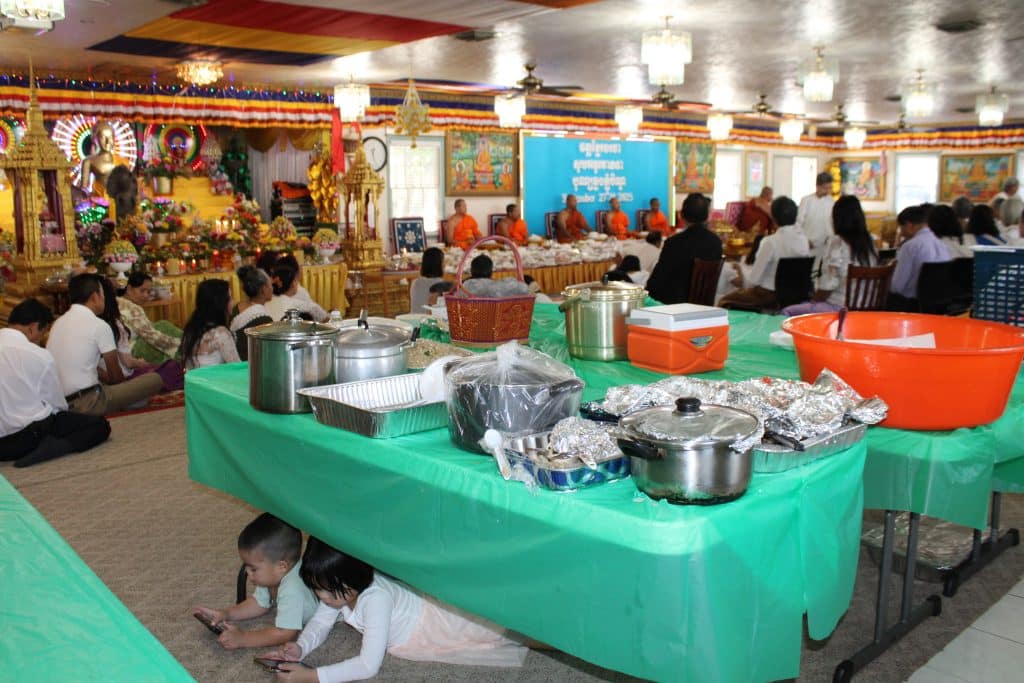
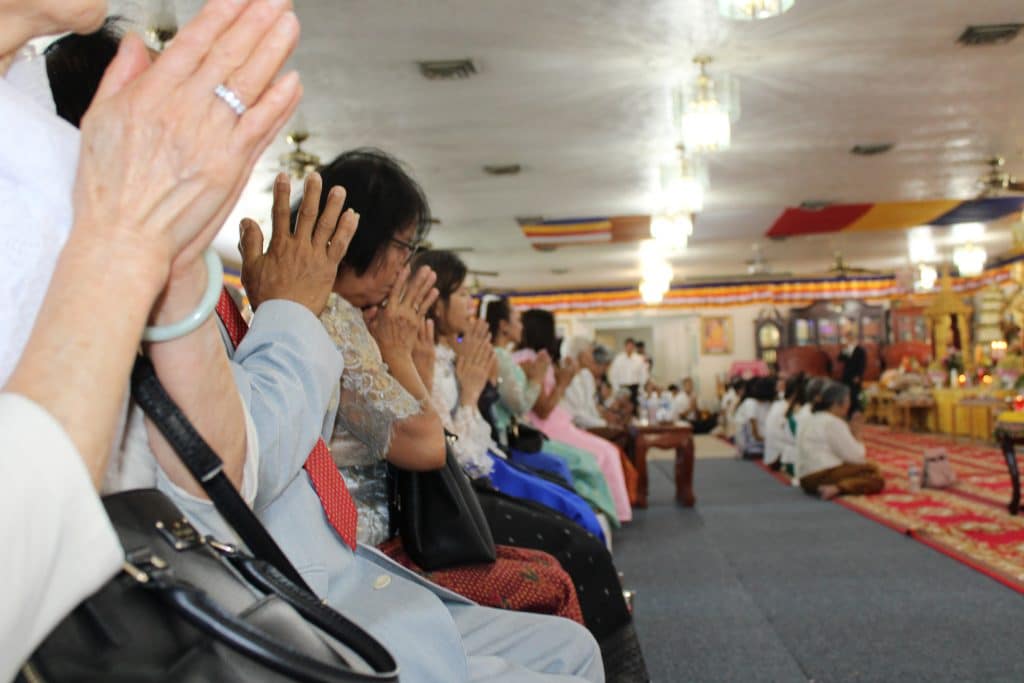
The rituals of Pchum Ben last for over two weeks, including individual days that families reserve at the temple to honor loved ones who have passed, giving alms to the monks, chanting, praying, and cooking food to place into small bowls as offerings.
For Chenda, remembering the good of the past, as well as the pain, is part of Pchum Ben. She teared up talking about the acts of kindness that saved her family. “I’m so sorry, I get emotional,” she said, remembering the Khmer Rouge official who helped her father escape. It’s a lesson that Chenda has never forgotten and tries to incorporate into her own life.
“[My] dad always said that, what you need to think about: It doesn’t matter what you do at life. You all have to pay the kindness that people get to you, even not to that family, to that person actually, but you can repay all the kindness to anybody that you see, anytime,” she said. “Have a pure heart to help other people, the good deeds might come to you, that’s what my dad told me.”
When the rituals are over, Malenda explained, “we just celebrate together, it’s like a big family gathering for all of us.”
For Malena, it’s a crucial lesson. “No matter how much stuff they went through, they try to show their family that no matter what, you can still enjoy life. They still smile. They still love life.”
Author

Related Articles
Andres Carrillo, founder of the pop-up Cocina Pachuco, is using his cuisine to fundraise for immigrants in detention
Born and raised in El Paso, the recently arrived chef is strengthening ties with his new home. One way he’s doing that: supporting the state’s immigrant communities.
“The work has become three times harder”
We speak to pro bono immigration attorney Serene Hawasli-Kashlan, legal director of Asian Americans Advancing Justice–Atlanta, about what it’s like to do her job right now.
“We did it”: Latinx student film Nuestra Realidad makes its cinematic debut at Tara Theatre
“We’re really taking up the space and not only just taking it, but we’re adding to it.”