
At the Georgia Capitol, advocates mark an uneasy anniversary for DACA
Now in its 12th year, the Obama-era program provides protection to the children of undocumented immigrants. But it’s currently facing legal challenges—and in GA, over 20,000 DACA recipients still don’t have a path to permanent status.
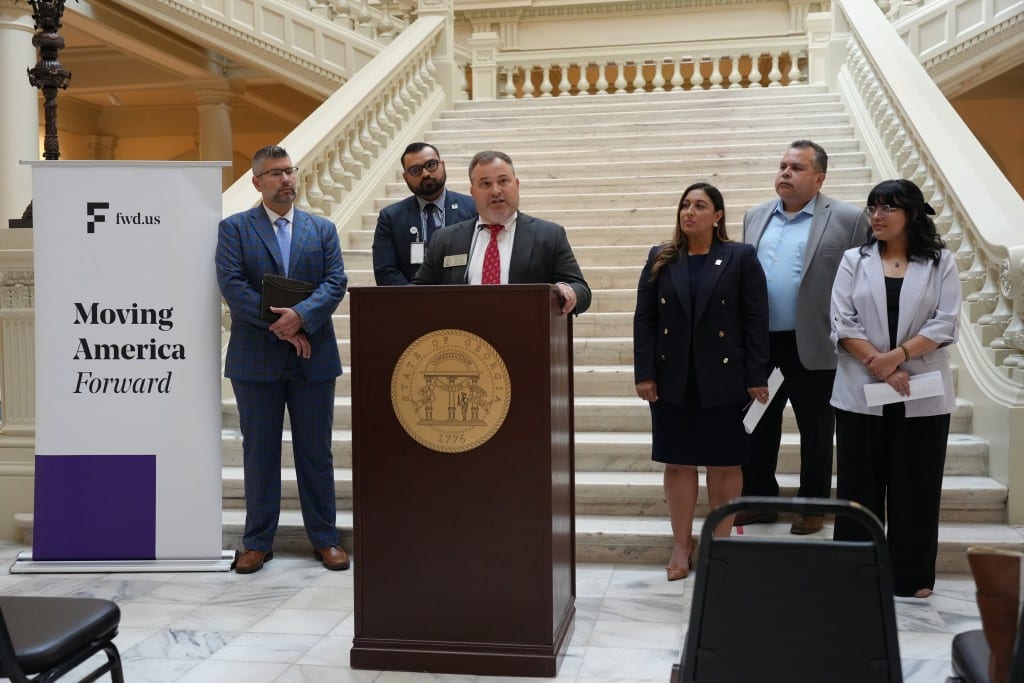
On Tuesday afternoon, Karen stood at the steps of the south wing of the Georgia Capitol and talked about the day that her life changed, 12 years earlier. Born in Mexico, Karen moved to Athens with her family when she was three years old. Because none of them had legal residency documents, her future always felt unclear; growing up, Karen didn’t know if she’d be able to go to college or have the same opportunities as her friends. But in 2012, she learned about a new program that gave her hope: Deferred Action for Childhood Arrivals.
Created by the Obama administration, DACA provided deportation protection for the children of undocumented immigrants. It opened up new pathways for Karen, who now could get a work permit and didn’t have to fear being expelled from the country. After graduating magna cum laude from Brenau University in Gainesville, she pursued a master’s degree at Boston University, and now works as a therapist, helping people overcome addiction and mental health struggles.
At the Capitol, Karen spoke at a gathering to mark the 12th anniversary of DACA—and to take stock of where things are at now with the program, which currently faces legal challenges. Though recipients can renew their status and work permits, new applications aren’t being processed due to court injunctions. Standing in the Capitol, Karen and other advocates urged Congress to pass legislation to provide a pathway to permanent immigration status for the more than 20,000 DACA recipients in Georgia and over 500,000 in the U.S.
“I remember a world where DACA didn’t exist, where thousands of school children had no hope and no future,” said Rep. Kasey Carpenter, a Republican lawmaker who represents the area around the manufacturing hub of Dalton—the “Carpet Capital of the World,” whose population is over half Hispanic or Latino. “With DACA, I saw lives changed, a workforce solidified and a community transformed.”
Others, like Georgia Hispanic Chamber of Commerce CEO Veronica Maldonado, highlighted the contributions that DACA recipients make to the state: While 66 percent of business leaders report having difficulty finding workers, Maldonado said, they rely on the talents of DACA recipients across sectors like healthcare, construction, education, technology, and hospitality. “Destabilizing them doesn’t just affect one person. It destabilizes entire families and communities,” she said. “They are our neighbors, our friends, and our coworkers.”
Rep. Carpenter says he’s still holding out support for DACA recipients. In previous legislative sessions, he has introduced proposals to expand in-state tuition to certain noncitizens, including this group. “I’ve been down here eight years, and seven out of the eight years I’ve had legislation on this issue, trying to push it and get some movement,” he told 285 South. “So of course, when we come back in January, we’ll be trying again. I think it’s a great policy for the state, for the businesses, and for Georgians as a whole.”
He said he tries not to keep his hopes up but keeps digging to hopefully get enough support to pass such a measure. In Georgia, there is a state policy that prohibits undocumented students from attending certain public colleges in Georgia, including University of Georgia (UGA), Georgia State University, and Georgia Tech.
For Karen, expanding in-state tuition would have offered some relief: Because she was a DACA recipient, she wasn’t eligible for any financial aid to attend college, so her parents and family came together to try to do what they could to pay her tuition. Today, though she doesn’t think about her lack of permanent status in the U.S. every day, she said it still crosses her mind pretty often—and that she hopes to see a permanent solution to what was always intended to be a temporary policy.
“I urge the lawmakers and the courts to protect the program that helps people like me to learn and grow,” she said.
Author
Related Articles


“The world just seems like it’s against them. So it’s really hard when the school does this on top of everything else they’re dealing with”
Cobb County parent speaks out, shaken, after conversation with principal about school walkout

En Plaza Fiesta, conocida como el corazón de la comunidad hispana en Georgia, “casi no entra gente”
Trabajadores y dueños de tiendas del centro comercial latino dicen que el negocio ha estado lento durante el último año, lo que ha provocado reducción de horarios y un futuro incierto