A Roswell Masjid Strives To Mimic the Trees
The Living Building certification has been granted to only 35 buildings worldwide. A North Fulton masjid wants to be next.
Renee Alnoubani always had big questions.
Born in California to Palestinian American parents, she lived in several states and countries before her family finally settled in Atlanta. From a young age, she was deeply distraught by the state of the environment. “There’s so much destruction that we’re seeing today,” she said. “We see the pollution, animals going extinct, ecosystems collapsing, and we’ve contributed to that.” When she was 11, Renee remembers asking her mother why the world was the way it was—and her mother couldn’t answer. “It’s the fire that has inspired me ever since,” Renee said.
As she grew older, Renee learned more about how her worries for the environment connected with her Islamic faith—how, for instance, the Prophet Muhammad took care of animals and the natural world around him. “As Muslims, we are called to be stewards of the environment. It’s a responsibility,” she said. “We should be the ones that society can rely on to take care of our environment.”
So when Renee enrolled at Georgia Tech, it was only natural that she’d bring her environmental passions with her—and that, after touring the university’s Kendeda Building, she’d think of a way to put them into practice.
Completed in 2019, the Kendeda Building for Innovative Sustainable Design is the first Living Building in the Southeast—a designation given to structures that have net-positive carbon, energy, and water footprints, meet their energy needs through solar power, and are built with locally sourced and recycled materials. In short, buildings that mirror how trees act in a forest: giving more than they take. That’s a high bar: there are only 35 fully certified Living Buildings in the world that do that.
Still, Renee took a leap. She thought of another place where the ideal could become reality: the Roswell Community Masjid, which, she knew, was making plans for expansion.
“My friends introduced me to RCM in my first year of college,” she said. “One day I found out they were working on a new construction project and I thought: ‘Oh my gosh, let me ask the director if they’re doing anything sustainability-related.” The masjid is already a sustainability leader in the Muslim community. In 2023, it became among the first masjids in the state to have a certified “Green Team” through Georgia Interfaith Power and Light: hosting zero-waste iftars, installing solar panels, composting, and avoiding styrofoam, among other environmentally friendly initiatives.
In 2021, Renee presented her idea to RCM board members: Why not make the new masjid a Living Building?
They were immediately receptive, recruiting her as a volunteer consultant and later hiring her as the masjid’s sustainability intern. “I was quite surprised, but it’s also a testament to who RCM is and what they stood for, for a long time,” Renee said. “They’re very forward-thinking and open-minded and I really see that they try their best to implement the Quran and prophetic teachings. I framed it in that way and I think it genuinely was a ‘meet the moment’ kind of thing.”
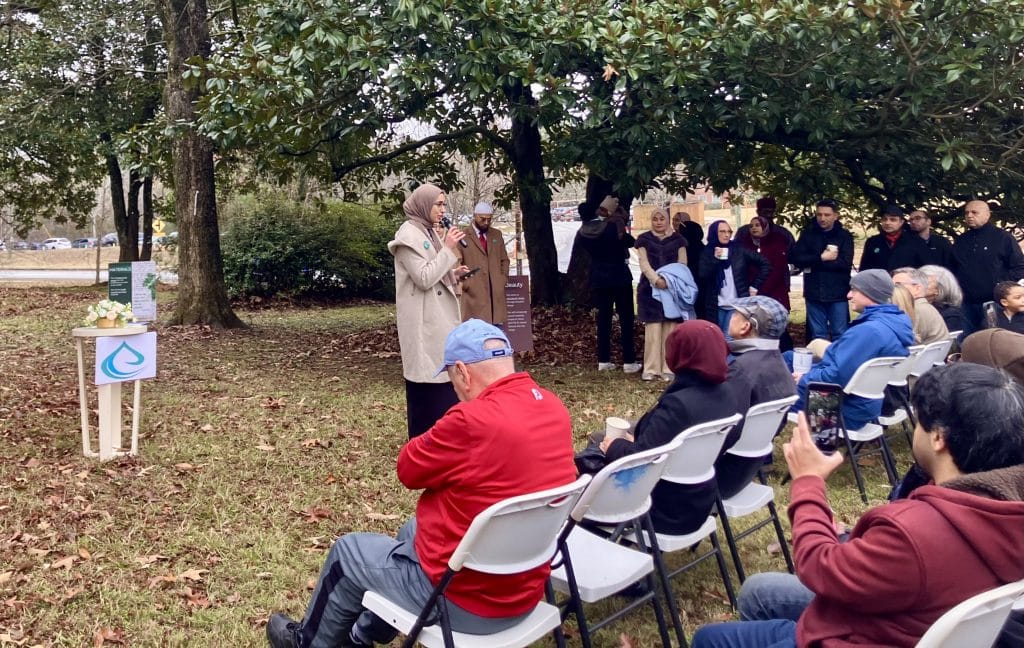
That moment grew even nearer on a recent chilly Saturday afternoon, when more than 200 community members, politicians, and faith leaders gathered on a 5.5-acre plot in northern Fulton County to break ground on the new building, which aspires to be the second in Georgia—and the first house of worship in the world—to attain Living Building status.
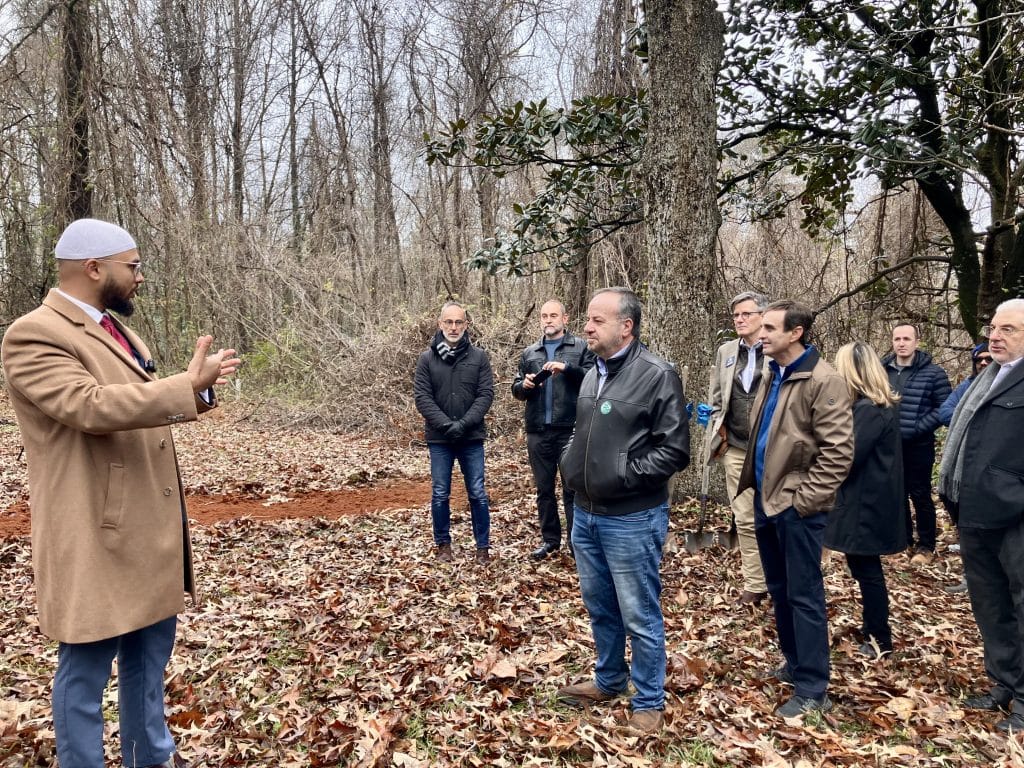
“A masjid or mosque is not for Muslims,” said RCM Imam Abdullah Jaber. “The mosque is also for Muslims. What we’re imagining here is not only a mosque, it is a campus that is for Roswell. But also for the Muslim community. It is with pride, honor, and humility that we are initiating a global first. We as the people of Roswell and as Muslims want to set a standard that is demanded by our faith.”
Founded in 2008, RCM serves more than 500 members at its weekly Friday prayer service, and hosts more than two dozen programs every week—in addition to welcoming members five times a day for prayer. With the community growing, the masjid—whose current location is just a few minutes away—needs more greenspace and a place for children to play outdoors.
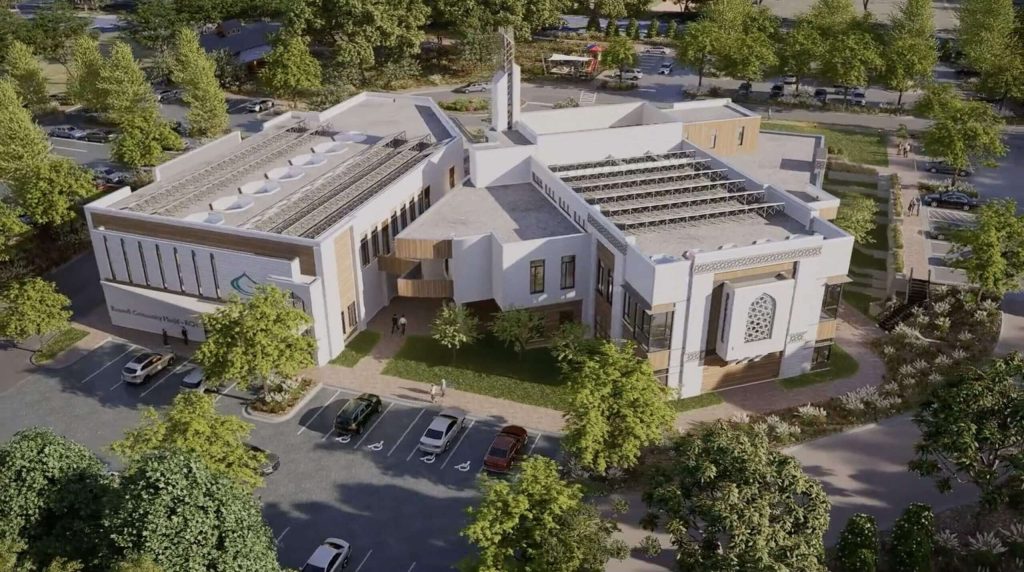
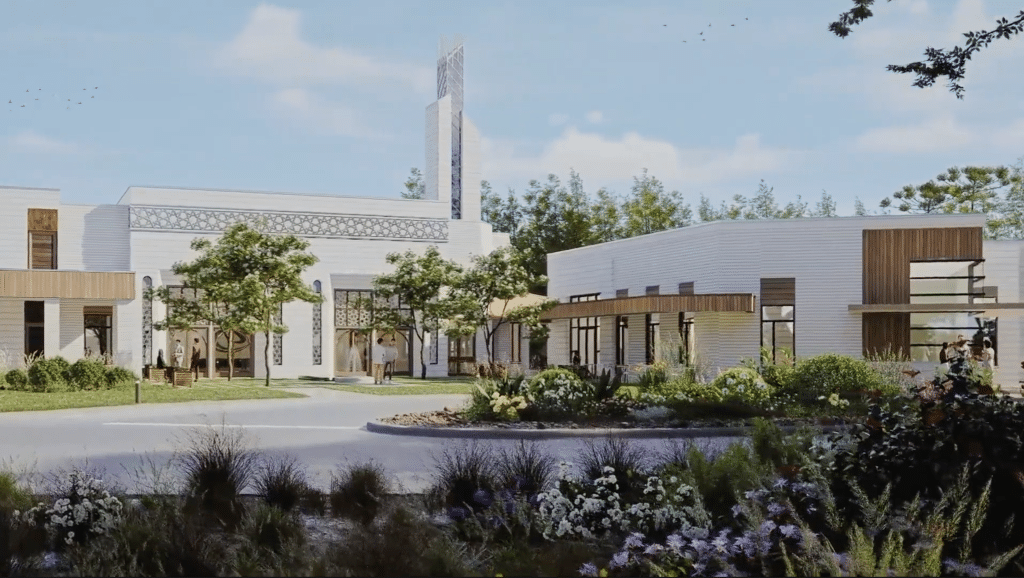
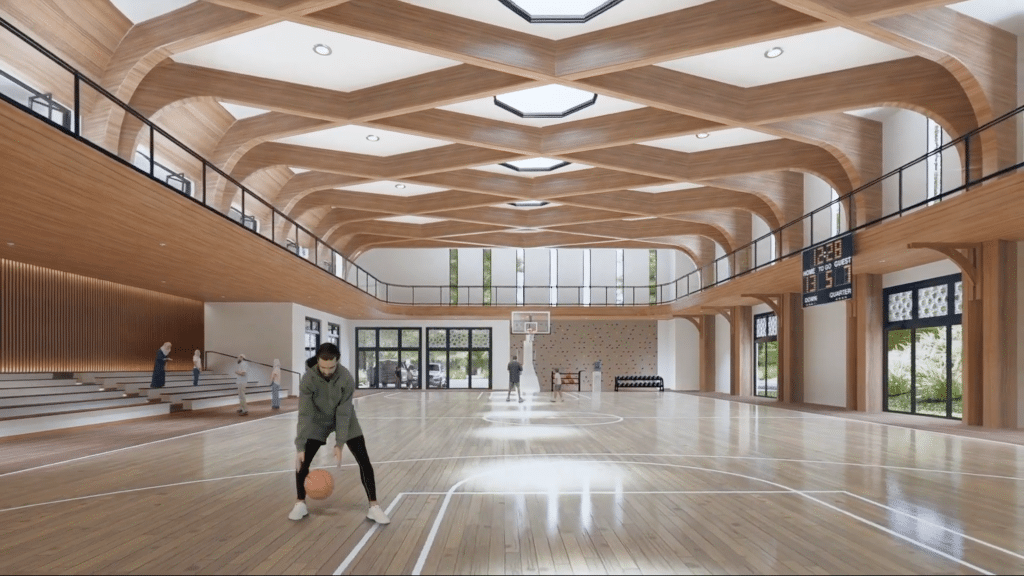
Imam Jaber said the completed campus would be open to all, and will include meeting rooms, a youth center, prayer spaces, a large gymnasium, a community cafe, a pavilion, a fire pit, and an outdoor playground. Mockups show an open-concept floor plan with large windows and wooden slats throughout that resemble the Kendeda Building, which gained its Living Building certification in 2021. (The designation is granted by the Portland-based International Living Future Institute.)
A religious call to action
Globally, more and more Muslims are connecting with religious principles of being caretakers of the Earth. Regenerative and sustainable design is a key feature of many new masjids or renovation projects—including the Cambridge Central Mosque in the United Kingdom, the Estidama Mosque in the United Arab Emirates, and the Istiqlal Mosque in Indonesia. The stereotype that sustainable building is expensive, even a “luxurious project,” isn’t true, said Renee, who’s now a master’s student in urban planning and a graduate fellow at the Kendeda Building. “It’s the opposite of luxury, it’s going back to our Islamic roots and our legacy for centuries before.”
Not that money isn’t a challenge.
With a footprint of nearly 30,000 square feet, the RCM building is estimated to cost $16 million—so far, they’ve raised about a quarter of that from community members. Living Buildings are typically about 15 percent more expensive than others, says Shan Arora, the director of the Kendeda Building (which, at 18,600 square feet, cost $25 million to design, build, and furnish). Shan expects construction costs to go down, though, as local contractors gain experience: “The more examples we get, it introduces more contractors and subcontractors to these ideas, and future projects will benefit without even knowing they’re benefiting.”
After construction, each Living Building must demonstrate over a 12-month period that the building meets design expectations in order to be certified. (The International Living Future Institute says so far, aside from RCM, only one other house of worship—another mosque—has applied for the Living Building Challenge.) The self-sufficient building must also be “equitable and just” through meeting less tangible benchmarks of beauty, inclusion, accessibility, health, and happiness. One requirement for its equity benchmark, for instance, is that 20 percent of contracts must be given to women, minorities, or disadvantaged businesses. Before construction could begin, workers had to dismantle an old barn still standing on the site—parts of which will be repurposed in the new building.
RCM is the perfect organization to take on the Living Building Challenge, Shan added: “This type of building really speaks to nonprofits, governments, higher education, and communities of faith because they own and hold their buildings for generations. The upfront cost today for hyper energy efficiency will save you money for the life of the building.”
Maher Budeir, an environmental engineer and one of the leaders of the RCM project, says a big challenge has been educating people about regenerative design. “It’s not about learning something new, it’s about reviving our heritage as Muslims to be stewards of our environment, of our community, of our resources,” he said. “These are Islamic principles at the heart of our religion and it’s a matter of making that connection for people and reviving that heritage.”
Twelve-year-old Yaseen Farooqui, a regular member of RCM along with his 17-year-old sister, seems to naturally get that connection. He says he’s most excited about the planned new basketball court—but also about the green aspects of the building. “I think it’s good because we’re not adding more pollution to the air and we’re reusing,” he said.
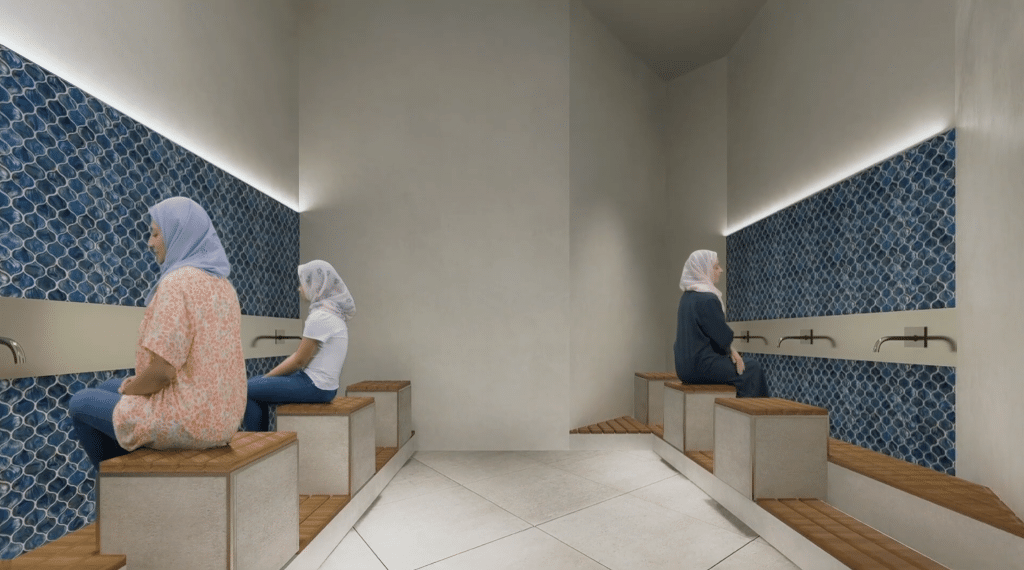
Both its religious values and its environmental values are reflected in the design of the new RCM building—down to the restrooms. They’ll include ablution areas—places to wash before praying—that rely on collected rainwater; after washing, the used water will be sent back to forested areas of the campus. That sensitivity to water consumption is also rooted in faith: Muslims are taught of an incident in which the Prophet Muhammad watched a companion wash himself before prayer—and called him out for wasting water. The companion asked if water could be wasted even while performing ablution. Muhammad’s response was, “Yes, even if you are by a flowing river!”
As part of her graduate fellowship, Renee occasionally gives tours of the Kendeda Building at Georgia Tech, which boasts thousands of visitors a year. She says she hopes the Roswell Community Masjid will serve as an inspiration in the same way.
“It is no longer good enough just to be sustainable or sustain the world that we live in,” Renee said. “We have to go beyond, we have to build to regenerate, to restore, and to build resilient communities. That’s why RCM is aiming to build a campus that will be socially just, culturally rich, and ecologically restorative.”
Author

Related Articles
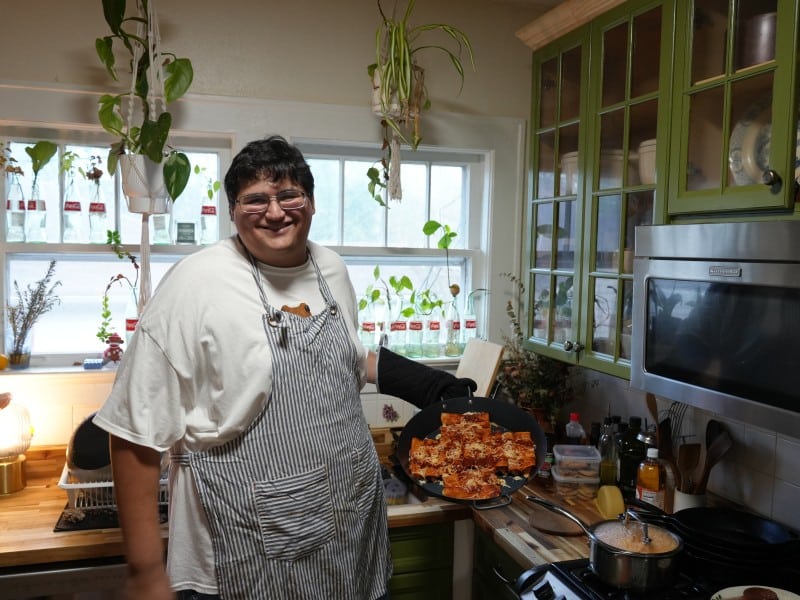
Andres Carrillo, founder of the pop-up Cocina Pachuco, is using his cuisine to fundraise for immigrants in detention
Born and raised in El Paso, the recently arrived chef is strengthening ties with his new home. One way he’s doing that: supporting the state’s immigrant communities.
“The work has become three times harder”
We speak to pro bono immigration attorney Serene Hawasli-Kashlan, legal director of Asian Americans Advancing Justice–Atlanta, about what it’s like to do her job right now.
“We did it”: Latinx student film Nuestra Realidad makes its cinematic debut at Tara Theatre
“We’re really taking up the space and not only just taking it, but we’re adding to it.”