
How candidates with immigrant backgrounds fared in Georgia’s elections
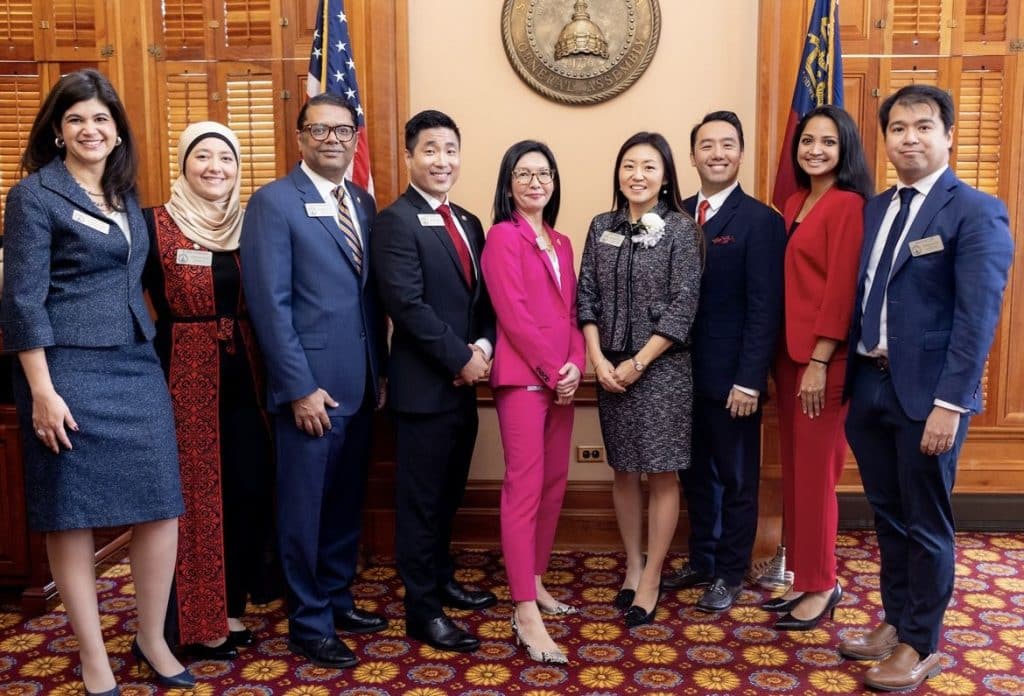
As of 2023, Georgia boasted more AAPI legislators than anywhere in the country—a reflection of how immigrant communities are transforming the state’s demographics and politics. Here’s how immigrant candidates performed this year in key races.
This story was published with support from the election reporting fellowship at The Pivot Fund, a venture philanthropy organization empowering independent BIPOC-led community news.
When he was elected to the Georgia State Senate in 2018, representing parts of Gwinnett County, Sheikh Rahman became the first immigrant and the first Asian American to serve in that body—as well as Georgia’s first Muslim lawmaker in either chamber. But on Tuesday night, when he was reelected to a fourth term, Rahman wasn’t in such a lonely position anymore: Today he’s one of a growing number of Georgia legislators from immigrant communities, boasting family backgrounds from Vietnam, Palestine, Nigeria, Colombia—and beyond.
That surge came in large part from people who entered politics after Donald Trump’s 2016 election to the presidency. They kept the energy going in 2020, when Georgia sent two Democrats to the U.S. Senate and threw its support behind Joe Biden, whose success owed partially to the growing power of constituencies like the state’s Asian and Pacific Islander community.
At a Tuesday-night election watch party at Jimmy’s Tequila & Carnes in Doraville, another member of this immigrant wave—Peachtree Corners restaurant owner Long Tran, elected to the Georgia House of Representatives in 2022 and reelected this week—talked about the impact that organizing at a local level can have. “The AAPI community flipped Georgia, and shortly after we flipped Georgia, 11 of us got elected,” said Tran, whose parents were Vietnamese refugees. (While some of the 11 AAPI lawmakers elected in 2022 were new to the body, others—like Rahman—had served previously.) “So our respect and our ability to make change grew.”
Those 11 lawmakers, including two Republicans, became the founding members of Georgia’s first-ever AAPI Caucus. When members were seated for the 2023 session, the group noted, Georgia had the most AAPI lawmakers of any state in the country. In 2022, New American Leaders—which supports first- and second-generation immigrants to run for office—found that nine states had no immigrant legislators at all.
Many of those Georgia lawmakers were up for reelection this year; other politicians from immigrant backgrounds, meanwhile, ran for office for the first time. Some races were thought to be bellwethers in a state whose shifting demographics are transforming its political landscape: The contest between Democrat Michelle Kang, a first-generation Korean immigrant, and Republican Matt Reeves in House District 99—which covers a historically Republican part of northern Gwinnett County—gained national attention. Reeves, a white incumbent backed by Gov. Brian Kemp, prevailed, though barely: He won 51.1 percent of the vote to Kang’s 48.9 percent.
These candidates’ campaigns, said Ashna Khanna, the deputy director of the Asian American Advocacy Fund, “were a powerful statement that AAPI and immigrant voices and communities matter.”
Here are some of the other state races that 285 South has been tracking.
Georgia House of Representatives
House District 42
Inspired to get into politics by Bernie Sanders’s 2016 presidential run, Democrat Gabriel Sanchez was born to Colombian immigrants in Cobb County—parts of which he now represents, having won his race with 63 percent of the vote. Sanchez campaigned on affordable housing, Medicare for All–style public healthcare, and workers’ and reproductive rights.
House District 48
Democrat Laura Murvartian, whose grandfather moved to Mexico after both of his parents were killed during the Armenian genocide, ran to represent parts of Peachtree Corners, Johns Creek, Alpharetta, and Roswell; she lost to Republican incumbent Scott Hilton, who garnered 55 percent of the vote.
House District 50
An anesthesiologist and a second-generation Chinese immigrant, Democrat Michelle Au was elected to the Georgia Senate in 2020—the first Asian American woman to serve in that body. When her seat was redistricted to favor Republicans, she switched to the Georgia House, first winning election there in 2022. Au was reelected this week with 55 percent of the vote, facing Republican Narender Reddy, an Indian-born Johns Creek businessman.
House District 97
A progressive Democrat and one of the few Palestinian elected officials in the country, Ruwa Romman was born in Jordan and is the granddaughter of Palestinian refugees; she gained a national profile this year after being denied a speaking slot at the Democratic National Convention. Romman represents parts of Atlanta’s northeast suburbs and won reelection with nearly 60 percent of the vote.
House District 99
A first-generation Korean American, Democrat Michelle Kang lost a close race to Republican incumbent Matt Reeves to represent a historically conservative—though changing—portion of Gwinnett County. She campaigned on lowering housing costs, promoting reproductive rights, and expanding environmental protections.
House District 102
Nigerian American Gabe Okoye was first elected to this seat in 2022 and was reelected this year with almost two-thirds of the vote. A small-business owner and former chair of the Gwinnett County Democratic Party, Okoye represents the Lawrenceville area.
House District 103
Representing an area southeast of Lake Lanier, Republican Soo Hong is a Seoul-born lawyer first elected to the Georgia House in 2022. Reelected this year, she garnered over 60 percent of the vote against Democratic candidate Chris Luchey.
House District 105
A Democrat representing parts of Dacula, Buford, and Lawrenceville, Farooq Mughal is the son of Pakistani immigrants and was first elected to this seat in 2022. After his district was redrawn to benefit Republicans, Mughal faced Sandy Donatucci in the 2024 elections; the tight race has not officially been called yet, though Mughal was trailing by fewer than 100 votes as of Wednesday.
House District 107
Born in Georgia to Korean immigrants, Sam Park became the first Asian American Democrat and the first openly gay man to serve in the legislature when he was elected in 2016; he flipped a formerly Republican seat representing parts of Lawrenceville and Gwinnett County. In this year’s election, Park earned 60 percent of the vote against Republican Hai Cao, who fled Vietnam in 1975.
Georgia State Senate
Senate District 7
Bangladeshi American Democrat Nabilah Islam Parkes, who grew up in Gwinnett County, became the first Muslim woman and the first South Asian woman to serve in the Georgia Senate after first being elected in 2022. This year, campaigning on Medicaid expansion and voting and abortion rights, she was returned to her seat with 55 percent of the vote against Republican challenger J. Gregory Howard.
Senate District 48
Twenty-five-year-old Johns Creek resident Ashwin Ramaswami, whose parents immigrated from India, decided to run for this position when the Republican incumbent, Scott Still, was indicted for his alleged role in the 2020 “fake electors” scheme. Still prevailed with 54 percent of the vote.
Gwinnett County Transit SPLOST Referendum
This wasn’t an elected position, but still an important choice facing the electorate in immigrant-dense Gwinnett County: After a series of failed attempts, Gwinnett voters were asked to consider an ambitious expansion of public transportation in a county where options are currently few. The proposal would have boosted bus lines, created a direct route to Hartsfield-Jackson airport, and expanded microtransit, a kind of publicly run rideshare system akin to Uber and Lyft. Some groups supporting the measure, like the Asian American Advocacy Fund, said it could be a lifeline for immigrant families who currently lack options for getting to work, the doctor’s office, and the grocery store. There are also an estimated 80,000 undocumented Gwinnett residents who aren’t able to get driver’s licenses.Garnering only 47 percent support from voters, the referendum failed—as did a similar ballot measure in Cobb County. Read more here about what those initiatives would have meant.
Authors


Related Articles
These are the bills impacting immigrants in Georgia that survived Crossover Day—or didn’t
Crossover Day is the make-or-break point for bills to have a chance of passing in each year’s legislative session. Here’s how a range of laws affecting immigrants fared.
Refugee, Muslim, and Latino organizations push for laws to improve immigrants’ quality of life in Georgia
Among them: increased opportunities for foreign medical graduates to expanding language access in schools to repealing immigration enforcement bills