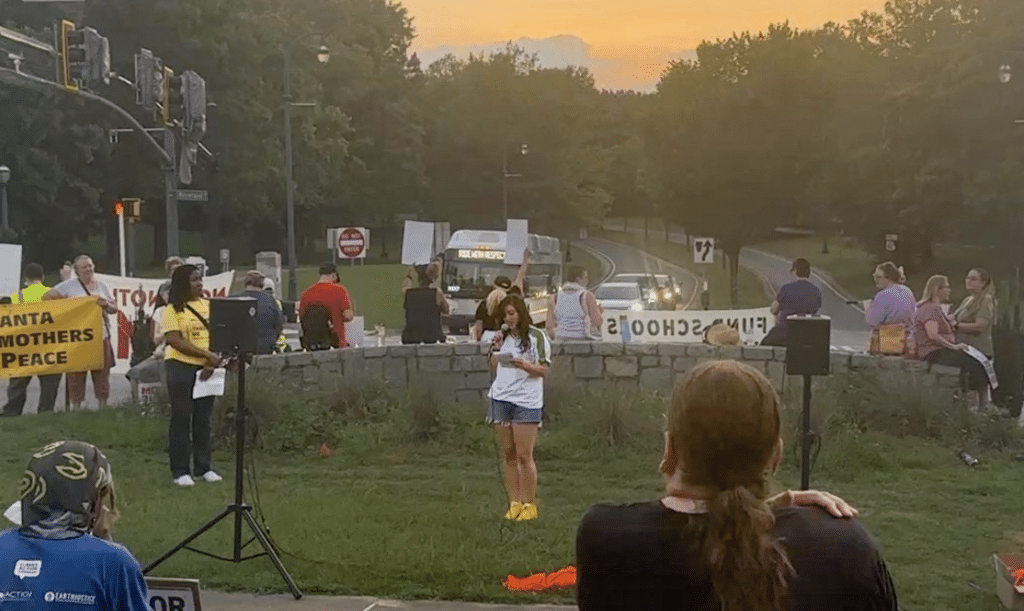
Metro Atlanta resident and Iranian American Shabnam Bashiri spoke at the Stop War protest at Freedom Park on Tuesday evening. Photo credit: Fiza Pirani
Since Israel attacked Iran earlier this month, Decatur resident Nazanin Tork hasn’t been able to sleep. Three years ago, after living in the U.S. for four decades, her parents retired and returned to Iran, where they were born, to take care of their own elderly parents. They now live in a suburb of Tehran. Nazanin’s mom had planned a trip back to Atlanta to see Nazanin and her kids; her flight was scheduled for June 28.
But suddenly, everything was up in the air.
On June 13, following months of tension, Israel launched a surprise missile attack on Tehran, accusing it of secretly developing a nuclear weapons program while targeting top military officials. Iran responded with a missile barrage of its own and, as the conflict unfolded, the U.S. got involved, attacking three Iranian nuclear sites on June 21. On Monday, after Iran attacked a U.S. military base in Qatar, President Donald Trump announced a ceasefire that appears to be shakily holding. In the conflict so far, over 400 people in Iran have been killed and over 3,000 injured, and more than two dozen people have been killed in Israel.
Nazanin is among the over 8,000 Georgia residents who were born in Iran—many of whom are directly feeling the impacts of the turmoil that has gripped the region. Like others, her focus has been on her loved ones, whom she’s been struggling to reach due to spotty WiFi and landline access.
Working with a cousin in Texas, Nazanine was eventually able to organize a bus and taxi to take her family out of Tehran and across the border to Turkey on Monday. “[My mom] was telling me that even during the Iran-Iraq War, she never heard bombs, but while she was packing her luggage, she said she could hear the bombs being dropped,” Nazanin said.
On Tuesday morning, just hours after Trump announced the ceasefire, she got a call through WhatsApp. It was her mom—she had made it to Turkey. “She was crying, she was trembling,” Nazanine said. For a moment she worried that she and her cousin had been too hasty: “We were like, Oh, there’s a ceasefire, maybe she should not have rushed to leave,” Nazanin said. But then she heard from her father, who’d decided to stay in Iran. “‘It was still terrible yesterday,’” she said he told her. “‘There were still attacks, bombings.’ [He said] it was actually good that Mom left, because the ceasefire has not actually happened.”
Like Nazanin, many Iranian Americans 285 South spoke to in the Atlanta area described the last few weeks as feeling surreal. For some, it has felt isolating to watch the conflict unfold from the other side of the globe, in a place where there isn’t a particularly large Iranian community; for others, it’s triggering memories and trauma related to past unrest in the region.
Farah, for instance, was just a baby when her family lived in Iran, and she grew up hearing stories of her family fleeing Tehran in the aftermath of the Iranian Revolution, when a popular uprising overthrew a ruling monarch—installed in 1953 in a U.S.-backed coup—and established an Islamic republic. Today, Farah is a Georgia resident who has lived in Cobb and Fulton counties for most of her life; she didn’t want to use her real name because she wants to be able to travel safely between the U.S. and Iran.
When Israel began its attacks, she said, her aunt and cousins in Tehran sought shelter in the same house in the mountains where her family fled during the revolution. “It’s exactly what happened 40 years ago,” Farah said. She spoke to her family on Tuesday night, shortly after Trump’s announcement over Truth Social, where he wrote in all caps, “CONGRATULATIONS TO EVERYONE!”
“They [didn’t] believe it,” Farah said. “Our families are not ready to go back home.”
For Nazanin’s family, it’s also an echo of the past: “My mom did the same 40 years ago, with my brother and I. She went to Istanbul to apply for a visa to come to the U.S.” Her dad, who was in the U.S., wanted to come back to Iran. “And my mom was like, ‘No, it’s getting worse. We’re leaving,’” Nazanine said. “This is why it’s very triggering and traumatizing for her. She’s already done this exact thing once before, except she was 40 years younger and had two children with her.” Back then, though, she said, her mother didn’t hear the bombs—just sirens. “This time it’s in the heart of the capital.”
Layla, an Iranian American living in Druid Hills who also didn’t want her real name to be used, has been watching the news unfold on her phone, following Instagram accounts of Iranian academics in the diaspora, as well as photojournalists she trusts. She said being Iranian right now feels isolating—in part because, with Iran under various U.S. sanctions since 1979, the country has been “iced out,” she said. “A lot of people just don’t know. They don’t know about the culture.” Atlanta has Iranian restaurants like Delbar and Rumi’s Kitchen, she said, but on a deeper level, “there’s no cultural exchange happening.”
“So when stuff like this happens, people just don’t even know what they don’t know,” Layla said.
There are institutions like the Kanoon Persian Cultural Center in Norcross, though Layla said that caters to mostly the older generation. For people her age, she said, “we just don’t really have a place to collectively mourn, hold grief.”
It’s difficult for many in the diaspora to travel back to Iran, she added, which makes the current situation feel even harder. “I haven’t gone in a long time, simply because of the political unrest,” Layla said. “Those of us in the diaspora, we’re really longing for homeland in a way that I think very few people can understand. It’s very strange to know the language and speak Farsi and know the culture of someplace that you just can’t go to.”
For Nazanin, another effect of the Islamic Revolution is that her family is all over the globe; in addition to the U.S., she has relatives in Canada, the UAE, Belgium, Italy, and Sweden. None of them live in Georgia, though. “We’re all spread out, and we all miss each other and miss the lives that we had, and this is how we live.” She hopes one day to take her kids, aged 11 and 8, to Iran—though at this point she’s not sure when that will be.
“I keep checking the news, because there’s so much unknown. You don’t know who’s going to do what when you wake up.”
Nazanin Tork, Decatur resident
Technically, Nazanin has been on vacation with her husband and two kids over the last few weeks—but it’s been anything but restful. “I’m a paralyzed zombie,” she said. “I’m trying to keep strong in front of my kids. I can’t sleep at night. I haven’t slept in over a week. I wake up at two or three and I just keep checking my phone. I keep checking the news, because there’s so much unknown. You don’t know who’s going to do what when you wake up.”
She hasn’t shared much with her kids about what’s happening—they’re just waiting for their grandma, who’s still expected to arrive in Atlanta on June 28, via Istanbul. “I’m trying my best to hide it from them right now, until when my mom gets here. I haven’t been sharing with them because we’re on vacation and I don’t want them to be worried about my mom.”
But keeping it all inside doesn’t feel natural either. “I just can’t believe we’re expected to just go on as if nothing is happening,” she said.
For mental health reasons, Farah keeps her news consumption to a minimum. But she has called the offices of Senators Jon Ossoff and Raphael Warnock, urging them to stop supporting Israel. “My voice kind of broke,” she said, when she was leaving the voicemails. “I was just really upset.” Overhearing her, Farah’s five-year-old son became alarmed, she recalled, saying, “‘What’s going on? Why are you crying?’ I was like, ‘Sometimes, you know, you have to speak up for others, when they can’t speak.’”
As of publication, Farah still hadn’t heard back from either senator’s office. Nazanin has been calling Ossoff’s and Warnock’s offices regularly since Israel began bombarding Gaza in 2023. When she hears back, she said, it’s usually in the form of a standardized email. 285 South also reached out to both offices for comment, and didn’t receive a response.
Sophia is the founder of 285 South, Metro Atlanta’s only English language news publication dedicated to the region’s immigrant and refugee communities. Before launching 285 South in 2021, she worked for over 15 years in media and communications, including at Al Jazeera Media Network, CNN, the United Nations Development Programme, and South Asian Americans Leading Together (SAALT).
Her writing has been published in Atlanta Magazine, Canopy Atlanta, the Atlanta Civic Circle, the Atlanta History Center, and The Local Palate. She won the Atlanta Press Club award for Narrative Nonfiction in 2023 and 2024; and was a recipient of the Raksha Community Change award in 2023 and was a fellow of Ohio University’s Kiplinger Public Affairs Journalism Program in 2024.
Contact her at sophia@285south.com and learn more about herhere.
Trabajadores y dueños de tiendas del centro comercial latino dicen que el negocio ha estado lento durante el último año, lo que ha provocado reducción de horarios y un futuro incierto