New report: Latinos are a fast-growing, economically powerful population in Georgia—but face persistent challenges
Community leaders came together in Norcross on Tuesday to take stock of the state’s Latino population.
The contribution of Georgia’s Latino communities to the state GDP is comparable to the entire economic output of some American states. But while the power of this bloc is growing, many of its members still struggle to get by.
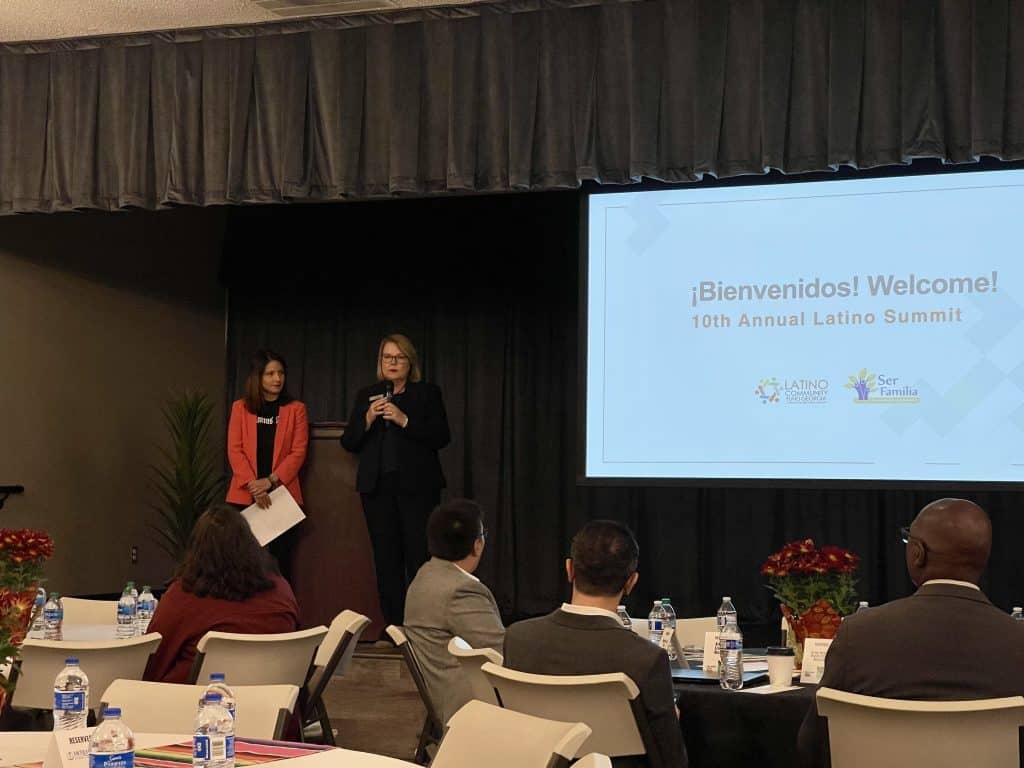
On Tuesday, dozens of community leaders from around Georgia gathered in a Norcross ballroom for the 10th Annual Latino Summit, a yearly occasion to take stock of the state’s Latino population and its economic and cultural contributions—as well as challenges in areas like education, housing, and healthcare. The event also marked the release of a new report, State of the Latino Community in Georgia, exploring the impact of this rapidly growing demographic.
The growth of Georgia’s Latino populations is outpacing the national rate, Nikolai Elneser, community impact officer of the data research group Neighborhood Nexus, told the room of attendees. “The speed in which Latinos are moving to Georgia, comparatively, it’s faster than that of other states,” he said. Latinos and Hispanics today make up about 11 percent of this state’s population—more than a million people, with roughly half in the Atlanta metro area.
The report also comes on the heels of a presidential election in which Donald Trump made major gains among Latino voters—demonstrating the increasing electoral power of this growing voting bloc, and offering a reminder that Latinos in the U.S. are a diverse community with a wide range of political views and affiliations.
That diversity was on display at Tuesday’s event, which included leaders from organizations like Ser Familia and the Latino Community Fund – Georgia—which partnered to sponsor the event—as well as local political figures including Gwinnett County Chairwoman Nicole Love Henderson. While attendees munched on bowls catered from the local fast casual restaurant Latin Fresh, speakers went through the details of the report, which covered everything from housing vulnerability to ESOL education to entrepreneurship.
Combining interviews with residents around Georgia with federal, state, and local data, the State of Latinos report was produced by the Latinx Alliance, an initiative of the Community Foundation for Greater Atlanta.
Here are some of the report’s key findings:
- Latinos have an entrepreneurial spirit but face barriers to opportunities
Latinos are an essential part of the economic growth of the state. In 2021, the report found, the Latino GDP in Georgia reached $52.2 billion—comparable to the entire economic output of Wyoming or Vermont. There are an estimated 91,000 Latino-owned businesses in Georgia, and about 43 percent of businesses reported that the majority or all of their customers were Latino.
Some of those are long-established businesses, but many are newer, explained Alejandro Coss, president and CEO of the Latin American Chamber of Commerce in Georgia: There’s been a shift, Coss said in the report, from entrepreneurs primarily from Mexico and the Caribbean to a new generation of business owners who immigrated from Venezuela and Central America.
There are also challenges associated with being a Latino business owner. Some, for instance, are in the country through DACA or with Temporary Protected Status—provisional designations considered high-risk by potential lenders, limiting would-be entrepreneurs’ access to capital.
Undocumented immigrants, meanwhile, can’t get business licenses or enter into contracts.
Economic prospects for second- and third-generation Latinos, though, are brighter, as they take roles in established companies or create their own businesses without facing as many barriers as their predecessors.
Latinos aspire to become homeowners—and renting is also a challenge
While homeownership is a goal of many Latino families, housing can be a struggle to navigate. Some immigrant families pay others to handle their paperwork, making them dependent on intermediaries and vulnerable to predatory practices from unscrupulous agents and landlords.
Then there is the expense: More than half of Latino households in Georgia reported spending more than half their income on housing, forced to make sacrifices—skipping medicine, buying less food, reducing utility consumption—in order to make rent. Latino and non-Latino Black households are more likely to experience rent burdens than their non-Latino white and Asian counterparts, the report found. Latino families are also bigger, with an average size of 3.4 people per household, compared to the state average of 2.7. That makes these families more likely to have multiple family members sharing rooms.
High costs can also contribute to instability, with families forced out of their homes and into worse housing—which can put them at risk of health problems. About 60 percent of cases at the Atlanta Volunteer Lawyers Foundation involve housing repairs tied to health issues, like respiratory problems caused by things like mold and insects. Michael Lucas, executive director of the Atlanta Volunteer Lawyers Foundation, noted that tenants with mixed-status families are often scared to speak up for their rights, with some landlords threatening anyone asking for repairs with eviction.
There’s more work to do, including state policy changes
The report also included recommendations on improving the quality of life for Latinos in Georgia—including expanding access to forms of identification beyond social security cards and driver’s licenses, which many Latinos don’t have. That shouldn’t be a difficult request, said Gilda (Gigi) Pedraza, executive director of the Latino Community Fund: “An ID is just an ID. If you have a program and you’re asking for social security when you don’t need social security—you just need to know the name of the person to confirm—just ask for documentation that confirms the name of the person.”
That wasn’t the only policy suggestion: The report’s authors also argued for expanding Medicaid in Georgia; strengthening worker protections, including in the agricultural industry, where Latinos are overrepresented; and repealing state laws that restrict the ability of immigrants with documentation to apply for federal assistance programs.
Author

Related Articles
These are the bills impacting immigrants in Georgia that survived Crossover Day—or didn’t
Crossover Day is the make-or-break point for bills to have a chance of passing in each year’s legislative session. Here’s how a range of laws affecting immigrants fared.
Rodney Taylor struggles to use his wheelchair and prosthetic legs as health deteriorates in immigration detention, says family
Advocates and family members of Gwinnett County resident held at Stewart Detention Center, travel to Washington D.C. to raise the alarm on his case.