
With no end to the Gaza war in sight, many of Georgia’s Muslim voters—and their allies—aren’t sure what to do
“Prior to this, I was solidly Democrat . . . I don’t know what’s the right thing to do. I’m greatly disheartened. It’s painful.”

Almost every weekday for the past nine months, Soraya Burhani has made it her job to call her elected officials with two primary demands: a ceasefire in Gaza and an end to U.S. military support for Israel.
The Buford resident, who moved to the Metro area ten years ago from Malaysia, has been working with other community members to galvanize hundreds of people through a WhatsApp group, now called Georgia Muslims and Allies for Peace, to do the same. The group, which has grown to about 1,000 members, is roughly half Muslim, with the other half from a diverse assortment of backgrounds.
“We didn’t think that we’re gonna be going this long,” Soraya said in early October at the Atlanta Arab Festival, where she stood behind a table stocked with bowls of lollipops and Tootsie Rolls and a sign reading “No Peace No Peach.” Just a month before, she and other organizers launched an online petition demanding that the Harris-Walz campaign commit to a ceasefire and an end to military aid to Israel. Garnering over 2,000 signatures, the petition gave the campaign a deadline—October 10—if it wanted the votes of those who had signed on.
The deadline came and went.
While it’s unclear how much the war in Gaza will affect the outcome in the presidential election in Georgia, or in down-ballot races, there are signs it may have an impact on the way some communities vote. Even as early voting is underway in the state, with record turnout so far, 285 South spoke to many people who aren’t prepared to cast a ballot just yet—if at all. For those who have spent more than a year protesting the U.S.’s support for Israel’s war in Gaza, only to see the death toll exceed 41,000 and the war expand into Lebanon, the decision isn’t straightforward.
The unease among many Muslim voters, in particular, could make a real difference in a state where the race between Trump and Harris is nearly tied, according to the most recent polls. More than 100,000 Muslim Americans are registered to vote in Georgia, where Joe Biden’s margin of victory in 2020 was famously under 12,000 votes. In mid-September, a national poll conducted by John Zogby Strategies for the Arab American Institute found that 8 of every 10 Arab Americans (81 percent) view Gaza as important in determining their vote.
285 South reached out to the Harris campaign to ask what it was doing to address Georgia voters concerned about its stance on Israel’s war in Gaza and Lebanon. The campaign declined to comment on the record.
With the election looming and the demands unmet, Soraya is one voter unsure of what to do—and whom to support. “Prior to this, I was solidly Democrat. Solid, really solid,” she said. Now Soraya doesn’t want to identify with any political party. “I don’t know what’s the right thing to do. I’m greatly disheartened. It’s painful.”
A disheartening feeling
Soraya said that some of the people who had phone-banked relentlessly for months were feeling “dejected.” Things were different when Georgia Muslims and Allies for Peace first started out. In the first few months, Soraya said, they were making up to “300, 400 calls a day. Even 500.” They’d been calling the offices of Georgia senators and congresspeople, adding calls to the White House in the late summer, when they launched the No Peace No Peach campaign. Now, though, the volume of daily calls has dropped to between 45 and 100.
The slowdown stems in part from the fact that this level of civic engagement was historic, Soraya said—and to continually see videos and news reports of massacres in Gaza and Lebanon, with no end in sight, has been bitterly disappointing. “Especially for the Muslim community, it’s like their first time trying to advocate for something so painful and so big. Seeing that it’s not working for nine months, some people have started leaving. Like, Oh, it doesn’t matter.”
“Especially for the Muslim community, it’s like their first time trying to advocate for something so painful and so big. Seeing that it’s not working for nine months, some people have started leaving. Like, Oh, it doesn’t matter.” – Soraya Burhani, Georgia Muslims and Allies for Peace
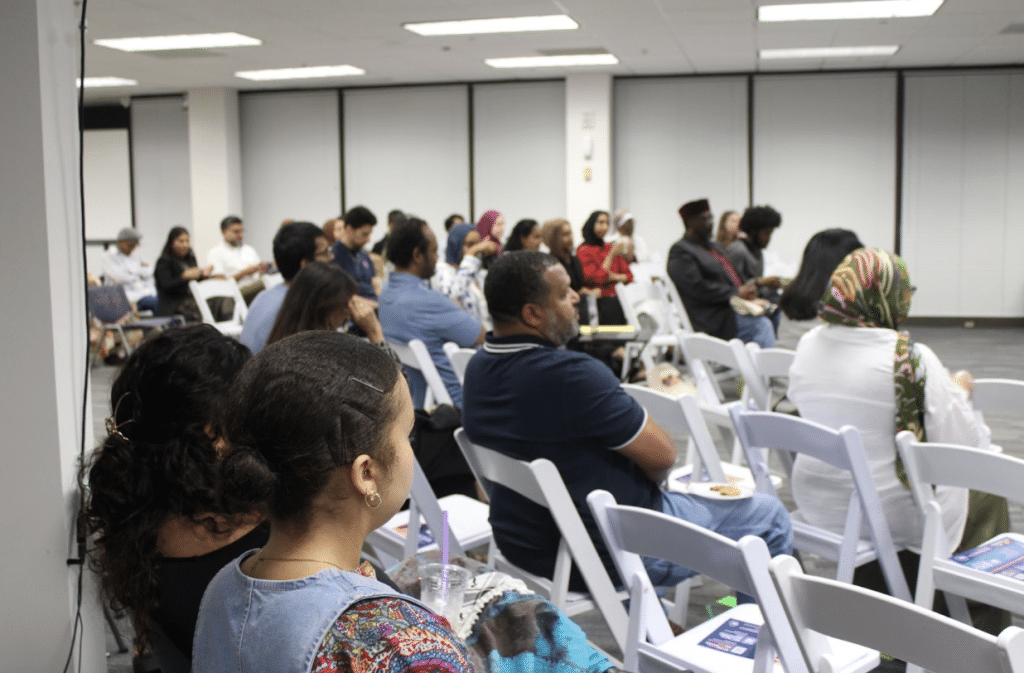
For some, the frustration is especially acute after a stretch of time when Georgia’s Muslims felt like they’d been making meaningful strides in the state. Speaking to a roomful of Muslim Americans at a recent event in Dunwoody, Shafina Khabani, the executive director of the Georgia Muslim Voter Project, celebrated the gains the community has made: “We are seeing halal menus being implemented in county schools across the state. We are on the brink of seeing Eid recognized as a holiday in counties like Gwinnett, and Georgia boasts the second largest number of Muslim elected officials in the nation.” She discouraged the audience from disengaging from the political process: “Apathy is not the answer.”
Ruwa Romman, a Palestinian American state lawmaker in Georgia, and one of just a handful of Palestinian elected officials in the country, says the activism around Gaza has in fact made a difference. At the Dunwoody event, she pointed to the “Leave It Blank” campaign, arguing that it was part of the reason Harris, and not Biden, ended up on the ticket.
Romman has been encouraging people to continue to put pressure on elected officials—but that hasn’t been enough to convince some to commit to Harris. “This time, we have to weigh everything. Is Roe v. Wade more important or the genocide in Gaza more important? The genocide has motivated us more than anything at the moment,” said one Lilburn resident who preferred to remain anonymous. Originally from Pakistan, she plans to vote for Green Party candidate Jill Stein. “I’m pretty positive the Green Party is not going to make it. I’m sure it’s not. But that’s the least we can do. Unfortunately.”
“None of these are actually good choices,” a Johns Creek resident originally from Bangladesh, told 285 South. “Even Jill. She’s the best option, but . . . it’s almost like a wasted vote. Unless it makes the other parties be more serious about stopping the genocide, since they know people will not vote for them.”
Others, like Imam Nadim Ali of the Community Masjid of Atlanta, say they’ve seen enough encouraging signs from the Harris campaign—and sufficiently fear the prospect of a Trump presidency—that they’ve been convinced to vote for the Democratic nominee. “I feel as though Vice President Harris has basically been saying the right things in regards to running a ceasefire, whereas Trump, what he said was to finish the job.” Ali was one of over 100 faith leaders in Georgia who signed a letter this week demanding that Biden and Harris “stop arming Israel.”

Muslim American groups like Emgage Action, the American Muslim Democratic Caucus, and the Black Muslim Leadership Council, as well as Muslim state lawmakers in Georgia like Representative Farooq Mughal and Senator Nabilah Islam have also come out in support of Harris—but not without criticism from others in the Muslim community.
And some, like the Georgia chapter of the Pakistani American Public Affairs Committee (PAKPAC), are endorsing Trump. The group, which mostly lobbies on issues related to U.S.-Pakistan policy, announced the news last week in an email sent to community members. PAKPAC was supporting Trump, it said, because his campaign “gave us assurances and solutions with regards to resolving current political turmoil in Pakistan and the Middle East.” The Harris campaign, on the other hand, “remained silent to our concerns.”
In an interview with 285 South, Munzir Naqvi, a Smyrna resident and member of PAKPAC’s Georgia chapter, said that the Trump campaign “didn’t provide any guarantees” about the conflict in the Middle East and the human rights situation in Pakistan (the group has been calling for a release of deposed Prime Minister Imran Khan and a release of all political prisoners). But, he said, the campaign said “they will definitely look into it.” When asked if he was concerned about another Muslim ban or Trump’s proposed policies towards immigrants, he said the group would encourage community members to stay civically engaged with Congress on those issues. The decision to back Trump was seen by some in the community as “suspect,” he said, but he described the endorsement as a strategy: “If you don’t engage either of the mainstream parties . . . none of the mainstream parties will take us seriously again.”
An arms embargo and a permanent ceasefire
For some Palestinians Americans, the promises and signals from the Harris campaign haven’t been enough. Jawahir Sharwany, who was born and raised in Palestine and has been living in Atlanta for about a year, has been a constant presence at marches and rallies for Gaza. She’s been waiting for the campaign to use a specific phrase when speaking about the war: “permanent ceasefire.”
In 2023, 285 South spoke to Ghada El Najjar, a Palestinian American mom in Alpharetta and longtime Democratic voter, just days after the October 7 attacks. Addressing a group of reporters at the Georgia Capitol, she held a photo of Yahya, a young teenager who had just been killed by an Israeli strike in Gaza, she said, along with four other children in her extended family.
She was back at the Capitol this month. But this time she was talking about her own teenage son, to a handful of reporters, during a press conference organized by the Atlanta Multifaith Coaliton for Palestine. “My son is 18 years old, this is his first time to vote,” she said. “And he said, I don’t want to vote, I don’t have good options to vote for. I’m not proud of my country right now. As a mother, this broke my heart.”
Soraya, for her part, still doesn’t know what she’s going to do. The day before early voting began, she and other organizers sent out a statement encouraging “all Georgia voters to Get Out The Vote, keep Palestine in mind at the ballot box, and vote with their conscience at the top of the ticket.”
Back at the Arab festival, she explained that like most immigrants, she never imagined getting involved with an issue this deeply. “I didn’t think that I necessarily wanted to be an activist. I didn’t see a particular reason to [be] involved,” she said. But Gaza has changed that. “Now, obviously I need to.”

Tasnim Shamma contributed to this report.
Authors

Related Articles

Woman who assisted in federal abuse investigation, arrested at Atlanta airport and deported days later
“A slap in the face,” her attorney says describing her client’s situation, who had a pending U-visa application
A Rohingya man in New York died under mysterious circumstances— his relatives in Georgia are grappling with the loss
Federal immigration officers left Nurul Amin Shah Alam outside a closed coffee shop in harsh winter weather— days later he was found dead. He was getting ready to move to Georgia, says his niece in Stone Mountain.