
From Multan to Marietta, Ras Malai cake fuses flavors and geographies
An afternoon with baker and caterer Caramelized by Halima.

Food is central to all of us in so many ways – whether it be to our health, identities, or enjoyment. And for many immigrants to the U.S., food is not just a way to maintain a connection with their heritage, it’s also a way to make a living—and make a mark.
In addition to playing a vital role as workers in the U.S.’s hospitality and agriculture industries, immigrants own nearly a third of this country’s restaurants and hotels. In many cities, including Atlanta, they’re especially prominent as small-scale entrepreneurs: operators of specialty groceries, food trucks, tamale carts and halal stands, and beloved local cafes.
Starting this month, 285 South’s Food Without Borders series will highlight some of the Atlanta metro’s diverse food producers—and their delicious creations—with a focus on home-based cooks and bakers, caterers and pop-up shops, and off-the-beaten-path brick-and-mortars.
Halima Arshad was standing behind a table filled with an array of desserts in small packages—mango milk cake, toffee date cake, pink frosted cupcakes—at the crowded Muslim Makers Market in a Hilton ballroom in Peachtree Corners in early November. The desserts were pretty, but my eyes were drawn to an empty gold-colored tray with the label “Ras Malai Cake $9”—and, next to it, a sign in chalk that read “SOLD OUT.”
South Asian desserts—jalebis, gulab jamuns, ladoos—can be cloyingly sweet; they stick to the sides of your mouth and stay with you for hours. But ras malai, which I remember eating on special occasions as a kid, was different. A dessert the internet generally describes as cheese balls cooked in boiled milk and flavored with rose water, it was refreshing and not too sugary, creamy and comforting.
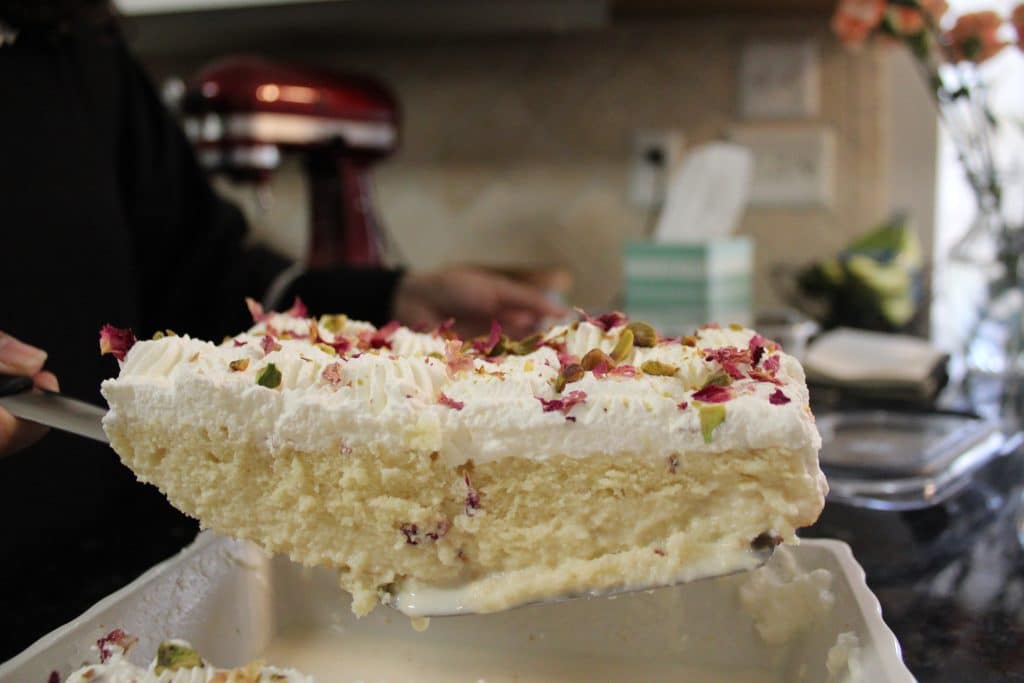
Two weeks after my disappointment at the Muslim market, and after a flurry of messages over Instagram, Halima was ushering me into her kitchen in Marietta, where she was making a Ras Malai cake—a tres leches–style cake but with the flavors of ras malai, topped with fresh cream, and garnished with pistachios and dried rose petals. She’d already put a pot of milk on the stove to boil to thicken the milk and infuse crushed cardamom, and had set aside what she called her “spiced cake,” which she had made earlier to save time.
As she used a tiny mortar to crush cardamon pods bought from a local halal grocery shop, Halima told me that although baking isn’t traditionally part of food culture in Pakistan, she grew up with her mom making cakes every day.
“Ami [Mom] would always bake all sorts of cakes, but her very famous [one],” said Halima, switching to Urdu, was “elachi-walla cake”—cardamom cake, which she would make in time for “sham ki chai,” evening tea. “That’s where I got my love for baking,” she said. “Ami.”
Cardamom is a central flavor in the cake—it was in the milk, the cream, and the sponge. Along with the rose water and dried rose petals, those were the only seasonings I saw her use, though she alluded to “secret ingredients” a few times. “Pakistani desserts have a lot of ghee, cardamom. They’re rich, very rich,” she said, as she strained the boiled milk into a bowl. “I wanted something that was a flavor that was close to home, but something that people here like as well,” she said.

Halima started her business, Caramelized by Halima, toward the beginning of the pandemic, just after she had her second child. She was living then in Albany, New York. “It was peak Covid 2020, and I think it was also sort of a way to combat postpartum depression,” she said.
Her first order was for Halloween cupcakes, which she made in the shape of pumpkins (she learned to decorate cakes mostly through YouTube videos, she said). From there, “it just took off,” through word of mouth and through her Instagram and Facebook accounts. She started doing dessert tables and taking orders for Ramadan- or Eid-themed events—and incorporating traditional South Asian and Middle Eastern flavors and ingredients like date, mango, and cardamom. Last year, she introduced the Ras Malai cake at a party. “People went crazy,” she said, as we sat down at the breakfast table. She’d just put the cake in the freezer, after pouring the boiled-milk mixture onto it. Normally, she lets it soak overnight, but said that the freezer helped speed up the marinating time.
Over the course of three years in Albany, Halima built a steady and loyal clientele, so when her husband got a job in Atlanta that required them to move in the late summer, she said she was “very nervous.”
But in just a few short months in the area, Halima has taken on catering orders and had set up dessert tables at two recent events—the Unity in Diversity art showcase and Atlanta Muslim Hub’s Muslim Makers Market. And she’s got some new sweets she wants to introduce to the Atlanta community – one of them is inspired by the traditional Christmas yule log cake, but is made with mangos and vanilla cake. She also plans to do orders for millionaire shortbread cookies, as well as continue to cater her staple desserts—sticky toffee date cake, mango milk cake, and, of course, Ras Malai cake.
As Halima has embraced baking, so have a number of people in her home country, where pastry was formerly harder to come by: “The trend is changing a little,” she said, noting a growing number of home bakers and commercial bakeries in big cities like Lahore—though less so in Multan, where Halima grew up.
But there is at least one new home baker in Multan: Halima’s mother, who took inspiration from her daughter’s own business. “You know how our moms, they don’t do anything for themselves?” Halima and her sisters told her, “You’re done with everything that you have to do now. If you have a passion, go ahead.” But instead of traditional Pakistani desserts and flavors, her mom makes eclairs and apple pies—desserts that are hard to come by there. “Whenever I’m in Pakistan, I’ll ask my mom to make apple pie, and then I’ll freeze it. I still have it in the freezer here.”
Halima took the cake out of the freezer and piped fresh cream onto it in neat lines, and then sprinkled crushed pistachios and dried rose petals over it.
I asked her about the cheese—which was central to the ras malai I grew up eating. Her recipe didn’t have cheese in any form; the cake took its place, she said, soaking in the cream easily. I took my first bite—a cloud of cream and cake, with hints of cardamom, rose, and secret spices that melted in my mouth, transporting me to my ancestors in Pakistan and then returning me to the present, right there with Halima and her big smile in her Marietta kitchen.
Check out Caramelized by Halima on Instagram here.
Author

Related Articles
Andres Carrillo, founder of the pop-up Cocina Pachuco, is using his cuisine to fundraise for immigrants in detention
Born and raised in El Paso, the recently arrived chef is strengthening ties with his new home. One way he’s doing that: supporting the state’s immigrant communities.
Ibu’s Kitchen gets back to the basics: “Food makes people happy.”
At this “one-stop shop” on Buford Highway, customers can find Indonesian groceries, Batik clothes, homestyle meals, and an unwavering commitment to values.
At La Mixteca Tamale House, colorful masa creations celebrate Valentine’s Day—and honor a mother’s memory
Born in Oaxaca, Rosa Lucia Hernandez launched a tamale business in 2018 to fulfill a longtime dream. After her death, Rosa’s children are keeping that dream alive.