
An Augusta man decided to “self-deport.” The government arrested him anyway.
The Department of Homeland Security says that when undocumented people declare their intention to leave the country, via the CBP Home app, they’ll be “deprioritized” for immigration enforcement. That’s not what happened to David.

LEA ESTA HISTORIA EN ESPAÑOL AQUÍ.
In early May, David, an immigrant from Nigeria, made the decision to self-deport using CBP Home, a mobile app that the Department of Homeland Security has branded as a way for undocumented people to leave the U.S. on their own accord—“instead of facing ICE enforcement actions, detention, and removal.”
Born in Nigeria, David has been in the U.S. since 2015. He arrived on a travel visa and, after it expired a year later, has remained in this country without legal documentation while applying to obtain a marriage-based green card. He has been married to Nicole, a U.S. citizen, and has three U.S. citizen children and grandchildren. (The couple asked 285 South to use pseudonyms to protect their privacy.)
But the morning of Saturday, July 12, three vehicles bearing unfamiliar men pulled up in front of their home, Nicole said. As she attempted to understand who the men were and what they wanted, one began asking about David—specifically, Nicole said, about an ankle monitor that U.S. Immigration and Customs Enforcement (ICE) had put on him earlier this year.
She realized then who she was dealing with: ICE agents who were there for David.
CBP Home, launched by the Trump administration in May, is a retooled version of the Biden administration’s CBP One app, which allowed asylum seekers traveling through Central America the opportunity to book appointments with immigration officials. The new version pushes “self-deportation,” promising a “historic opportunity for illegal aliens to receive cost-free travel” and advertising a $1,000 “exit bonus.” It’s been touted as a way to fulfill a promise that President Donald Trump campaigned on: the “largest deportation in history,” possibly targeting up to a million people a year. According to media reports, federal immigration agents have been under intense pressure to meet a daily quota of 3,000 arrests of undocumented immigrants. Trump “border czar” Tom Homan told Fox News in May that about 7,000 people have used the CBP Home app’s self-deportation feature.
One of them was David, trying to leave the U.S. on his own terms.
“I told my husband that I love him enough to let him go instead of living his life every day in America, always looking over your shoulders with all of this weight on his back, not knowing when ICE is coming,” Nicole said.
ICE’s online detainee locator confirms that “David” is now in custody at Stewart Detention Center in Lumpkin. ICE’s Atlanta office didn’t respond to 285 South’s request for comment on his case.
David’s decision to leave
David and Nicole own two businesses together, buying and selling cars and operating several real estate properties. Nicole also works for the U.S. government. They’ve filed taxes jointly for the past decade and have two children, ages 15 and 16. (David also has a 29-year-old son and a younger boy from a previous marriage.)
In 2021, David was arrested on suspicion of fraud, which turned out to be a case of mistaken identity. The charges were dismissed and, Nicole said, he received an apology from the county. Still, the legal encounter put him on the radar of immigration authorities, and David ended up being placed for two years in immigrant detention. (The U.S. Supreme Court has ruled that immigrants in ICE custody, who are not entitled to legal representation, can be held indefinitely even if they’re not charged with a crime.) In 2023, David was released under ICE’s Intensive Supervision Appearance Program, which required him to check in online with an ICE officer every other Wednesday, Nicole said. On his last visit to the ICE field office in Atlanta, in early 2025, David was fitted with an ankle monitor with GPS.
The same year he was released, David received a final deportation order. Since then, he and his family have lived anxiously, uncertain when he would have to leave the country. This past May, after years of regular check-ins, David was getting tired of not knowing when he would be deported—so he decided to “self-deport,” using the CBP Home app to notify U.S. Customs and Border Protection. The government’s website advertising the “self-deportation” process says that those who apply and “pass vetting,” as David did, are “temporarily deprioritized by ICE for detention or enforcement action before their scheduled departure”—a claim that Nicole and David considered part of the agreement they’d made with authorities when David signed up to voluntarily leave the U.S.
According to the couple’s plan, David would leave first for Nigeria, then the rest of the family would resettle with him, where they could live comfortably. But to leave the country, he still needed to retrieve his passport, which is being held by ICE, and have the GPS monitor removed from his ankle. So it was a shock to David and Nicole that, two months after he’d notified the government of his decision, ICE agents showed up at their house in Augusta.
Just moments before that, Nicole said, a man had pulled over in the family’s driveway, claiming his car had broken down. It appeared to be an attempt to trick David to come outside his house to arrest him, Nicole said—an allegation 285 South cannot independently verify. 285 South asked the ICE field office in Atlanta about these claims but received no response.
Once officers properly identified themselves, Nicole said, they told her they were there to check David’s ankle monitor, which appeared to have been cut off. Nicole knew that wasn’t the case: It was still attached to David’s body and had been charged that morning. The agent replied, “Well, our system shows that it’s been cut off. We need him to come outside so we can check it.”
While Nicole tried to understand if the officers were at her house to arrest her husband, she said, one of them accused her of falsely claiming that she was a federal employee—and threatened to arrest her. (Nicole is, in fact, a federal employee.) Then he accused her of obstructing justice, she said.
“I was asking questions,” Nicole told 285 South. “You’re at my home, you have no warrants, and we were advised via the self-deportation contract we signed that you aren’t even supposed to be here. We’re not supposed to have any more communication with ICE from the moment we signed the contract of self-deportation. So why are you here?”
They eventually told her that they were looking for David because he had missed his past two appointments. (Nicole showed 285 South documentation that ICE had cancelled those appointments, he also had upcoming check-ins through September— information the officers didn’t appear to have.) While Nicole spoke with one officer, she said, another was banging on the door of the house. She pleaded with him to stop—her kids were home. She knew the claims about the cut-off ankle monitor were false, she said. “But with all of the aggression and banging on doors,” her husband decided to “de-escalate” the situation: “He just went outside and that’s when they detained him.”
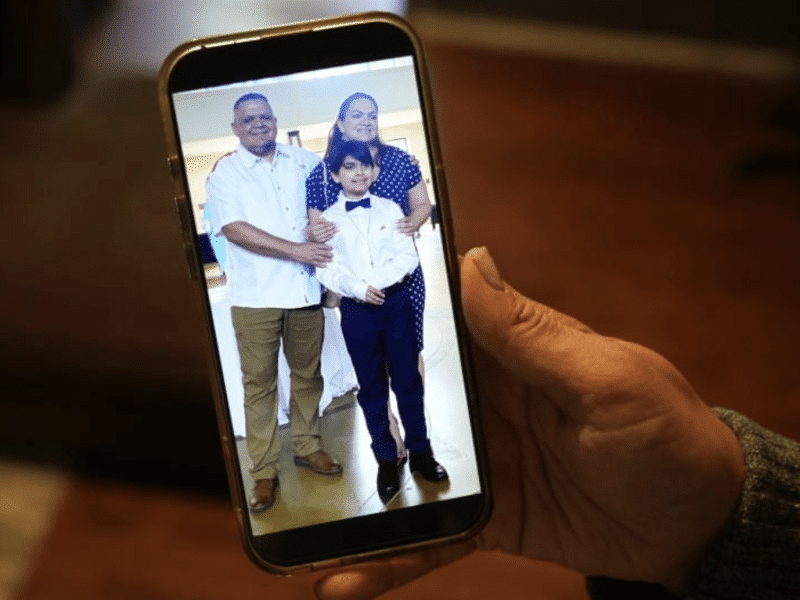
Nicole showed 285 South a photo of one of the vehicles driven by officers who showed up at her house to arrest her husband. Meredyth Yoon, the litigation director for the nonprofit Asian Americans Advancing Justice–Atlanta, who is connecting Nicole to lawyers in her organization who can help with David’s case, described seeing a video recorded by one family member showing moments before David was arrested. In the video, two officers are standing outside of the family’s home. Moments later, David is seen leaving the house, hugging his family and saying goodbye, and being escorted by the officers to the curb where he was arrested. Meredyth could see from the footage that the monitor was still attached to David’s ankle and that he peacefully allowed officers to handcuff him.
For years, immigrant rights groups have complained about deceptive tactics that ICE uses to draw people into public, or gain entry into their homes, and then arrest them. Earlier this month in Louisiana, a federal judge ordered the release of an Iranian doctoral student whom ICE had detained, along with his wife, after agents had allegedly shown up to their house with state police who said they were following up on a hit-and-run report the couple had recently filed. Once the pair emerged, they were taken into custody and transferred to ICE detention.
“ICE’s behavior is really egregious,” said Meredyth. “They clearly put on this [ruse] just for the purpose of deceiving [David] and his family, so that he would step outside the home, so that they could arrest him, despite the fact that he is reporting faithfully. He’s just being ripped apart from his family under these terrible circumstances.”
Self-deportation app was a farce, the family says
Speaking from her home in Augusta, Nicole said she feels like the self-deportation app was a trick to arrest more immigrants. “It is very important for the public to know that that whole self-deportation system was a farce,” she said. “That was a device used to gain knowledge of people’s addresses, get information so they can grab them and just throw them in detainment.”
Though ICE’s website says that people using the self-deportation app will be “deprioritized,” there’s nothing that actually prohibits ICE from targeting them, said Stephen Yale-Loehr, a retired professor of immigration law at Cornell University who is not involved with David’s case. At the same time, he added, ICE’s highest priority under any presidential administration is people with criminal records and people, like David, with final deportation orders.
“It seems that ICE is working at cross-purposes with itself,” he said. “Because, on the one hand, they are encouraging people to self-deport, and their website says that if you do self-deport, you are a lower priority for being picked up. But on the other hand, here we have an instance where ICE did arrest and detain someone who had applied for self-deportation. So it’s like the immigrants can’t win no matter what they do.”
After being arrested at home in Augusta, David was transferred to an ICE facility in Atlanta, where Nicole reported that he was “in a box with 43 people” and wasn’t receiving enough food: “One meal, which is a sandwich and a bottle of water a day, one toilet with no door in the midst of 43 people in a room.” More people arrived daily, she added.
285 South also asked Atlanta’s ICE field office to comment on these claims, as well as to Georgia Senators Warnock and Ossof for comment on David’s case, but as of publication, had not received a response.
After four days at the ICE facility, David was moved to a federal penitentiary in Atlanta where ICE has begun transferring detainees, following an agreement the agency entered earlier this year with the Federal Bureau of Prisons; according to media reports, detainees at FCI Atlanta have been having a difficult time accessing legal counsel or communicating with the outside world, and face conditions that Sen. Jon Ossoff has described as “abusive and inhumane.” After David was sent there, Nicole spent an entire morning trying to send money to his commissary account so that he could make phone calls. But his inmate ID was never activated because, after two days at FCI Atlanta, David was transferred to Stewart Detention Center, an ICE facility operated by a private prison contractor in Lumpkin.
Neither of them knows what happens next. “Why is he there in such excruciating and inhumane circumstances, when he was on a monitoring device, they could have left him at our home, until they executed a date, as it stated on the self-deportation website?” Nicole said. “That’s what we signed. That’s what we expected.”
Author

Related Articles
After her brother’s death in ICE custody, a Georgia woman is left with unanswered questions, the logistics of his burial—and deep grief
On July 13, Jesus Manuel Arenas-Silva became the 22nd person this year to die in ICE custody. Advocates say the government isn’t providing the medical care detainees need.


Leaked reports show surge in use of force in Georgia immigration detention centers
Use of force surged 63% at two Georgia immigration detention centers