
Press-freedom advocates sound the alarm over Yaacub Vijandre, stuck for nearly two months in ICE custody in Georgia
The Filipino photographer and activist, who’d documented pro-Palestine rallies in Texas, was a DACA recipient. The government informed him of its decision to revoke his status two weeks before arresting him.
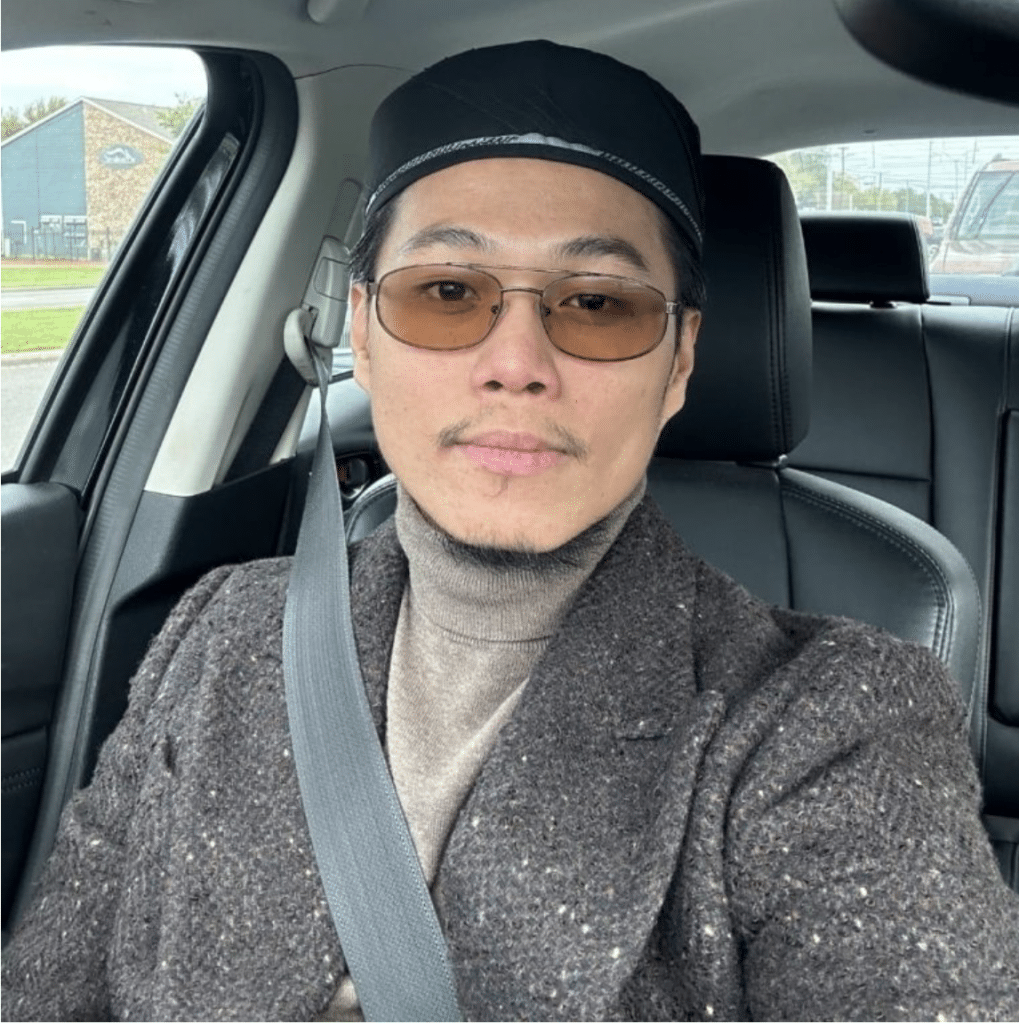
In late November, Jan left her home in Denver to travel to Dallas—where she found herself cleaning out her cousin Yaacub’s fridge. It had been more than six weeks he’d been to his apartment, and the place needed tending to.
It was a holiday weekend, but “we’re not even celebrating,” Jan said. Instead, she was “cleaning things up since it has been close to a month and a half that he’s been gone.”
Yaacub Vijandre, who is 38, was arrested by Immigration and Customs Enforcement (ICE) agents in early October. Confined initially to a facility in central Texas, he was transferred on October 25 to Folkston ICE Processing Center in South Georgia—where he’s been ever since, facing deportation to the Philippines, a country he left as a child 24 years ago.
“I found myself a bit shell-shocked about this whole situation,” said Jan, who asked for her real name to be shared out of concerns for family’s security. She grew up with Yaacub, and would often see him during yearly family Thanksgiving gatherings. Now, she’s the primary person in the family navigating care for Yaacub since his immediate family lives in the Phillipines. On any given day she might be checking in with him on the phone, sending him commissary money, or coordinating with his legal team.
Yaacub is a recipient of Deferred Action for Childhood Arrivals (DACA), a legal protection from deportation provided to many children of undocumented residents—and a status he thought wouldn’t be up for renewal until May 2026. A photographer and activist, Yaacub regularly took photos at local pro-Palestine protests and actions in the Dallas area, and posted them on his social media accounts, as well as posted Gaza aid appeals, and faith inspired personal calls to action. He also taught Filipino martial arts, said Jan, and posted some videos of martial arts techniques as well.
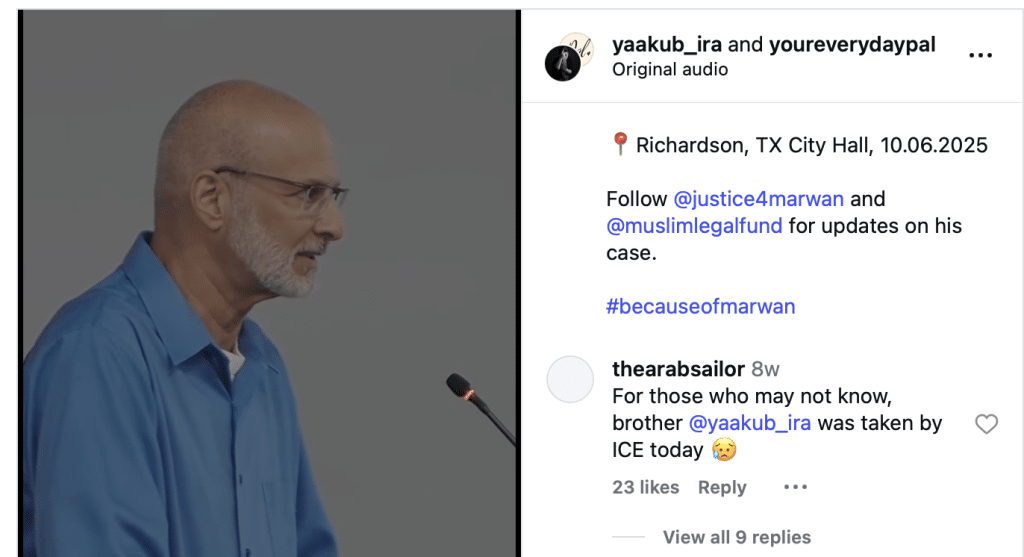
It was on one of those social media accounts that Jan said she found out about her cousin’s detention. “So I am on my Instagram feed, and I come across one of his videos he had posted the night before.”
It was of a town hall Yaacub had filmed of local residents advocating for Marwan Marouf, a Muslim community leader in North Texas who was detained after federal authorities accused him of links to alleged terror groups. (He’s since been ordered deported.)
As she scrolled through the Instagram comments, one caught her eye. “There was someone that had said that [Yaacub] was taken that day,” said Jan. I” was shocked. I was trying to figure out, you know, how else I could get more information.” Since then, she said, “this detention has thrown our family in a whirlwind.”
On September 22 of this year, Yaacub had received a notice from the Department of Homeland Security declaring its intent to terminate his DACA status, citing his social media posts as the reason: “Your support for organizations and individuals who are known to engage in acts of terrorism presents public safety, national security concerns, and is a significant negative discretionary factor under the totality of the circumstances analysis.” Two weeks later, ICE agents showed up at his apartment and arrested him.
Yaacub’s lawyers argue he’s being targeted for his criticism of U.S. foreign policy, and criticism of Israel. “The First Amendment protects the speech mentioned by DHS in its statements,” reads a statement from Yaacub’s legal team. “He makes no apology for expressing his deeply felt opposition to the genocide and to the US government’s inhumane and illegal treatment of those it accuses of terrorism, including at black site torture centers like Guantanamo Bay.”
285 South has reached out multiple times to ICE, which is under DHS, for comment on Yaacub’s case, but the agency has not provided a response.
Yaacub’s legal team—which includes local lawyers with Asian Americans Advancing Justice–Atlanta, along with the Muslim Legal Defense Fund—filed a habeas petition for his release in late October, and then an amended petition in November, after they said a judge weaponized Yaacub’s political speech at a bond hearing. The government filed a motion to dismiss, and on Monday, his legal team was filing their opposition to that motion.
Civil rights groups and press-freedom advocates say his arrest and detention is part of a larger pattern, similar to that of Mahmoud Khalil, Rümeysa Öztürk, and Sami Hamdi. “Yaa’kub Ira Vijandre’s arrest is another example of pro-Palestine advocates being targeted by ICE,” said a representative of CAIR Georgia.
Though Yaacub’s case isn’t that different from Khalil’s or Öztürk’s, it isn’t getting the same level of public attention, said Seth Stern, the director of advocacy at the Freedom of the Press Foundation. “The American public has to an extent been conditioned to accept this as normal—every so often the administration is going to abduct some lawful resident who said something it doesn’t like about Israel or Palestine,” Stern said, calling it “a very concerning development because the only way this will stop is if the public won’t tolerate it.”
Nora Benavidez, a member of the board of the Georgia First Amendment Foundation, said she’s hoping people beyond just press freedom advocates step up: “we are in desperate need of local support across civil rights communities…our collective freedoms hang in the balance.”
Earlier this year, the foundation raised the alarm around the case of Spanish-language journalist Mario Guevara, who was arrested while covering a Stop ICE protest in the Atlanta area in June. Mario was transferred to ICE custody in Folkston, where Yaacub is now, before being finally deported back to his native El Salvador in October.
In both cases, Nora said, the journalists were “most acutely targeted because they are immigrants” and because, she said, “they are seeking to expose and report on and share with communities what is happening.” That puts a target on their backs: “The twin dynamics are creating a real, vulnerable, fragile set of individuals who are test subjects for the government’s efforts to undermine free speech more broadly,” Nora said.
Another vulnerability, said Samantha Hamilton, a lawyer with Asian Americans Advancing Justice–Atlanta (who also is a legal consultant for this publication) is that ”freelance journalists are traditionally in a lot more precarious positions than people who work at larger news outlets,” lacking the institutional power of better-resourced legacy media organizations.
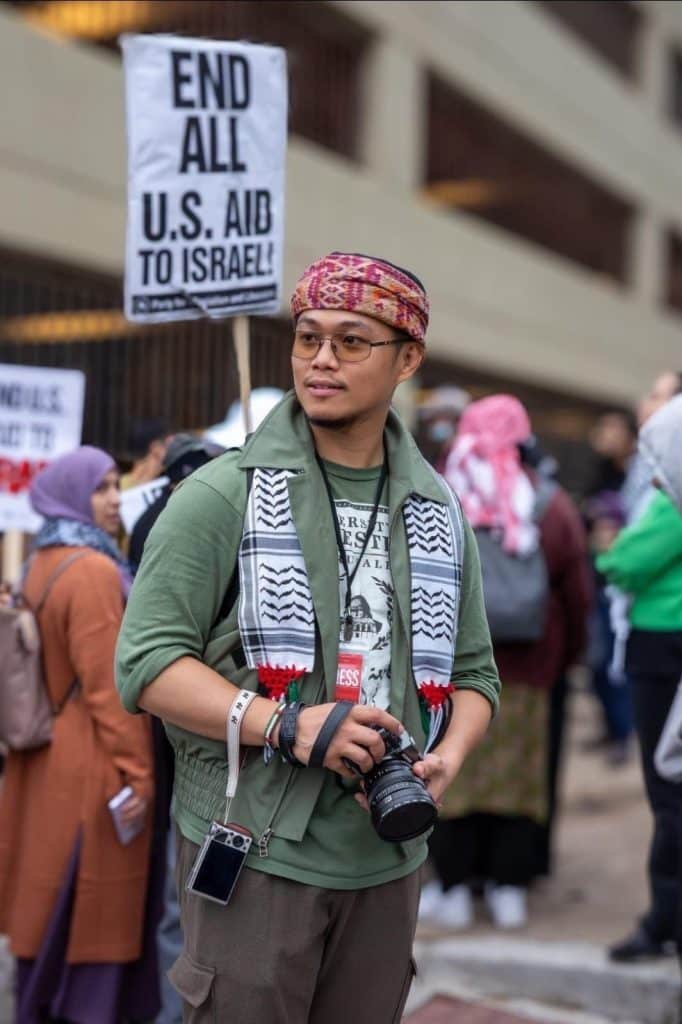
In the Atlanta area, some residents have been working to spread awareness of Yaacub’s case.
Noor, an organizer with Atlanta4Palestine, working alongside the Free Yaacub Campaign, says the grassroots group is encouraging folks to help with his family’s legal expenses, urging community members to sign a petition demanding congressional action, and plans to go “door-to-door to masjids and bring up awareness that our fellow brother is detained over being a good human and being for Palestine, and he is our responsibility.” Adding that, “even if he’s not from Atlanta, he’s still one of our own.”
Jan said she speaks to Yaacub almost every day. “He doesn’t want to be in there, but his spirit is definitely not shaken,” she said. “He encourages me to tell that to people.” He hasn’t had a ton of visitors, she said, given how far Folkston is from Dallas, where he lives, but some community members from Georgia and Florida have visited him.
“A lot of those people have been reaching out to me more recently, saying they want to support because of the impact he’s had on them, are like, Yeah, I knew him, I saw him in various things. And the fact that he’s advocating for these causes, I want to make sure that I’m doing my part to advocate for him too.”
Yaacub’s parents, said Jan, “and the aunts and uncles of that generation, are saying they will continue to pray.”
Author

Related Articles
A Rohingya man in New York died under mysterious circumstances— his relatives in Georgia are grappling with the loss
Federal immigration officers left Nurul Amin Shah Alam outside a closed coffee shop in harsh winter weather— days later he was found dead. He was getting ready to move to Georgia, says his niece in Stone Mountain.
“Our family was destroyed. We’re piecing it back together,” says Adalina, whose husband was deported to Peru
After months apart, a metro Atlanta resident decides to leave the U.S., apply for Peruvian citizenship and join her husband in Peru—at least until a new administration takes office. As she prepares to leave the U.S., she is finding support in her Atlanta friends and community.

“I love this country (…) and I just ask to be treated fairly,” says Rodney Taylor from Stewart Detention Center where he is facing deportation
Gwinnett county resident and double amputee issued travel documents signaling imminent removal to Liberia, as his health continues to deteriorate.