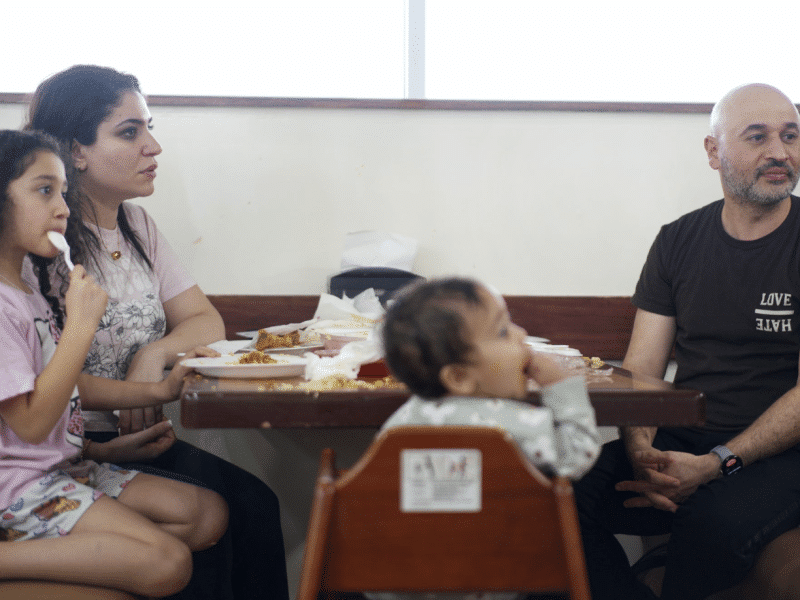
A Greener Ramadan? How Atlanta-area masjids are cutting food waste during the Muslim holy month
At some places of worship, hundreds of people attend the evening breaking of the fast—which means a lot of discarded food and plastic water bottles. This year, more than a dozen sites of worship are planning “zero-waste” iftars to tackle the problem.

One evening in early March, Nina Ansari frowns as she picks up an untouched plate of rice left on the floor of the masjid she attends near her home in Stone Mountain. “Would anyone like to take this?” she asks a group of women standing nearby. When no one responds, she picks it up. Her hands are already full of the pizza and curry leftovers that her kids didn’t finish. If she doesn’t take the rice home, it will be thrown out. “There’s a lot of waste that happens during Ramadan,” says Nina, 38, who grew up in Georgia.
During the Muslim holy month—a time of spiritual rejuvenation through increased prayer and daylight fasting—masjids may serve hundreds of visitors for iftar, the sunset meal that marks the breaking of the fast. Some also serve a meal in the predawn hours, suhoor, before congregants start their fast.
That all can add up to a lot of trash, though. At mosques in Atlanta and elsewhere, it’s not uncommon to find garbage cans packed to the top by the end of the night, with some plates and plastic water bottles still half full.
“It’s just not acceptable for us,” says Nina. “My family is conscious of water and food conservation. We eat leftovers—we are not wasting or being snooty about wasting.”
She’s not the only one concerned about the problem. This year, more than a dozen Atlanta-area masjids or Islamic groups are planning environmentally friendly “zero-waste iftars,” aiming to cut down on the amount of discarded food, disposable plates, and water bottles. Food waste is a global and national dilemma—in the U.S., almost 40 percent of the food supply ends up in the landfill. But the trash generated during the holy month directly conflicts with a religious mandate to not be wasteful, says Marium Masud, who attends Marietta’s Masjid Al Furqan West Cobb Islamic Center: “We are called to be stewards of the Earth. There is a saying from the Prophet Muhammad that all of the Earth is a masjid. So it’s up to us to keep it clean, just like we keep our masjids clean.”
Marium is part of a “green team” of 17 volunteers that Al Furqan established to help tackle the problem. This past year, Al Furqan’s green team focused on one thing: banning plastic water bottles. In the past, the masjid threw away nearly 300 plastic bottles every night—but this year, hardly any. To prepare for Ramadan, the team added water filling stations, brought in reusable five-gallon water bottles, and had their Cub Scout packs sell recycled aluminum bottles to community members for $10 each. They also accepted donations to give out water bottles for free to anyone who couldn’t afford them.
On March 19, Al Furqan—where between 200 and 250 people come for iftars each weekday night—will host its first “zero-waste iftar” in partnership with Georgia Interfaith Power and Light, a nonprofit that works with religious groups on environmental justice. The organization provides training, workshops, and grants for reusable or compostable plates and cutlery. At the end of the iftar dinner, GIPL also covers the cost of sending the excess to the Atlanta nonprofit CHaRM, which composts food waste and processes hard-to-recycle items.
Al Furqan’s zero-waste iftar is just one of 24 zero-waste iftars planned across Atlanta-area Islamic centers this Ramadan. At least 15 now have dedicated green teams. That’s a big increase from 2023, when there was only one masjid with a GIPL certified green team: Roswell Community Masjid (RCM). RCM, which hosts weekly zero-waste iftar dinners every Saturday, signed a contract with Atlanta-based Goodr in mid-January to handle its composting and provide food waste recovery services year-round.
Monitoring trash at Masjid Fatimah: “I see you!”
At Masjid Fatimah in Stone Mountain, Mohammed Ata Ur Rasheed helps direct trash traffic during Ramadan. He sits in a folding chair for hours each night telling male congregants where to put the recycling, trash, and compost. About 150 people attend their iftar dinners each night.
“People waste so much food. There are half-eaten plates. Sometimes the entire plate. And because they don’t want me to see what they’re throwing away, they take another plate to cover it,” Dr. Rasheed says. “I see you! Sometimes I tell them, when you’re grabbing food, get a smaller portion. The food is there. I collected a lot of bread the past two days because people didn’t like it and were trying to throw it away.” (Some local masjids like Masjid Fatimah are working to reduce food waste by having volunteers portion out plates before handing them out to attendees—who tend to pile food on their own plates after fasting all day long.)
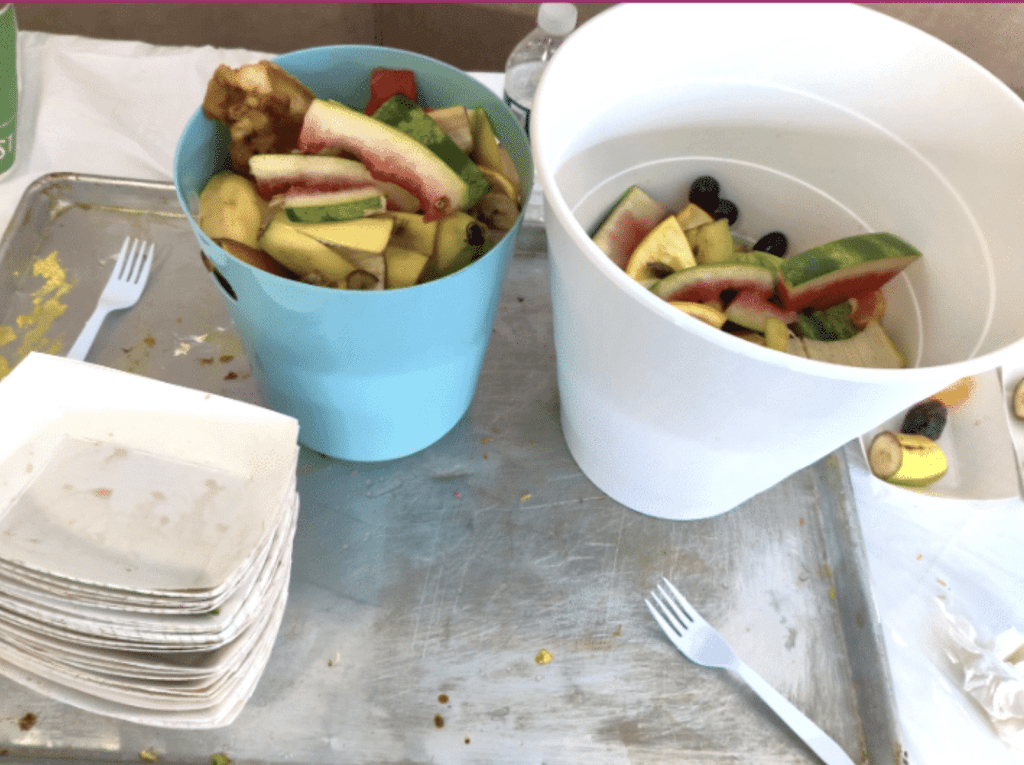
Reducing waste isn’t just aligned with religious principles —there’s also a financial incentive. Dr. Rasheed estimates that his masjid has saved nearly $1,000 so far because it has not needed to call the trash company to pick up excess trash: Instead of five bags every night, there is now only one.
Masjid Fatimah still provides congregants with plastic water bottles. But this year, it’s cutting down on the volume of its recycling by placing permanent markers with instructions on neon-green poster boards near the free bottles. “I put up a message and every day I remind people: Label your bottle, put your initial,” says Rasheed, calling this his personal pilot project. When they’re done drinking, he reminds people to remove the caps from their bottles and crush them so they’ll take up less space in the trash.
At the end of the night, he sorts through the compost bin and trash to bring home what he can to add to his compost pile and feed his four chickens and red wiggler worms. Dr. Rasheed, who grew up gardening in Hyderabad, India, spends two hours a day working with his beehives and tending to his backyard permaculture setup after he returns home from his job as a biologist at the CDC; his garden provides hundreds of pounds of produce each year for his family of four. At the masjid, he shows other gardeners how to use the pizza boxes left over from Ramadan iftars to create easy garden plots and reduce time spent pulling weeds. He says more congregants are following his example and bringing scraps home to feed their backyard chickens, as well.

‘Khalifas’ of the Earth aka Green Teams
Ayesha Abid is the program coordinator for Georgia Interfaith Power and Light. Informally, she calls herself the Muslim organizer for the nonprofit, and has been working to increase the number of Muslim organizations embracing recycling and reducing energy use and waste since she joined in 2023. “It’s hard to say for sure, since we are in the Bible Belt and we have more churches, but we have about 150 green teams [statewide],” Ayesha says, explaining that it includes teams across all religious houses of worship. “If there are about 100 masjids and 15 have green teams, I don’t think that’s a bad representation.”
Atlanta Masjid of Al-Islam in East Atlanta is composting for the first time this year, and received a grant from GIPL for its zero-waste iftar. The masjid, which opened in 1958, is the largest and oldest Islamic community center in metro Atlanta.
“It isn’t that expensive to do composting,” Ayesha says. “What’s expensive is manpower or volunteers. The biggest thing I was hearing was ‘I don’t have volunteers to take it to CHaRM.’ There was a woman at [Atlanta Masjid of Al-Islam] who just took six to eight bags of compost/recyclable waste in her van. You need community members willing to step up to do that. I think the women in the community are uplifting this the most.”
Ayesha says East Cobb Islamic Center, Al Furqan West Cobb Islamic Center, and Roswell Community Masjid have all called to eliminate single-use plastic bottles and encourage people to bring their own tupperware to take home food so it isn’t thrown out.
“I grew up in Georgia and going to masjids, my most significant memory of Ramadan is seeing aunties forget which water bottle is theirs and getting a new one and letting entire bottles of water go to waste,” Ayesha says. “Volunteers are tired after fasting all day and don’t have energy to empty it into gardens. Muslims are supposed to be ‘khalifas’ [stewards] of the Earth, especially during Ramadan, and I could never make sense of the waste. This disconnect has always stood out to me. A lot of people question it but don’t care about it. But we’re working to fix that.”

Masjids/Islamically-aligned institutions participating in green Ramadan initiatives through GIPL:
*This list was updated on March 3, 2026.*
- Anhar Institute (The Hub)
- East Cobb Islamic Center
- Emory Muslim Student Association & Emory Interfaith Center
- Georgia Tech Muslim Student Association
- Roswell Community Masjid
- Atlanta Masjid of Al-Islam
- Ilm Academy
- Intercity Muslim Action Network
- Masjid Jafar (John’s Creek)
- Masjid Al Momineen
- Mohammad Schools in Atlanta
- MTO Shahmaghsoudi
- One Ummah
- Al Furqan West Cobb Islamic Center
- Atlanta Unity Mosque
- Islamic Community Center of Atlanta
- Muslimahs Endure
- Morehouse College Muslim Student Association
- Spelman College Muslim Student Association
- Souljas ATL
- Wellstar (Interfaith Iftar)
- Islamic Society of Augusta
Author

Related Articles
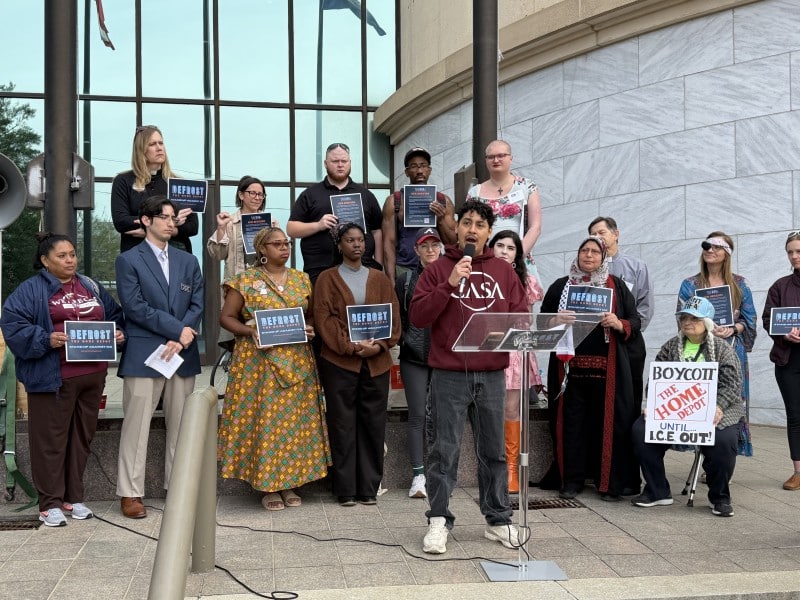
Atlanta advocates demand: “Get ICE out of Home Depot now”
As popular spots for immigrant day laborers to find work, Home Depot locations across the country have been repeated targets of ICE raids. Now advocates are pressuring the Atlanta-based company—an official sponsor of the upcoming World Cup—to take a stand.

Woman who assisted in federal abuse investigation, arrested at Atlanta airport and deported days later
“A slap in the face,” her attorney says describing her client’s situation, who had a pending U-visa application