“Everyday of my life I need Veronica’s help.”
How one Burmese resident of Metro Atlanta is lifting up her community and hopes to widen that support through a new nonprofit.
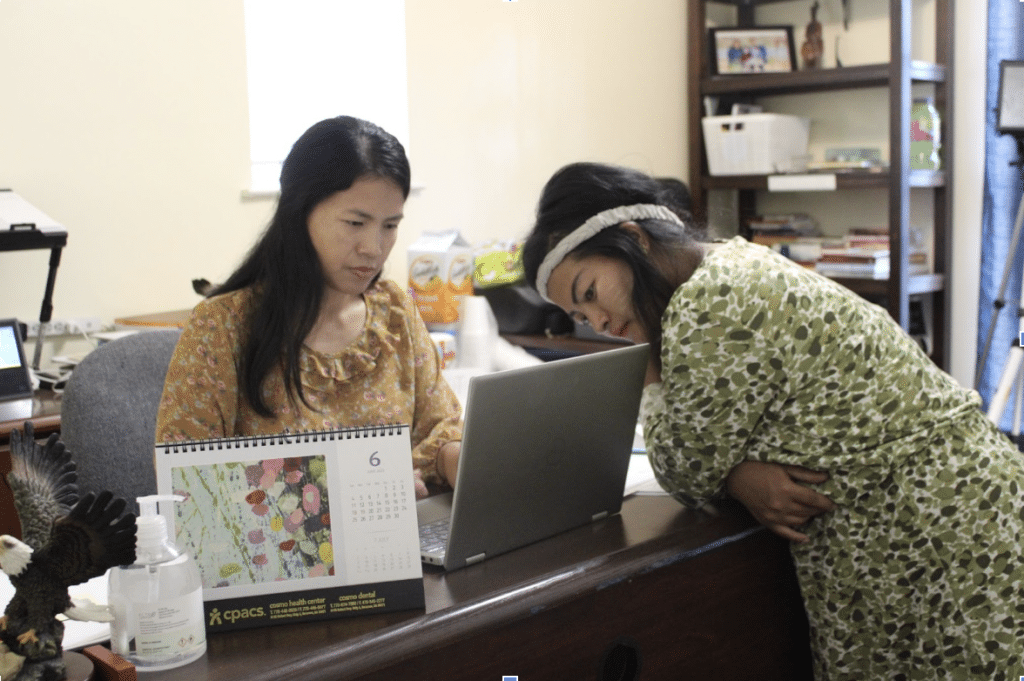
In the back room of an apartment complex off North Indian Creek Road in Clarkston, Veronica Thang sits down at a desk. She’s helping a fellow member of the Burmese community, Mary Maan, file an immigration petition to bring her brother to the U.S. They speak quickly in Burmese, as Veronica types. But every few seconds they are stuck by the most common of online snags – they’ve forgotten the online password. This continues for several frustrating minutes before they’re able to move on.
“Everyday of my life I need Veronica’s help,” says Mary. She regularly comes to Veronica for help reading her mail and for assistance with accessing SNAP (food stamps).
She’s not the only one. On a Friday afternoon in June, over a half dozen people sit patiently in the living room of the apartment waiting for Veronica’s to help with everything from applying for food stamps to Medicaid renewals. “Every service that they need in our community, they come to me,” says Veronica.
Veronica had worked for almost 10 years at the Center for Pan Asian Community Services – helping refugees. But after an investigation into the organization led to funding shortages, she along with dozens of other staffers were laid off.
She may have lost her salary, and her office, but she still had people who needed her.
“People from the community have my phone number…they keep calling me, they need help.”
So every Thursday and Friday she drives from her home in Lawrenceville to the apartment in Clarkson, courtesy of her church pastor who uses it as his regular office and a space for ESL and citizenship classes. Often, community members who speak Karen or Rohingya, languages spoken by Burmese minority groups, will help with interpretation. On the other days, Veronica handles as many requests as she can over the phone.
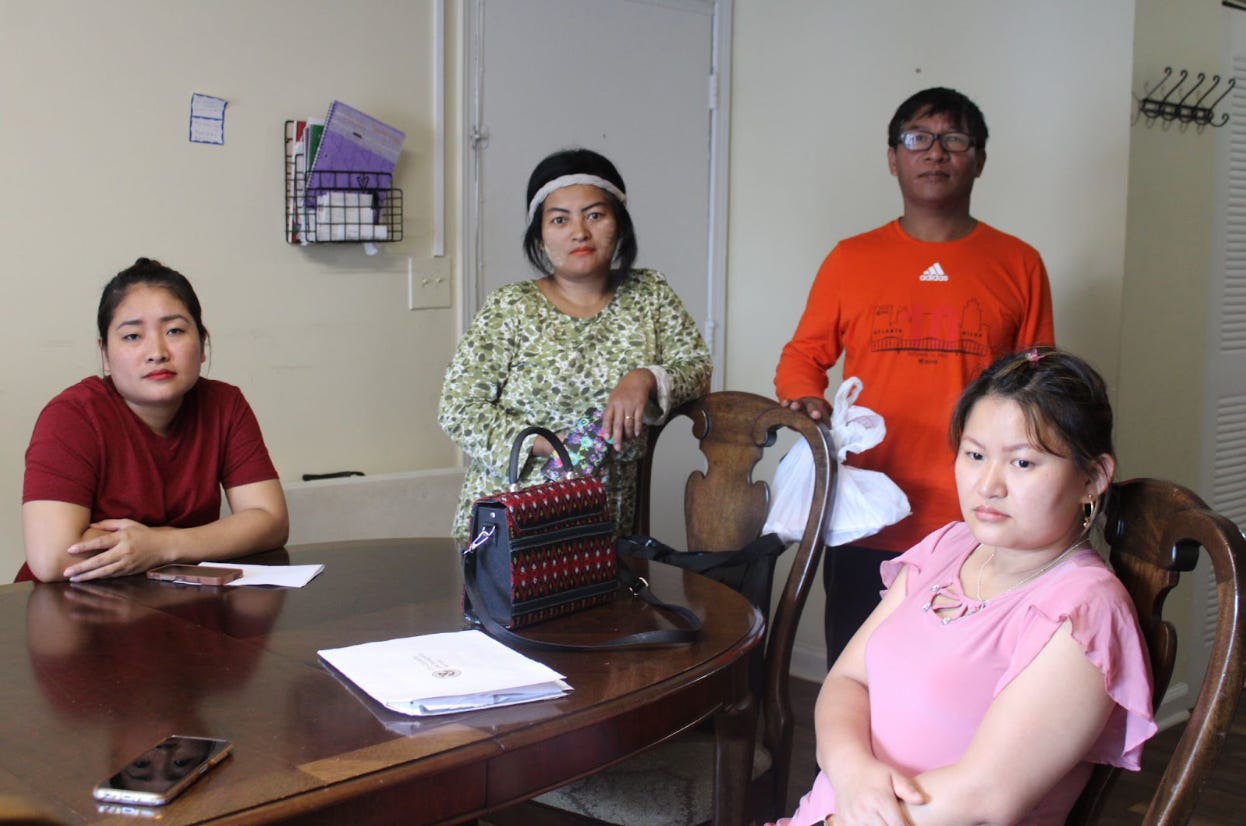
Approximately 6,000 Burmese have come to Georgia as refugees over the last two decades, originating from diverse minority communities (Karen, Chin, Rohingya) that have been targeted for decades by the military-ruled government in Burma. Georgia ranks fifth in the country in the number of Burmese refugees taken in. Many settle first in Clarkston and later move to surrounding cities like Tucker and Stone Mountain.
Many of them immediately start work at poultry farms or retail warehouses. That makes finding the time to learn English, make necessary phone calls or fill out online forms to access support and government relief, nearly impossible.
In 2022, when it became clear she wouldn’t have her job at CPACS for much longer, Veronica filed paperwork to register a new organization – Home of Helping Hand – as a nonprofit. The goal, she says, is to create a wider foundation of support for the Burmese community.
I spoke to her about what motivates her to do what she does, and what her hopes are for Home of Helping Hand. The interview has been condensed and edited for clarity.
Tell me about yourself.
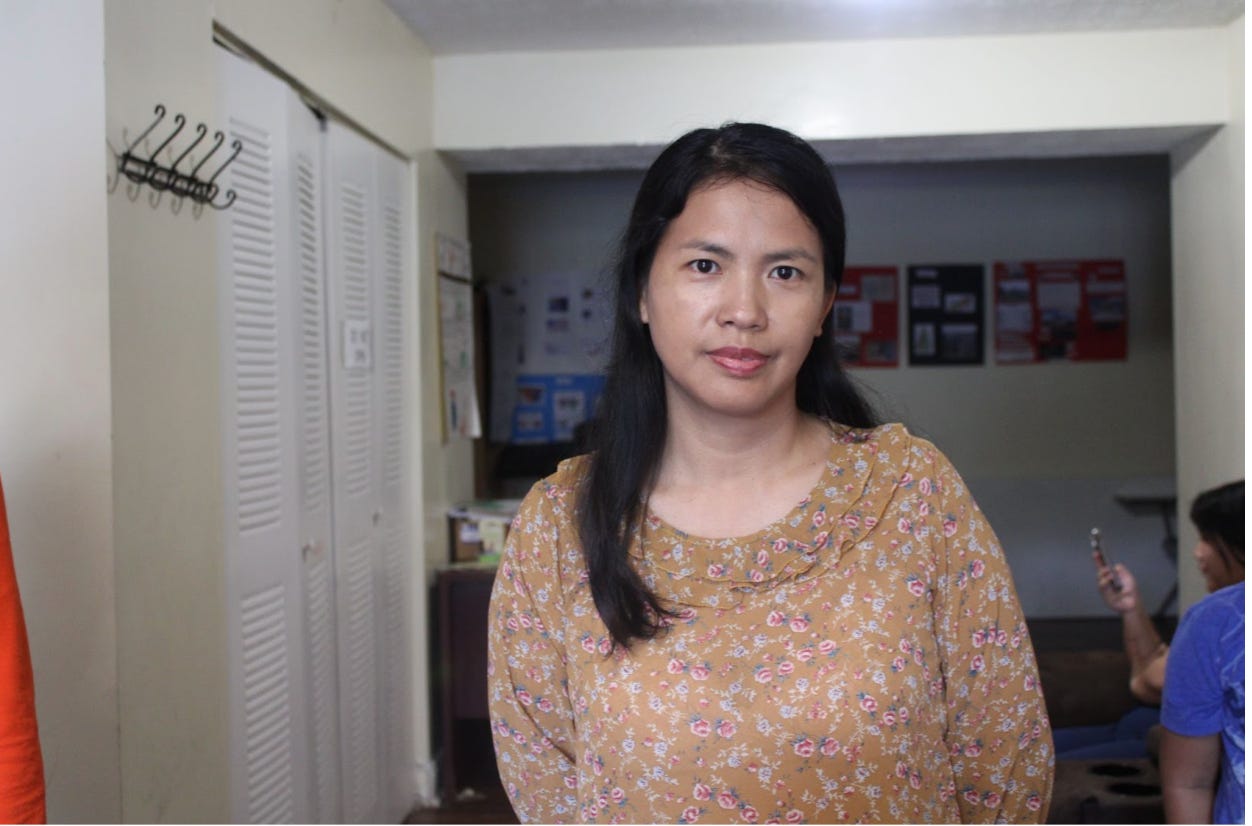
I am a Burmese refugee. I came here in 2010 with my family.
The reason I’m here today is to serve my community. I was a social worker since 2014 all the way to 2023. I’ve been serving the community with ongoing services like food stamps, Medicaid, every public benefit that our community needs. In 2023, I stopped working at the organization. January 10th was the last time I worked at CPACS. So even though I’m no longer with CPACS, people have my phone number, my contact information, [and] they keep calling me. They need help. So I decided to look for a space. First I rented on Memorial Drive, but it was a little difficult to pay a monthly rental fee by myself. Then I talked to our church pastor, and then I am here. So I keep serving community people with public benefits [and] employment. Even domestic violence cases. I think every service that they need in our community, they come to me.
What do you think are some of the biggest challenges for the Burmese community in Metro Atlanta?
ESL class might help to communicate. Let’s say if somebody [doesn’t] come to me, they need to go to DFACS [Georgia Division of Family and Children Services) directly. You don’t get an interpreter all the time. So at least you need to know greetings in English, and what you want to do, what you need help with, right? So if we can have ESL class, very, very basic English class, that [is] really helpful for our community. And then even though we have ESL class, the online application is still too hard for them…. If they have space, if they have somebody to go see, to go see and tell them their problem to meet and talk about what they want to do, that is really helpful.
What is the best part of living here?
The best part is our kids can go to school. That we never…dreamed of in our life. The school system here is very good. That is the best thing for our community. And then health. You have many ways to see doctors and go to a hospital because in Burma, we don’t even have a doctor…And then government public assistance, those benefits. Those are the important things that we never had in our life. In Burma, we don’t have that assistance. Even going to school, you pay by yourself. If you cannot pay for your kid, your kid is staying home. Those are the benefits and the good things. I will say we are lucky here. We are very lucky because of those benefits.
And what’s the hardest part about life here for people in the Burmese community?
The hardest part is newly arriving [here]. Getting jobs, transportation issues, solving transportation issues. We pass[ed] all those difficulties.
Lately, the thing we need most is community education. For middle aged people, like my age and seniors, we really need that. English language and even transportation. Most of the women don’t drive. But again, compared with the time that we arrived, we developed a lot. But still, those are the needs that I see in the in Burmese community.
What are the challenges to building up your organization, Home of Helping Hand?
We don’t have that many connections. We work with a team. But that team, everybody needs income. When I was at CPACS, I had my own income. So we work for community, we volunteer, we have stipends for our transportation. But once we merge into a nonprofit, and I’m no longer with CPACS, it’s hard to work together like before because everybody needs income. So it’s hard for me to pay from my pocket, right? I myself don’t even have any income. It is very difficult to work together and build up again like before. So we are trying to look for available funding.
So far we connect[ed] with DHS [Department of Human Services]. They said maybe next fiscal year, they may allow us to apply. We don’t know if they’re gonna approve or not, but they might allow us to apply. So that’s one hope. Then, if they let us apply and approve, then at least we can rent our own space.
What sort of services will Home of Helping Hand provide for the community?
Social services including food stamps, medicare applications, job applications, legal assistance, citizenship applications, green card renewals. When families receive bills from the hospital, help with calling the hospital and requesting a discount or assistance. And then voter engagement.
What is your dream for your community and for yourself?
Oh my God (laughs). My dream…
I want to build this organization. So whenever Burmese community is faced with any problem – language barrier, transportation, health, civic engagement – anything that they need, I want them to have in their mindset, oh, we can go there. There is somebody who can help us. So then they wouldn’t worry anymore. Sometimes I heard from my clients saying, Oh, my God, you’re here. I think they thank me because when they receive one envelope from their mailbox…they bring it here and they let me read and I say, oh you don’t have to worry, just put it in the trash can. For them, even those commercial letters or whatever they see they get worried.
I want to build this organization as much as we can. Of course only one person cannot do everything. We need a bigger team. If we have enough people to serve the community, Burmese community will be very happy and myself too. Yeah, that is my biggest dream.
Is there anything else you’d like to share?
I was raised by a single mom, so I didn’t grow up with my father. My mom raised me and my sister. My mother didn’t go to school. When I left my mother, our country, we talked over the phone. And until she passed away – she passed away in 2016 with lung cancer – she always told me to serve community. Especially people like her. She always said, my daughter, whatever you do, whenever you do your work, whenever you talk to people, especially to uneducated people, be patient. Serve them as much as you can. Like you talk to me, like you helped me, like you take care of me, treat everybody like me. She always mentioned that. My mom’s words are always in my head. So I am happy with what I’m doing. I will do as much as I can. I will serve as much as I can for our community. That is my dream.
To connect with Home of Helping Hand and offer support, visit the Facebook page here.
###
Author

Related Articles
“They’re free to be kids here”
On a makeshift soccer pitch in a Decatur gym, middle schoolers from countries including Afghanistan, Congo, and Sudan speak a shared language (with a little trash talk mixed in).
Spring has sprung—and for one Burundian farmer, that means it’s time to get back to the garden
This year, gardeners from the nonprofit Global Growers Network are combating food insecurity by harvesting produce for local food banks.
Andres Carrillo, founder of the pop-up Cocina Pachuco, is using his cuisine to fundraise for immigrants in detention
Born and raised in El Paso, the recently arrived chef is strengthening ties with his new home. One way he’s doing that: supporting the state’s immigrant communities.
Comments (0)
There are no comments on this article.