Medical licensing, HIV prevention, and ICE enforcement: Here are the bills affecting immigrants that passed—or failed—during Georgia’s legislative session
Advocates from Muslim, Latino, and Asian American advocacy organizations help 285 South take stock of this year’s meeting of the Georgia General Assembly.
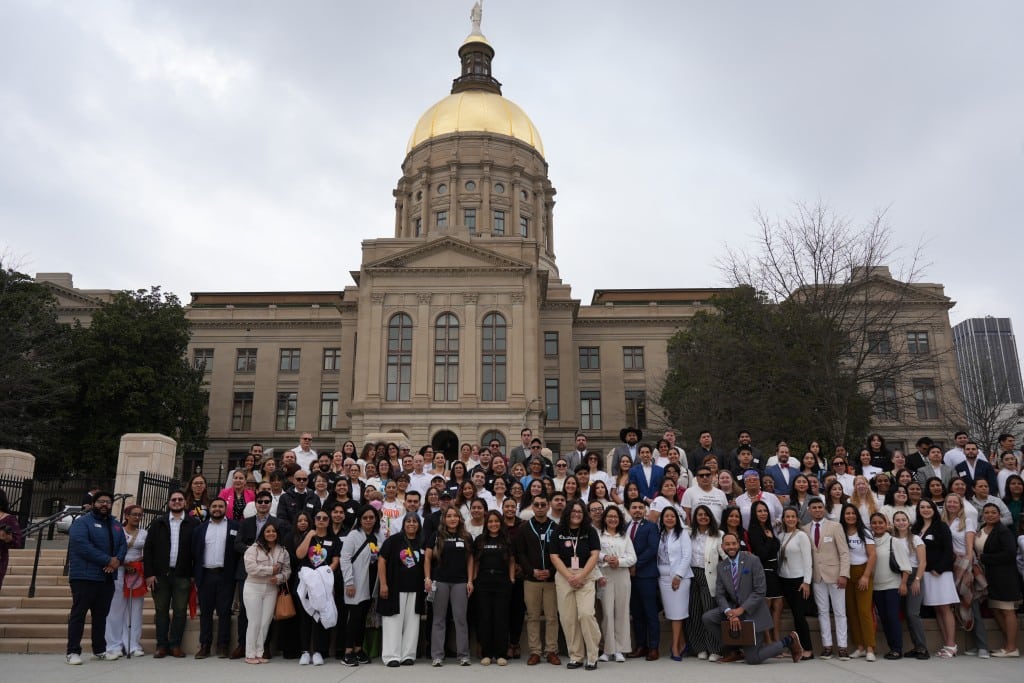
When the Georgia legislature first gathered in January for its annual session, advocates expressed anxiety about what was to come—the beginning of the session coincided with the Trump administration’s harsh crackdown on immigrant communities nationwide, and local advocates worried that politicians in Georgia would continue to pursue measures that targeted immigrants, free speech, DEI programs, and the rights of Muslims and other religious and racial minorities.
But this year, observers saw a shift in the legislature’s priorities, said Jennifer Lee, policy director for Asian Americans Advancing Justice–Atlanta.
“We still have work to do to pass bills that are supportive or helpful to immigrant communities,” she said. “But the fact that at least some of these bills were not high-priority enough, or didn’t have enough steam to pass, gives me a little hope.”
Advocates were also heartened by what did end up on the House and Senate floors, she said: “We were happy to see more pro-immigrant bills introduced this year just because that hasn’t been the case in the past.”
For Azka Mahmood, executive director of the Georgia chapter of the Council on American-Islamic Relations (CAIR-Georgia), the legislative session was a difficult but successful one. One of the bright spots – just how engaged people were. She told 285 South that Muslim Advocacy Day had the highest turnout it’s ever had, and Muslim and allied communities sent over 25,000 emails to Georgia legislators to oppose harmful bills.
CAIR-GA was able to block or amend most of the bills it focused on, she said, relating largely to religious freedom and First Amendment rights. At the same time, “it’s very depressing to be a minority, or a progressive organization, or a civil rights organization in the state, because we see that there are so many attacks on immigrants on education, healthcare, and our environment that that did succeed.”
Jean-Luc Rivera, deputy executive director of the Latino Community Fund, echoed her remarks: “We still saw a lot of anti-immigrant sentiment within the legislature this year,” he said. “It reminds you that there are people out there who still are not fond of immigrants, and that’s saddening and unfortunate.” Still, he said, “I’m glad that we were able to rally together as a coalition to do as much harm mitigation as possible to protect our community.”
Jennifer, Jean-Luc, and Azka took us through the bills impacting immigrant communities that did—and didn’t—make it past the finish line during this year’s session. The measures that did pass now go to Gov. Brian Kemp’s desk for final approval.
Bills that passed—and await the governor’s signature
Senate Bill 427 would make it easier for foreign-trained doctors to obtain a license and practice medicine in the U.S. if they meet certain requirements, including being legally present in this country.
Advocates celebrated the passage of the law, which aims to address a shortage of physicians in rural areas of the state. “It’s good for Georgia and all the people who are struggling with access to healthcare, and it’s good for all the global talent that we have in Georgia that is underused,” said Darlene Lynch, legal and policy director for Georgia Appleseed Center for Law and Justice.
Dr. Gulshan Harjee, cofounder of the Mosaic Health Center in Clarkston, said the law as it’s currently written though, has some stringent requirements that present multiple hurdles for foreign medical graduates. For instance, to apply for a full license, doctors have to demonstrate they have worked in their countries for five to 10 years after graduating, and then have four years of supervised medical training in the U.S. for a limited provisional license; and two additional years in rural Georgia, at a licensed hospital, a federally qualified health center, or an accredited medical school. “I’m hoping that perhaps there will be a way to create amendments where it’ll be more friendly [and] that international medical graduates will want to stay in Georgia.”
Senate Bill 195 would allow trained pharmacists to dispense pre-exposure prophylaxis (aka PrEP) and postexposure prophylaxis (PEP), which help prevent HIV infection. Currently, pharmacists can dispense the drugs only after they’ve received a physician’s prescription. Access to the treatment is an important issue among Latinos, as researchers found rising rates of HIV infection among Georgia’s Latino communities in 2023.
House Bill 295 would allow property owners to seek compensation from local governments if they fail to enforce ordinances related to homelessness, immigration, or public safety. People seeking compensation from their local governments would have to make a petition for mandamus relief with a superior court, which would then compel the local government to follow the existing laws. Advocates explained that since there are no sanctuary laws in the state, it is unlikely that a court would take a case brought against a city in the realm of immigration. Nonetheless, advocates such as the National Homeless Law Center are calling Gov. Brian Kemp to veto the bill by claiming that it will coerce cities into punishing homeless people.
Senate Bill 523, in its original form, proposed that anti-Semitism be treated the same way as any other form of religious discrimination in public schools and colleges and universities, requiring the Georgia Department of Education to designate a coordinator to monitor complaints of discrimination and harassment.
Advocates such as CAIR-Georgia, though, pushed for an amendment expanding the bill’s protections to include all religions. “We thought that it was very dangerous to set aside just one group of students and one religious group for special protections,” said Azka Mahmood. “We asked for more religious states to be reflected in the language, and the bill sponsors and authors decided to remove the anti-Semitism exception, so we were pretty pleased with the bill that eventually passed.”
Senate Bill 591 would make it illegal to protest at or close to a religious service, funeral, or memorial service. The bill prevents protesting close to political or commercial events, Azka said, such as if a local synagogue were hosting an event where vendors were selling occupied Palestinian lands.
What didn’t pass
Four bills introduced by Democratic lawmakers to regulate how Immigration and Customs Enforcement (ICE) and other federal agents could operate in the state did not pass. The proposed measures would have required ICE agents to display clear identification and not wear masks; banned immigration arrests in places such as schools, hospitals, and houses of worship; allowed people to bring personal lawsuits against federal agents if their civil rights had been violated during immigration enforcement; and required permission from Georgia elected officials before the National Guard could be deployed in the state. None of the bills ever got a committee hearing.
“We didn’t expect them to get a hearing,” Jean-Luc said. But, he and others said, it was important for advocates and lawmakers to have bills that were reflective of the opposition that some constituents have against ICE actions in the state.
SB 116 proposed collecting DNA samples from anyone charged with a misdemeanor or felony who is also subject to an immigration detainer notice from ICE. Under current law, DNA samples are collected only from those charged with a felony, so this bill would essentially have lowered the threshold. Organizations like Asian Americans Advancing Justice–Atlanta opposed it. “It would have mandated DNA samples from individuals before conviction of a crime, so it would be an unreasonable search of a person,” Jennifer said.
“We put so much pressure on the House, in particular focusing on the lawmakers who are also attorneys, because they know how bad this bill would be if it were passed,” Jean-Luc said. “It would probably be litigated almost immediately if it had passed.”
House Bill 947 would have increased verification requirements to be eligible for SNAP, aka food stamps. Under the law, all members of the household where the applicant lives would have to verify their immigration status. The bill’s sponsors said this would reduce error rates in applications, which are often caused by unintentional mistakes made by applicants or caseworkers. Under current federal law, only citizens and some permanent residents are eligible to receive SNAP benefits, regardless of the legal status of other members in their household.
The bill never got a committee hearing, and instead, legislators added $52 million for SNAP benefits in the state’s budget. “It’s a very big win for safety net programs in Georgia,” Jean-Luc said.
House Bill 963 would have stopped “foreign nationals” from contributing to or participating in ballot measure campaigns. The bill defines “foreign national” as “not a citizen or lawful permanent resident of the U.S.,” and considers certain businesses and political parties in this category. Advocates say that because of its broad language, the bill would have prevented noncitizens from indirectly participating in decision-making or fundraising related to state and local advocacy campaigns.
Senate Bill 442 would have changed the requirements on commercial driving licenses (CDLs), allowing the state to revoke a CDL if the driver is a noncitizen and their legal status in the U.S. changes or ends. For noncitizens seeking to renew their CDL or transfer their license to Georgia from another state, the bill would have required that they take the knowledge and skills test again. Immigrant advocates opposing the bill said it would have made it more difficult for people who aren’t citizens to obtain a truck-driving license, while contributing to a driver shortage that would affect the U.S. supply chain and economy.
At a federal level, new regulations bar immigrants who are asylum seekers, refugees or recipients of Deferred Action for Childhood Arrivals (DACA) from obtaining CDL. The measure effectively affects about 200,000 truck drivers nationwide.
Senate Bill 177 would have required foreign-supported political organizations from “hostile foreign countries” (Russia, China, Iran, and North Korea) to register with the State Ethics Commission. It was opposed by groups including Project South, CAIR-Georgia, and the Georgia ACLU, which feared it would criminalize First Amendment–protected political advocacy. “That bill was targeting nonprofit organizations that are working on progressive civil rights issues such as immigration, pro-Palestine advocacy, freedom of speech, and this was done under the guise of national security,” said Azka from CAIR Georgia. It was “basically a way to muzzle progressive organizations from pursuing civil rights issues and freedoms for Americans.”
CAIR Georgia opposed a series of bills that proposed that all state government communications refer to the West Bank in Palestine as “Judea and Samaria.” A law that proposed codifying “Hinduphobia” as a form of discrimination—but, according to Azka, would have potentially chilled criticism of India’s right-wing nationalist government, which has repressed minorities — never got a hearing. And a law that would have made it a crime to help, fund, or support terrorism under Georgia law, even if indirectly –which Azka said would have criminalized organizations like hers as providing material support to terrorism for protected First Amendment activity like criticizing the U.S. government or advocating for Palestine.
Author
Related Articles
After a Palestinian activist was excluded from a Decatur book talk, a pastor hopes to make amends
Sparking criticism from civil rights groups, private security prevented Jawahir Sharwany from entering an event featuring Sen. Cory Booker—even though she’d bought a ticket.

At Unity Fest in Clarkston, children celebrate their cultures, both old and new
DeKalb County students come together for the third annual festival