
President Trump expected to sign Laken Riley Act into law, and Latino community members in Athens say they’re “scared” but “trying to live a normal life”
The bill was approved by the Senate on Monday, supported by both Georgia Senators, and now moves on to the House. It authorizes the arrest and detention of undocumented immigrants who have been accused of crime.
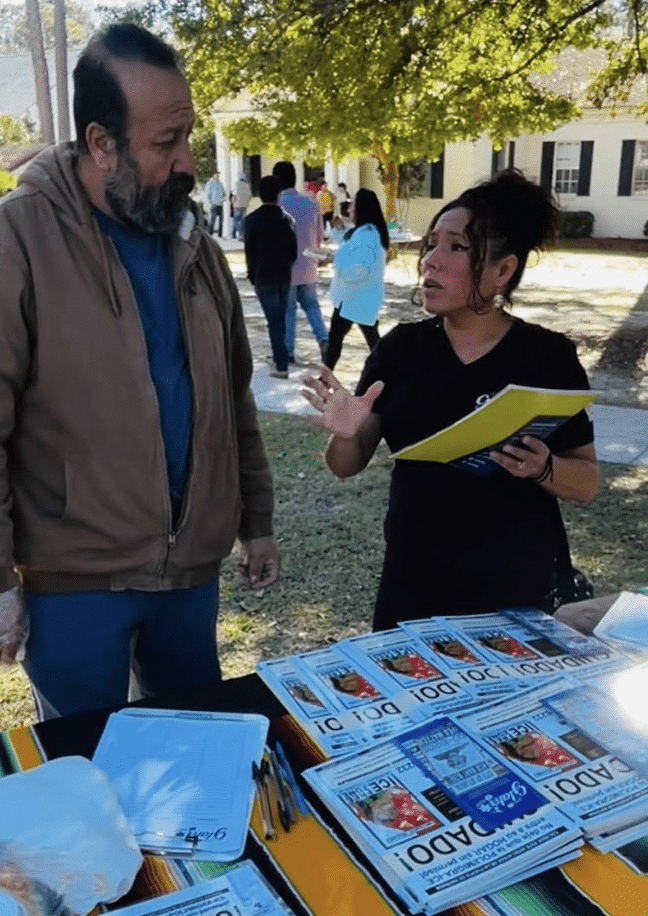
Rosalba Alvarez remembers the days immediately following Laken Riley’s death in Athens. “La policía empezó a poner retenes,” she said. “Eso es algo que no hacían antes”: The police began setting up more checkpoints. That’s something they didn’t do before.
A native of Mexico City who’s lived in Athens for 20 years, Rosalba works closely with Latino community members as an organizer with the Georgia Latino Alliance for Human Rights (GLAHR). After Riley, a 22-year-old University of Georgia nursing student, was killed in February 2024 by a Venezuelan immigrant in this country without legal residency papers, Rosalba also remembers seeing hateful messages on local Facebook pages, saying things like, “We need to go hunt immigrants.” Athens’s immigrant community found itself doubly threatened, she said—from police on one side, and on the other from some people who were posting hateful messages about immigrants on local Facebook groups.
Thankfully, the messages calmed down after a while—but the political reaction to Riley’s murder continued to gain steam.
Now, federal legislation named after Riley could be the first bill President Donald Trump signs into law as he takes office. Authored by Rep. Mike Collins, whose U.S. House district contains Athens, the Laken Riley Act authorizes the Department of Homeland Security to detain any person who doesn’t have legal residency documents and has been arrested for burglary, theft, larceny, or shoplifting. The bill also expands states’ ability to sue the federal government over immigration policy. Critics have decried the legislation as a violation of civil liberties—it will affect people who’ve been merely arrested for a crime, regardless of whether they’re ultimately convicted—that would lead to a vast expansion of the federal immigrant detention system. Both Georgia Senators, Senator Warnock and Senator Ossoff, voted in support of the bill on Monday. It now requires a vote in the House before going to the president’s desk.
“It’s so broad, it violates the concept of due process,” said Kyle Gomez-Leineweber, director of policy and advocacy at GALEO Impact Fund, an organization that aims to increase Latino political representation in the state. “A person who was ultimately not convicted of a crime and has not committed a crime could be placed into a detainer and ultimately deported.”
He said the bill violates the legal principle of presumed innocence. “Essentially what this legislation says is, well, this constitutional right to due process doesn’t really apply to anyone other than citizens, which is completely antithetical to constitutional principles that have been long held since the founding of this country.”
The law also doesn’t have any protections for minors. “A 12-year-old kid who allegedly made a dumb choice—stole a pack of gum or a T-shirt from a clothing store—could end up deported from the only country that they’ve ever really gone to,” Kyle continued.
Policy experts in Atlanta agree that this Act perpetuates the narrative that immigrants have proclivity to commit crimes, when the evidence shows otherwise. Research from the American Immigration Council, the Brennan Center for Justice, as well as the CATO Institute, a libertarian conservative think tank, have all found that undocumented immigrants are less likely to be convicted of crimes than native-born Americans.
“[The bill] also enhances and escalates the degree of fear a lot of our community is feeling right now, which ultimately makes it harder to actually hold actual criminals accountable, because it makes innocent community members, hardworking families less likely to contact public safety officials when they’re experiencing abuse or victimized in some way,” Kyle said.
“[The bill] makes innocent community members, hardworking families less likely to contact public safety officials when they’re experiencing abuse or victimized in some way.” – Kyle Gomez-Leineweber, director of policy and advocacy at GALEO Impact Fund
“It’s all just using the immigrant community as a scapegoat.”
“No one in the Latino community or in the immigrant community signed off on this terrible crime and tragedy,” he said. “I think it shocked the community of Athens and our entire state; Laken Riley should still be with us today and I wish that there were actually meaningful policy proposals being put up and discussed to address how can we tackle violence against women, what can we do to ensure that women, especially in public spaces, can feel safe and secure and not at risk of losing their life.”
“El acto de una persona puede haber creado todo esta conversacion anti-immigrante para nuestra comunidad,” Rosalba said: One person’s act created this entire anti-immigrant conversation for our community. As the incoming president takes over, people in Athens are apprehensive, she said. “La gente tiene miedo. Estan tratando llevar sus vidas normales”: People are scared. They’re trying to live their normal lives.
Authors

Related Articles
A Rohingya man in New York died under mysterious circumstances— his relatives in Georgia are grappling with the loss
Federal immigration officers left Nurul Amin Shah Alam outside a closed coffee shop in harsh winter weather— days later he was found dead. He was getting ready to move to Georgia, says his niece in Stone Mountain.
“Our family was destroyed. We’re piecing it back together,” says Adalina, whose husband was deported to Peru
After months apart, a metro Atlanta resident decides to leave the U.S., apply for Peruvian citizenship and join her husband in Peru—at least until a new administration takes office. As she prepares to leave the U.S., she is finding support in her Atlanta friends and community.
“I love this country (…) and I just ask to be treated fairly,” says Rodney Taylor from Stewart Detention Center where he is facing deportation
Gwinnett county resident and double amputee issued travel documents signaling imminent removal to Liberia, as his health continues to deteriorate.