“If we’re not operational, there isn’t really anywhere else that they could go”
Free mental health provider for refugees and asylum seekers stops taking new clients in Atlanta, after its overseas work was decimated by a termination of USAID contracts
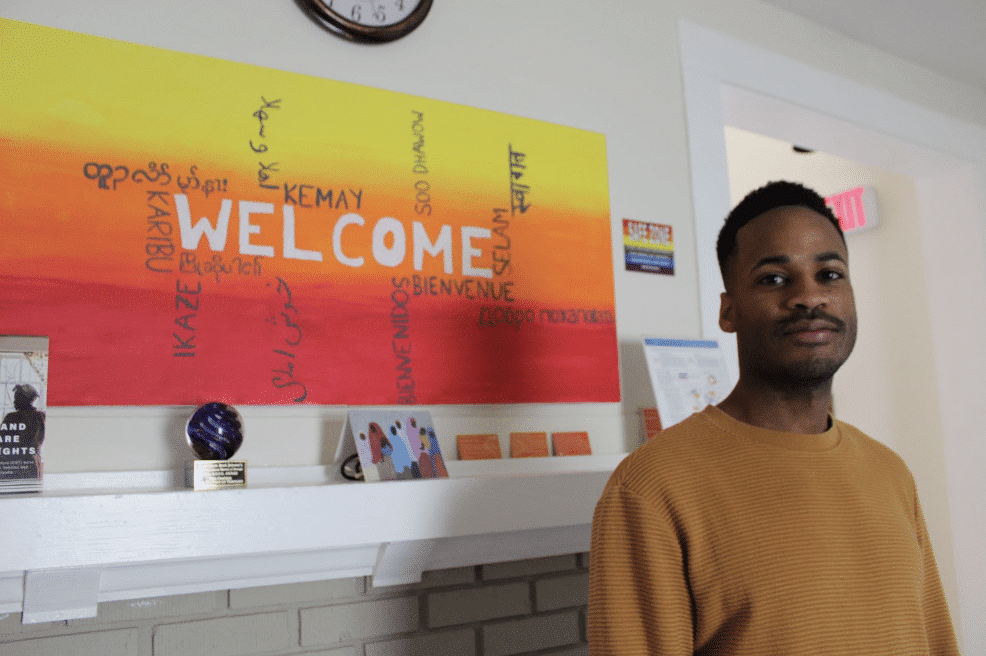
Cecil Walker, a psychotherapist at the Center for Victims of Torture, in the organization’s Clarkston office. Photo credit: Sophia Qureshi
Cecil Walker sits in his office in a cozy cottage painted in warm tan and red colors on East Ponce de Leon Avenue in Clarkston. Inside this office, people—mostly recent arrivals to the U.S. who have fled political persecution, war, and authoritarianism in their native countries—confide in him. They’ve gone through a lot to get here, he says: “A lot of my clients, this is the only place that they were willing to risk leaving their home for.”
Cecil is one of three therapists working in the Clarkston offices of the Center for Victims of Torture, an international nonprofit headquartered in Minnesota. In metro Atlanta, CVT is one of just a handful of organizations providing free mental health support to refugees and asylum seekers, with the support of in-person interpreters in multiple languages. At any given time, CVT in Clarkston serves around 100 clients, and there’s a waiting list. Their speciality—counseling and therapy for refugee and immigrant survivors of torture and trauma—is a service that no other organization in metro Atlanta provides.
But now the organization, which is primarily funded through federal grants, is under threat. Internationally, over 70 percent of CVT’s staff has been furloughed because of the Trump administration’s termination of USAID contracts—over 400 people who work in Jordan, Ethiopia, and Uganda. CVT’s local work could be vulnerable, as well, as it is also federally funded. The organization is no longer taking any new clients, a spokesperson for CVT told 285 South, and, the interpreters they worked with have been laid off by the resettlement agency that provides them, because that agency’s budget has been diminished by federal cuts.
Cecil took a job at CVT in 2021 because, he said, he wanted to work with underserved communities. He’s the child of an immigrant (his dad is from Antigua), and he said he didn’t have access to mental health support growing up.
“The place that I started was just trying to get mental health professional service to people who need it the most,” he explained. “Growing up not having many resources myself, in our family, I felt like I understood how it feels to be excluded from resources that might be needed.”
We spent some time with Cecil in his office and talked to him about what he’s hearing from his patients, potential cuts to CVT’s programs, and what that could mean for the work to support the mental health of refugees and asylum seekers in metro Atlanta.
This interview has been edited and condensed for clarity.
Can you tell me about some of the clients you’re seeing right now?
The clients that we see here in general are all refugees and asylum seekers. Depending on the year and what’s going on politically in the world, the populations shift a bit. Sometimes there’s lots of people coming from Central and South America. Sometimes lots of people come from West Africa.
Often, asylum seekers are people who have just come here recently. By the time I see them, they could have been here a few months. Sometimes we see refugees who’ve been here for a couple years. [But] more often than not, there are people who have just recently been in the U.S., and very often they don’t speak English. Sometimes they have education and professional backgrounds. I think a slight majority of them don’t.
CVT provides a specialized type of support for people who have survived trauma or torture. Can you tell me about the kinds of things your clients have been through, and how you’re able to work with them?
In the last year or two, some individuals from Nicaragua who were political prisoners, [and] were targeted by their government. The ones that I’ve seen weren’t leading rebellions or doing anything violent, they just were having a difference of opinion from the government, or just found themselves on the wrong side of the government in power. Sometimes that would lead to years in imprisonment, where literally [they’re] being isolated and mistreated, or sometimes that would mean they’re kind of on the run from authorities, so they have to live in secrecy or travel. Sometimes it looks like being violently persecuted by community members. Maybe that’s family or spouse, some organization, things like that—and the government failed to do anything about it.
How does what they’ve been through—whether they’re imprisoned or persecuted—impact their lives here?
It’s a lot of uncertainty and insecurity. It’s not being sure how to venture out and build relationships, especially in a new place. Not being sure what to expect of the government or people or systems here. Difficulty sleeping, just feeling like your well-being in general is suffering. Sometimes they have words for this stuff and sometimes they don’t. Sometimes they’re unaware there’s a categorization for this stuff, that there’s terminology, and it’s to be expected from the experiences that they’ve had. They just think they’re miserable, and that’s just the condition that they’re in. They always realize: No, this is what people would expect from the kinds of things that you’ve been through.
Is there something particular that you need when working with immigrants and refugees who have suffered trauma, versus native-born Americans?
A lot of treatment, particularly in the U.S., is based on and used for Westernized, Americanized populations. That’s not to say it can’t be useful or relevant for people who fall outside of those populations, but that’s not what it was built for and who it was built with in mind. So what treatment actually looks like for them here, in order to be the most effective, is building—instead of from a very sterile, clinical kind of perspective—a more relational perspective. It’s about the relationship we build with them and the ways we can strengthen them through that relationship.
Can you describe how it works with interpretation?
A lot of our clients don’t speak English, so obviously that necessitates having an interpreter, which is a different component to the process of doing therapy. If this is about the relationship, now it’s about this partnership between all of us. I do think some clients start to build a bit of a familial attachment—I come here for help—and this interpreter is a part of that process.
But what’s been going on more recently is, IRC was a partner we depended on for a lot of interpretation—I think the most common languages we’d go to them for were Arabic and French, but we also have often needed them for Spanish. Now that they have laid off all of their interpreters, we can’t really go to them for those languages.
The impact I’m most concerned with is, the interpreters that our clients are used to aren’t going to be there anymore. This person that you’re used to being in the room when you talk about some really difficult things is going to be a different person now. I don’t know who the person is going to be, and we just have to make it work.
What’s your clients’ understanding of what’s happening on the national level and how that impacts them?
They do know things are shifting, and it’s making it more dangerous and more uncertain. I think that’s very, very clear to all of them. But what happens—especially in communities that already have so much insecurity—is they start filling in their gaps with hearsay. I heard this is happening and Trump’s gonna do this, or has already done this.
It could even start moving into a fear of rumors. I had a client who was an asylum seeker. She is very dependent on her work authorization. She told me that she heard—through a news story, but it’s hard to know where these things really originate from—that Trump was rescinding work authorization. I haven’t heard of that specific one. It’s hard for any of us to take anything off the table, I guess, these days. But it’s like the fear just kind of boils over into, Nothing is safe. Of course that’s going to impact people. You’re going to be scared if you think your lifeline, your job, is not going to be something that you have.
What did you say to her?
Here’s what I know. I don’t believe that work authorization has been revoked. There is a lot of uncertainty out there—I’m not going to invalidate any of that. But I know for now, you’re safe in all these ways. Here’s what is true. Here’s what is the law. I think what was most helpful to her is, Regardless of how things shift, there’s still people who are trying to help you.
A lot of clients will say some of this reminds them of the country they came from—the kind of political aggression or uncertainty that they faced. To Americans, it feels like freedom and our rights and all these things are pretty locked down. And that’s not the case for refugees and asylum seekers. They feel much more triggered, and it does remind them of things they’ve dealt with before. One of the really common things about having experienced trauma is your brain is kind of in this mode of self-protection: How do I make sure the thing that happened to me doesn’t happen again? A lot of my clients have said, too, that this is the only place they were willing to risk leaving their home for. I have a client that I talked to on the phone. He’s an asylum seeker—he decided to just never leave his home. He’s not working, so he just stays at home.
“A lot of clients will say some of this reminds them of the country they came from—the kind of political aggression or uncertainty that they faced. To Americans, it feels like freedom and our rights and all these things are pretty locked down.
And that’s not the case for refugees and asylum seekers. They feel much more triggered, and it does remind them of things they’ve dealt with before.”
Cecil Walker, Psychotherapist, The Center for Victims of Torture
If programs like CVT were to no longer exist, what do you think that would mean for your clients?
At its worst? I don’t think it is a stretch of the imagination to say that that’s very much life-threatening for some of the clients. I just heard about a case in our Afghan program: a single mother who said she didn’t really want to live anymore. That has changed in her time at CVT. She’s less at risk. Her family or children are less at risk because of the work here at CVT.
Just that understanding of: My life can get better. Things can change. I can work with people on my problems. My life here in the U.S. can be better than my life was before, and I can do something about that. Otherwise it feels like everything is transactional. Maybe it’s just: I go to work, I come home, take what I can get, where I can get it. I just survive. Survival is obviously important. But I think everyone also should have a right to live a real life beyond just being alive.
If we’re not operational, there isn’t really anywhere else they could go. We’re talking about specialized care for refugees and asylum seekers. It’s already a pretty scarce environment. If CVT isn’t here—I’m thinking specifically for Georgia—I don’t know where else other people could go.
“If we’re not operational, there isn’t really anywhere else they could go. We’re talking about specialized care for refugees and asylum seekers. It’s already a pretty scarce environment.
If CVT isn’t here—I’m thinking specifically for Georgia—I don’t know where else other people could go.”
Cecil Walker, Psychotherapist, Center for Victims of Torture
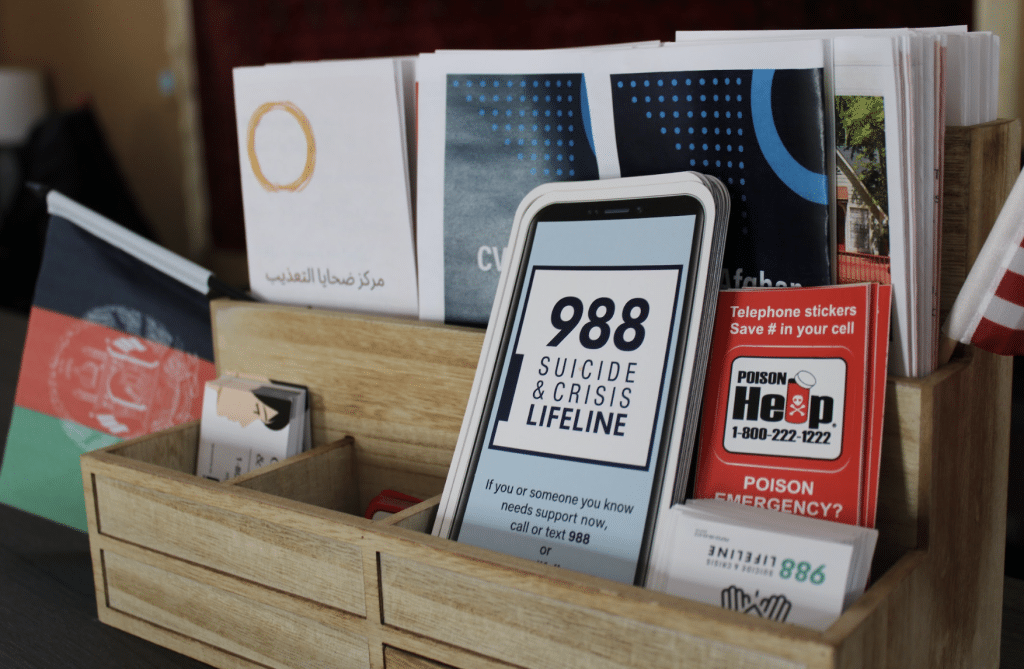
Brochures displayed at CVT’s Afghan clinic, a federally funded mental health program for Afghan families in Metro Atlanta. Photo credit: Sophia Qureshi
Is there anything that gives you hope right now?
That same woman I was telling you about, who said that she heard that work authorization was being revoked, she and her husband came here with their children and were very skeptical of forming new relationships. For whatever reason, they felt like they shouldn’t be making friends and going out and becoming a part of the community. They should just focus on taking care of themselves and their children and staying alive, and that’s it.
But she told me that a teacher at her kids’ school who happened to speak Spanish just seemed to take an interest in making sure they were all right, and would reach out and help them with parent-teacher meetings and other things that they need to do for their kids. And then that woman retired and still continued to help them.
It’s always really nice to hear when clients find some kind of breath of fresh air where they’re like: Maybe we can trust people. Maybe life here can be good. There are lots of stories like that. Clients still being willing to do the human thing of connecting with people and seeing the best in people—and receiving from others, the fact that they see the best in them. Whether it’s torture or whatever circumstances they’re coming from, that’s one of the things that is threatened—that sense of, There’s goodness in people, there’s something for me to latch on to.
“It’s always really nice to hear when clients find some kind of breath of fresh air where they’re like: Maybe we can trust people. Maybe life here can be good.”
Cecil Walker, Center for Victims of Torture
Anything else you want to share?
I would just reiterate how important it is for anyone to live a life that’s worth living, to have a life where it can feel like their well-being is something that’s valuable. There’s obviously no guarantee to happiness and well-being, but you can work on that.
I think places like CVT should exist to offer that to people who don’t really have a chance at that. And I think if places like CVT cease to exist or become much less operational, that’s a big deal. That takes away a lot of that opportunity for people who probably need it the most. It’s more than just a nice extra thing that’s available in the community. This is a thing that is really contributing to the lives that are being lived in Georgia.
Artwork by the child of a client, displayed in the waiting room of the Center for Victims of Torture office in Clarkston. Photo credit: Sophia Qureshi
Sophia is the founder of 285 South, Metro Atlanta’s only English language news publication dedicated to the region’s immigrant and refugee communities. Before launching 285 South in 2021, she worked for over 15 years in media and communications, including at Al Jazeera Media Network, CNN, the United Nations Development Programme, and South Asian Americans Leading Together (SAALT).
Her writing has been published in Atlanta Magazine, Canopy Atlanta, the Atlanta Civic Circle, the Atlanta History Center, and The Local Palate. She won the Atlanta Press Club award for Narrative Nonfiction in 2023 and 2024; and was a recipient of the Raksha Community Change award in 2023 and was a fellow of Ohio University’s Kiplinger Public Affairs Journalism Program in 2024.
Contact her at sophia@285south.com and learn more about herhere.
Federal agents recently fined a green card holder for not having his papers with him—sparking questions about what kinds of documentation immigrants should be prepared to show. 285 South sought out three local lawyers for guidance.