Atlanta Chinese Dance Company’s new show explores the Chinese American experience in the U.S. South
Chinese American Journeys is the first all-original show by the longtime local troupe Atlanta Chinese Dance Company.
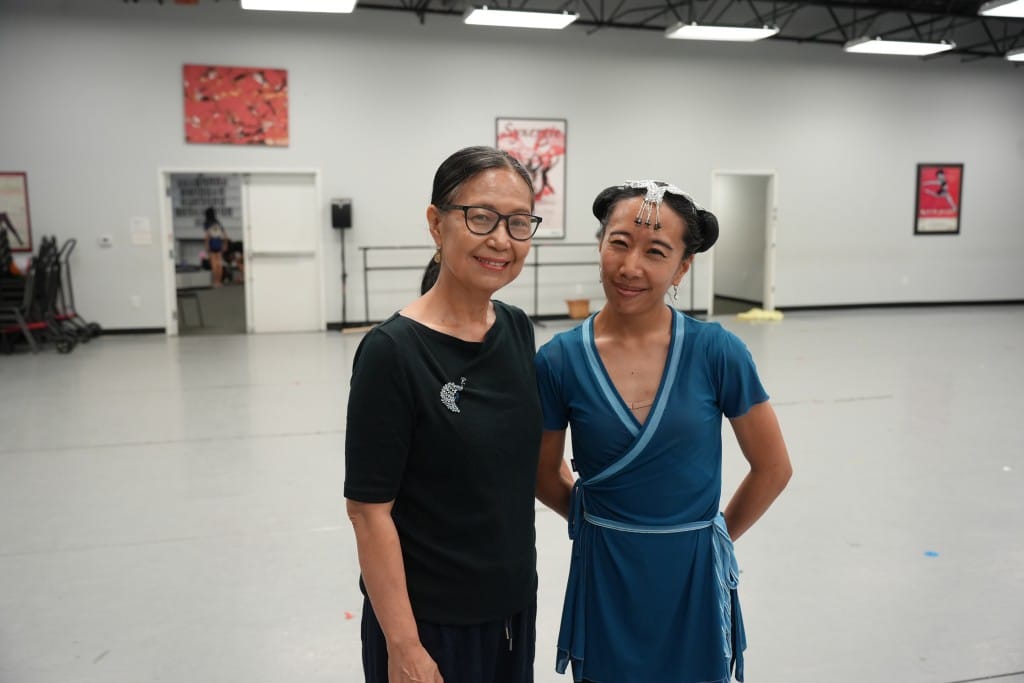
Kerry Lee’s history with dance is lifelong: Her mother, Hwee-Eng Y. Lee, founded Atlanta Chinese Dance Company (ACDC) in 1991. As a toddler, Kerry remembers wandering around the classrooms while her mother taught, watching teenage students dance with ribbons and trying to copy their movements. Once, while her mother was performing, Kerry was supposed to be watching from the wings—“but I was so mesmerized by her performance that I was imitating it,” she recalled, “and then slowly ended up on the stage with her.” She started taking lessons when she was four years old.
On a recent Saturday afternoon, Kerry stretched her muscles and put on eyeliner in a mirrored dance studio in North Atlanta. Now the co-artistic director of ACDC, she was preparing to rehearse for their Chinese American Journeys, running this weekend at Emory Performing Arts Studio in North Decatur. The performance, which Kerry choreographed, traces the history of people of Chinese descent in the U.S., and in the American South.
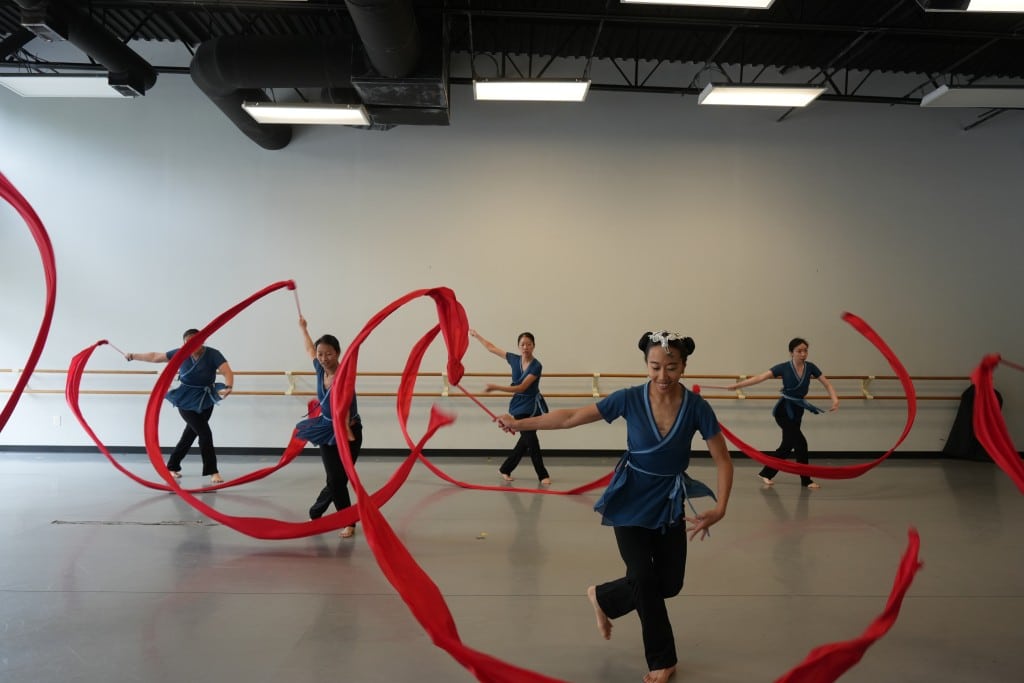
This is the company’s first time doing an entire evening of original work. “Usually, we do the so-called traditional pieces,” Kerry said—the “famous repertoire from China that we restage.” Chinese American Journeys, though, is different. The show mixes traditional Chinese classical and folk dance and martial arts – incorporating ribbons, swords and lanterns- with modern Western forms such as ballet.
Featuring some of ACDC’s most experienced students, Chinese American Journeys comprises three shorter pieces, each of which Kerry created separately for different shows starting in 2018. The first, “Votes for Women,” was inspired by Mabel Ping-Hua Lee, a Chinese American teenager who campaigned for women’s suffrage in the 1920s—at a time when Chinese workers weren’t even allowed to enter the U.S., and residents couldn’t become citizens. (The first major law restricting immigration to the U.S., the Chinese Exclusion Act, was passed in 1882.) “Despite this restrictive time, there was a Chinese American teen who worked with American suffragists in support of the women’s suffrage movement,” Kerry said. “It’s such a remarkable story, and it’s a cross-cultural story.”
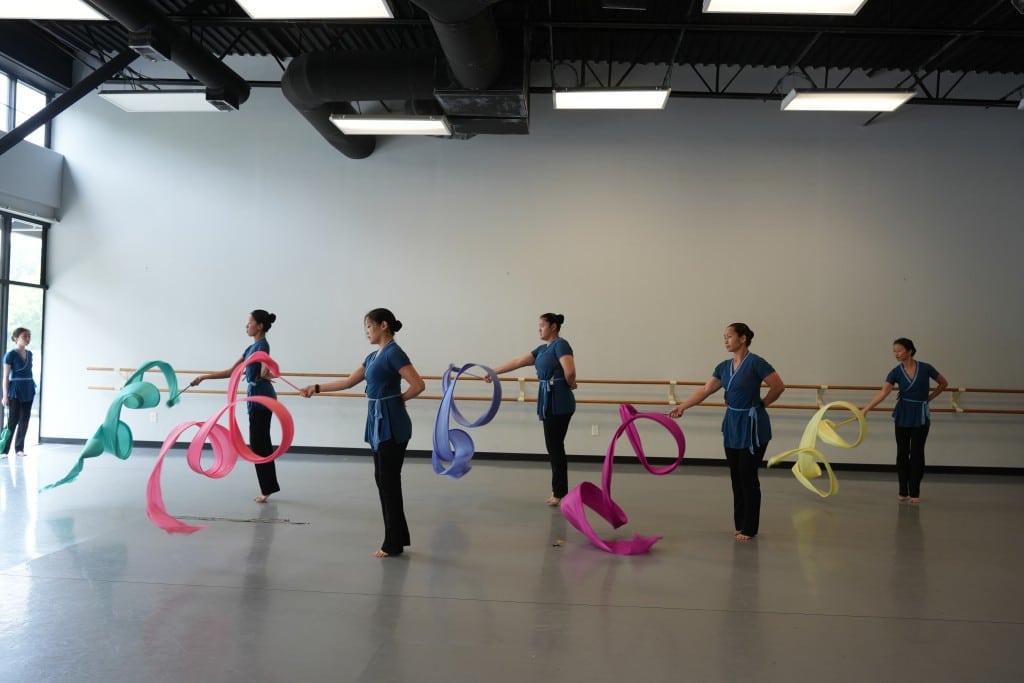
The second drama, “Ribbon Dance of Empowerment,” is about growing up in the South as a Chinese American person—Kerry’s own background. Ribbon dancing is a traditional form of Chinese dance where performers use long, flowing silk ribbons attached to sticks to draw patterns in the air, often symbolizing grace, luck, and happiness.
The process of performing the ribbon dance, she said, “empowered me to feel more comfortable with being Chinese, despite feeling kind of alone in it in the South.” One moment in particular has stuck with her, and even shows up in Chinese American Journeys. Kerry remembers being at a birthday party, when a white girl told her, “I’m the only real American here.” It stung. “The way she said it, it’s like implying we’re not American.”
The third drama in the show takes place in the aftermath of the 2021 Atlanta spa shootings. Around that time, Kerry was reading a book about the 1982 murder of Vincent Chin, a 27-year-old Chinese American draftsman in Detroit. She wanted to make sure these histories weren’t forgotten, and to highlight something true in both incidents: “a lot of people from different backgrounds came together to support each other and make sure that we lean into the idea that when any community is hurting, we all have a responsibility to speak up.”
A family’s journey with dance
The Atlanta Chinese Dance Company’s roots trace back to Singapore, where Kerry’s mother, Hwee-Eng Y. Lee, first started dancing as a child herself. Her sister, who is 18 years older than she is, took her along to rehearsals. She started taking lessons and kept it up even after moving to the U.S. for college. “Dance was always part of my life since I was little, so I never stopped dancing, never stopped learning,” Ms. Lee said. She moved to the Atlanta area in 1986 when her husband found a teaching job at Georgia Tech. She founded ACDC after a friend asked her to teach Chinese dance to her daughter.
The friend’s request became the inspiration that eventually led to ACDC. “That’s how I started, with five students, and then slowly grew from there,” Ms. Lee told 285 South. She began by renting out space at the Culture Center of Taipei Economic and Cultural Office —formerly the Chinese Community Center and the forerunner of Atlanta Chinatown in Chamblee.
Kerry studied engineering at Stanford University, and eventually found herself called back by this family tradition. After graduating, she worked at an economic consulting company in New York while she auditioned and took classes to improve her dancing skills. After about a year, she started dancing professionally with H.T. Chen & Dancers, a New York–based modern dance company. In 2010, she moved back to Atlanta to work with her mother.
When Kerry decided to return to Georgia to pursue dance full-time, her parents were hesitant; they thought she’d make better money as an economic consultant. But ultimately Ms. Lee came around, not only supporting her daughter’s passion, but inviting her to become a part of the dance company. Now, mother and daughter work together, teaching over 100 students about Chinese dance, history, and culture—in Chamblee as well as in Duluth and at the North Atlanta Dance Academy. “Within a year, sometimes we go to school to do lecture demonstrations, so I will lecture and teach workshops, and then Kerry will dance,” Ms. Lee said.
For Kerry, the debut of Chinese American Journeys marks an important point in her evolution as a dancer—and as a choreographer. “Going from a Stanford engineering major to the dream of being a professional dancer was already like, Oh wow, I did that,” she said. “And then slowly being like, I think maybe I have something to say as a choreographer, I want to start dabbling with choreography, and to put something together, and to finally be able to get to this place, it feels very surreal.”
For the Lees, working together is a dream come true. “I consider myself one of the lucky people who are doing what I love,” Ms. Lee said. “A lot of people are not so happy with their job—they do the job because they have to make money. So in that sense, I’m really grateful to have this chance in my life.”
Tickets to Chinese American Journeys are available here.
Author

Related Articles
Latin music is having a moment in Atlanta—and DJ B. Bruja is riding the wave
An Emory art grad who decided to stick around, Anna-Frida Herrera is one of a new generation of Latin DJs finding bigger, more diverse audiences for their eclectic sounds.

Update: Culturally specific food pantries and other food resources
SNAP terminations continue to have ripple effects on immigrant and refugee communities.
A new Doraville cafe serves up a taste of Southeast Asia’s kopitiam culture
Kopitiams aren’t just coffee shops—”there is human warmth, the friendliness from that cup of coffee”