Holding elections in Spanish: Are Latino voters lost in translation?
Athens-Clarke County, like Gwinnett, now provides ballots in Spanish.

Jazmín Méndez voted in Athens-Clarke County this week for the fourth time – but in at least one way it felt like the first.
That’s because Méndez cast her vote in Spanish for the first time. This year, Athens-Clarke has become only the second county in Georgia, after Gwinnett, to translate the ballot itself, along with voting information, into the state’s second-most widely spoken language.
“I’m so happy!” said Méndez. She was born in Joliet, Ill., but her family moved to Mexico when she was three, and she returned to the United States as an adult. “It’s … a new experience!”
The 45-year-old remembers her first time voting in 2008 with frustration. She didn’t understand a local ballot measure, and when she asked a poll worker for help, they didn’t understand each other. “I didn’t know if I should answer yes or no to the question on the ballot, Méndez recalls.
“I didn’t know if I should answer yes or no to the question on the ballot.” – Jazmin Méndez, voter
She avoided that problem in this election, but she also knows from experience that translating election information into another language is only the first step; it also needs to be done well. Her experience as a community organizer in Gwinnett provides a window onto voting that is rarely looked at in detail – language access, and how it’s accomplished.
Gwinnett became the first Georgia county to provide ballots in Spanish in 2017, after reaching a threshold in the Spanish-speaking population that required the county to do so under the Voting Rights Act. With nearly a million residents, almost 1 in 4 Latino, it has the largest Latino population of any county in the state. DeKalb County translates some election-related information into Spanish, but voters can’t actually cast their ballots in the language.
Gwinnett: Lost in translation?
Although Méndez has mostly worked in customer service jobs at places like Chick-fil-A and Auto Zone, she started working as a community organizer several years ago with Mijente PAC, a national progressive Latino group. This led to another frustrating voting experience – but this time in Spanish.
Méndez was helping a Latino voter in Gwinnett who had come across yet another confusing referendum on the ballot. Although both were Spanish speakers, neither understood what the measure was asking people to vote on. Once again, the voter “doubted whether to write yes or no,” she recalls. “It was very confusing … a really bad translation.”
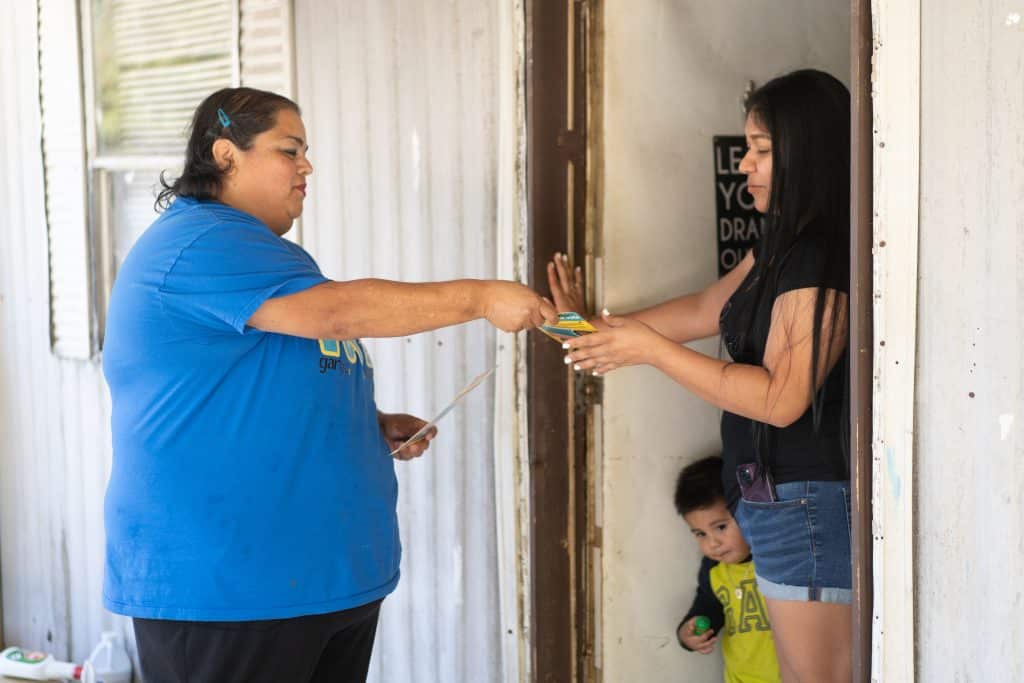
Gwinnett began offering election materials in Spanish in response to several decades of population growth, driven by Latinos. But “there was a lot of resistance” to get to that point in 2017, said Jerry Gonzalez, executive director of the Georgia Association of Latino Elected Officials (GALEO).
Along with other organizations, GALEO had been pushing the county to translate election information into Spanish since the mid-2000s. That was when Gwinnett became subject to Sec. 203 of the Voting Rights Act, which requires jurisdictions to provide bilingual election materials if more than either 5% or 10,000 citizens of voting age make up a single-language minority and have difficulty speaking English.
Fast forward to today: When asked to look at the Spanish-language version of Gwinnett’s elections webpage, a professional translator’s first reaction was, “I assume they use machine translations.”
Nicolás Arízaga, an American Translators Association member who specializes in political and legal translations, went on to say that everything from the tone to the actual meaning of certain terms was jarring to read: for example, using informal instead of formal pronouns in a voter survey and translating “absentee ballot” literally as “voto ausente,” a term not used in Spanish-speaking countries.
The federal Election Assistance Commission instead recommends the term “voto en ausencia” and provides an explanation in a Spanish-language glossary of recommended election terminology. Confusingly, Gwinnett uses both terms on its elections website.
In fact, Gwinnett’s election website can be machine-translated from English into seven other languages, including Spanish, French, Mandarin and Vietnamese, for keen-eyed users who spot the translation tab at the bottom right corner of the screen.
Gwinnett’s Elections Department uses a software program called Weglot for the website translations, according to Gwinnett spokesperson Joe Sorenson. The county’s website provides a disclaimer that includes this phrase: “[T]he service is not perfect and the machine-generated website translations may, or may not, effectively convert the intended design, meaning, and/or context of the website.” PDF documents, which can’t be machine-translated, are translated by “a combination of staff and vendors,” Sorenson said in an email.
That might explain another issue Arízaga noted: using different terms for the same thing in different places. The translator summed up his evaluation of Gwinnett’s Spanish-language election information by asking, “Are they trying to inform voters or just letting software do the work?”
“Are they trying to inform voters or just letting software do the work?” – Nicolás Arízaga, member of American Translators Association
The question is an important one, said Isabelle Muhlbauer, National Advocacy Manager for Voting Rights at LatinoJustice PRLDEF, a national civil rights group. In order to inform voters, she said, “You’re looking for certified, qualified translators – not machine translations. Software typically translates word for word, which can lead to confusion.”
The Gwinnett voter survey, which is in English, Spanish, Mandarin, Korean, and Vietnamese, is prominently displayed at the top of the county’s elections website. The county says the aim is “to help us improve our electoral processes.” But the grammar throughout seems “based in English,” and it’s “not clear what they’re asking” from the vocabulary used, Arízaga said.
The survey was translated from English to Spanish by county staff and a group of volunteers, according to Sorenson. No one has filled out the Spanish-language version in the 11 months it’s been online, he said in an email.
“If they want to say they’re being inclusive, they should allocate funds to translate accurately and with cultural competence,” Arízaga said.
No Spanish voter-registration info
The most important first step to voting is making sure that you’re registered. But when you click on “Comprobar/actualizar mi registro,” the Spanish for “Verify/update my registration,” on Gwinnett’s elections website, you get sent directly to the Secretary of State’s “My Voter Page” – which is entirely in English.
In other words, if you’re Spanish-speaking, verifying your voter registration will require you to read English, or get some assistance. That doesn’t meet the requirements of Sec. 203 of the Voting Rights Act, said GALEO’s González. “The county is out of compliance,” he said, adding that the Justice Department has jurisdiction over the issue.
Sorenson, the Gwinnett spokesperson, said in an email that the page is on “a state [web]site and … outside of our control.” And further, a 2022 Eleventh Circuit decision involving GALEO and Gwinnett may mean that the county is “under no obligation … to provide translated materials from the state in Spanish,” said LatinoJustice’s legal team in an email.
Either way, González said, translating the text on the page “is not that complicated.”
All these issues related to Gwinnett’s handling of its Sec. 203 obligations have not gone unnoticed by Latino community groups in Georgia. “The question is, are you making sure the spirit of the law is being met?” said Gilda “Gigi” Pedraza, executive director of the Latino Community Fund, a grant-making and advocacy nonprofit. “If you’re doing the minimum possible, we can assume you’re not interested.”
Meanwhile, in Athens-Clarke County, Elections and Voter Registration Director Charlotte Sosebee is hoping “word of mouth” will help Latino citizens find out about their first-time opportunity to vote for president in Spanish.
Méndez, who continues to work with Mijente PAC, has been telling as many Latinos in Athens as she can about the county’s bid to make voting easier for them. She looked at some of the voting materials the county paid an outside firm to translate several weeks ago and said she found “no problem” with them.
“It’s very important,” Méndez said of the county’s decision to translate election materials into Spanish. “I hope people show up!”
This story is brought to you by 285 South and the Atlanta Civic Circle, a journalism nonprofit dedicated to increasing civic engagement.
Related Articles
Refugee, Muslim, and Latino organizations push for laws to improve immigrants’ quality of life in Georgia
Among them: increased opportunities for foreign medical graduates to expanding language access in schools to repealing immigration enforcement bills

Some wins for immigrant survivors of violence, despite slowdown in U visas
“I knew I could do better. It was just the one thing that was lacking for me to go further: my immigration status,” one survivor said.