
Refugee, Muslim, and Latino organizations push for laws to improve immigrants’ quality of life in Georgia
Among them: increased opportunities for foreign medical graduates to expanding language access in schools to repealing immigration enforcement bills
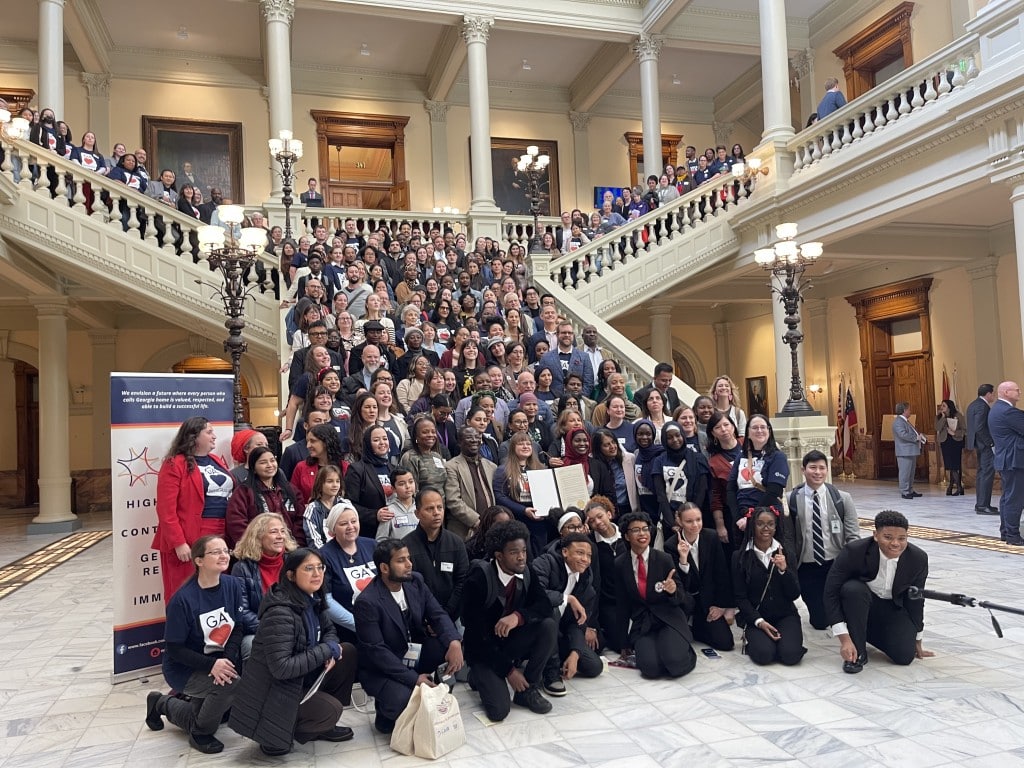
Hundreds of Georgia constituents with roots from around the world walked the hallways of the Georgia State Capitol on Thursday. Organized by local immigrant and refugee serving organizations, they were there to learn about the process of creating laws and meet directly with lawmakers to share with them what issues they were most concerned about.
The Georgia Chapter of the Council on American-Islamic Relations (CAIR-Georgia) and Georgia Muslim Voter Project (GAMVP) hosted Georgia Muslim Advocacy Day; the Coalition for Refugee Service Agencies, a Georgia-based network of over 30 organizations supporting refugees and immigrants, hosted the New Americans Celebration; while the nonprofit We Are CASA, a national nonprofit advocating for immigrant and working class families, met at Liberty Plaza for a press conference to share life experiences from immigrants in the state. Altogether, they gathered more than 400 people to the Capitol.
Participants hailed from across the world, from Mexico to Syria to the Dominican Republic, but as constituents of Georgia, they supported similar bills focused on improving their quality of life here.
The Coalition for Refugee Service Agencies advocated for Senate Bill 427, which would allow legally present physicians trained outside the United States to practice medicine with a provisional license, after meeting a series of conditions. The bill, which has bipartisan support and it already passed a committee hearing, is aimed at addressing Georgia’s rural physician shortage. A similar bill failed to pass in the previous legislative session.
“A lot of clients are well trained, employed physicians, mental health specialists, counselors, therapists counselors, occupational therapists in other countries,” said Whitney Kweskin, chair for the Coalition for Refugee Service Agencies, amid the crowded south steps of the Capitol. “This licensing bill will give them an easier path through residency so they don’t have to do the entire thing [studies] again.”
The Coalition for Refugee Service Agencies and We are CASA also expressed support for a Language Access bill (House Bill 437), which would require the State Board of Education to create rules for local schools so that students and parents who speak limited English have access to English as a Second Language (ESOL) program materials in their own language. Other organizations like the Latino Community Fund have also expressed support for the law.
“We really wanted to focus on these two because they’re positive, progressive legislation that would make the lives of immigrants and refugees in Georgia better,” Whitney said about supporting the medical licensing bill and the language access legislation.
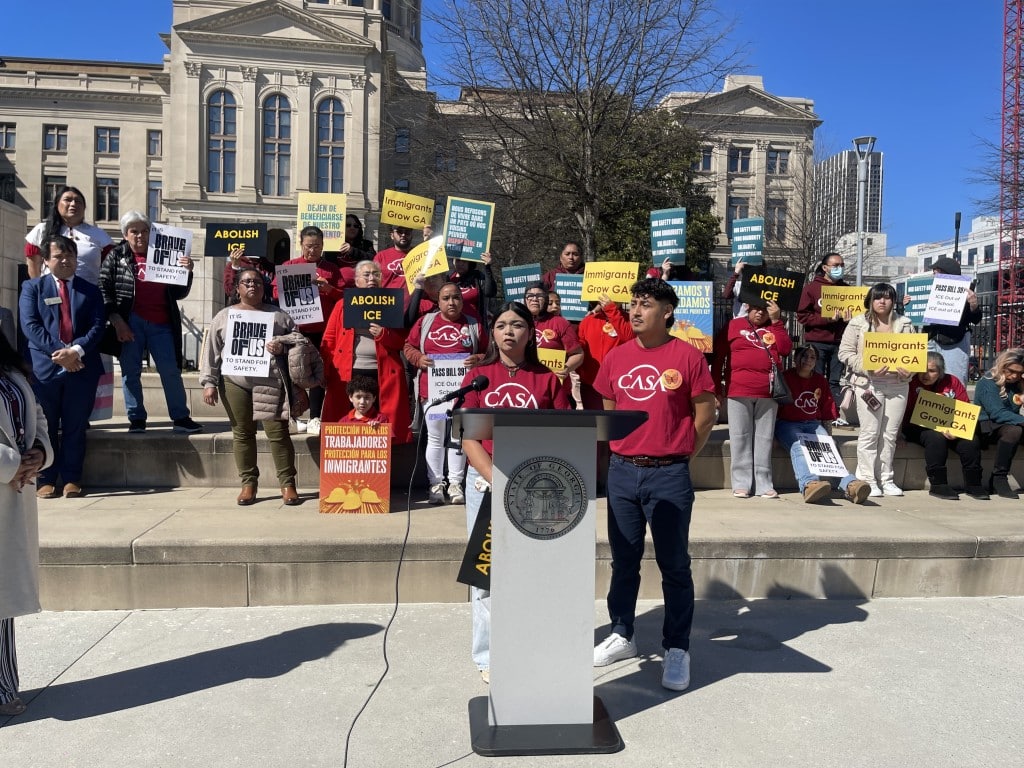
Just outside of the Capitol, at the steps of Liberty Plaza, members of the advocacy group We are Casa met to show support for a bill that would repeal HB1105 –a 2024 law that requires local law enforcement to cooperate with ICE and federal immigration authorities.
House Bill 1053 was introduced by Rep. Marvin Lim, a Filipino-American politician representing a district in the Norcross area, with large Hispanic and Asian communities. Apart from repealing the 2024 law, it also establishes guidelines by which local law enforcement agencies can process applications for U and T visas for victims of violence and human trafficking. He explained that victims of domestic violence are fearful of calling local police because they don’t trust that they won’t call ICE on them or their families. As a result, communities have become less safe, he said.
“I very much understand that this is a very difficult political climate, given who our president is and all the anti-immigrant sentiment, but at the very least, we feel it is an important conversation to have to show this is making us less safe,” Rep. Lim told 285 South.
In support of the bill was Mildred Pierre, wife of Gwinnett County resident and double amputee Rodney Taylor, who has been at Stewart Detention Center since January 2025. He’s had challenges charging his prosthetics to independently move, and more recently, accessing meals –Mildred said in the past, employees of the detention center would bring him the food. On Thursday, she told 285 South this is no longer the case. Now he relies on other inmates to help him by bringing him the food to his cell.
Cancelling HB1105, Mildred said, “is about humanity; it’s about restoring balance; it’s about refusing to normalize policies that divide families under the guise of safety.”
The bill hasn’t been scheduled for a committee hearing yet, and Rep. Lim made a call for people to call their local representatives and tell them they want to get the bill heard in committee. “It doesn’t matter what your own [immigration] status is, call and email them to say we want to hear HB1053,” he said.
The different advocates who met at the Capitol on Thursday support or are sympathetic to a series of bills requiring more transparency from ICE agents, including Senate Bill 389, Senate Bill 391, Senate Bill 390, and Senate Bill 397. It is uncertain if they will have committee hearings, and a chance to pass, as they were all introduced by Democratic representatives in a Republican-controlled Capitol.
“We are very supportive of those bills, those are very important, but the sanctuary city laws [HB1105] passed in 2024 would make those bills very difficult to pass,” Whitney said.
Daniela, a 19 year old U.S. citizen whose parents are from Mexico, was at the Capitol on Thursday with We are Casa. She took her place at the podium in front of the Capitol steps, and addressed the small huddle of journalists in front of her. It was her first time ever speaking at a press conference, and despite being visibly nervous, she took the mic, fueled by belief in the message she was there to share: “We have a right to live without constant fear,” she said. “I am here today to stand up for my family, my second generation immigrant community and all the families that came here to build a better future.”
Author
Related Articles
“We believe that God will make a way for us, whether here in America or somewhere else”
As Temporary Protected Status for Haiti expires, a Lawrenceville pastor is comforting his community, amid reports of self deportations and job cuts
“I didn’t expect it to happen in my family.”
A flurry of homemade videos points to a summer uptick in immigration arrests in the Atlanta area
Venezuelan man dies in immigration custody in Georgia
45-year-old Jesus Manuel Arenas-Silvia is the third person to die in ICE custody in Georgia this year.