Amid a federal funding freeze, local groups are doing what they can to meet a major need for newly arrived families: jobs.
“I’m really stressed,” said one man from Afghanistan. “I’m looking for a job, but there’s really no luck.”

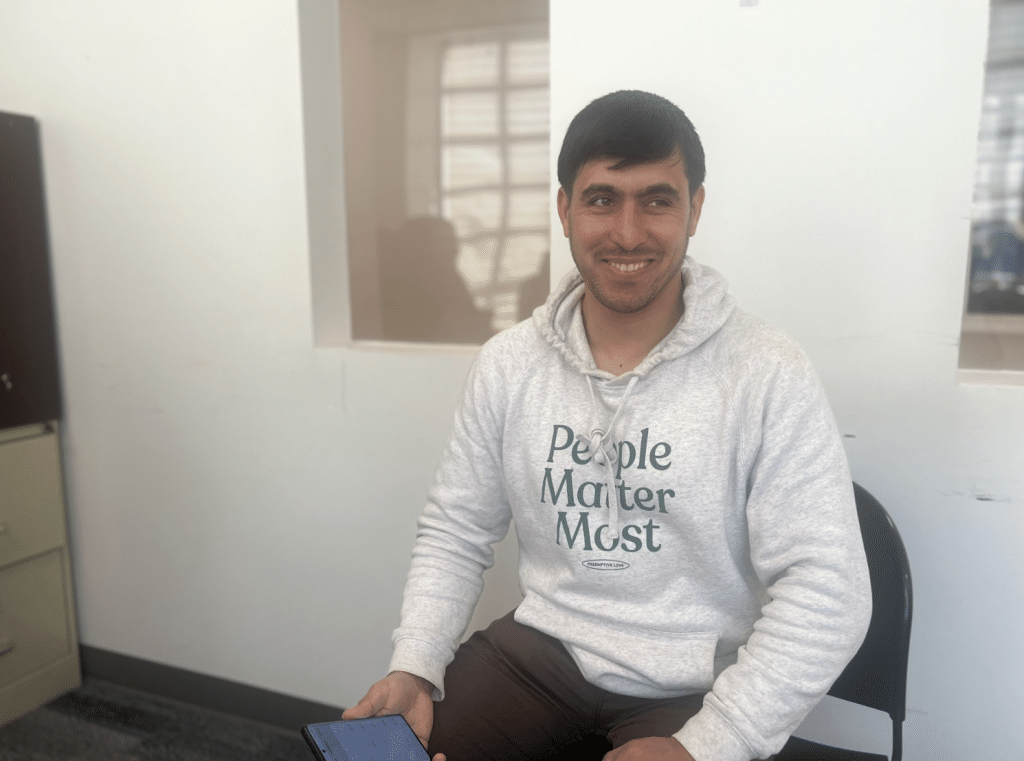
Islamuddin Safi sits in the office of the Afghan American Alliance of Georgia (AAAGA), talking with the organization’s director, Shaista Amani, and her colleague Marzia Rostami. As he scrolls through his phone, occasionally showing them photos of his bodybuilding days in Afghanistan, or his late brother dressed in a military uniform, Marzia types on her laptop. She’s following up with Ross department store to see if there are any jobs there for Islamuddin or any of their other clients.
Islamuddin has come into the office to ask for help. He arrived in Atlanta toward the end of 2024, and hasn’t yet found work to support his wife and children. And finding a job is feeling increasingly urgent.
Thankfully his rent, which he says is $1,655 a month, was paid in February by his resettlement agency. But that agency—along with others—was hit by federal funding cuts in January, and his caseworker was laid off. He was assigned a new case manager, who he said told him: “We may be able to help you for another month or so, or maybe we won’t be even able to help you at all. Because we don’t know what’s happening.”
“I’m really stressed,” he says in Dari, with Shaista interpreting. “I’m looking for a job, but there’s really no luck.” As he speaks, he shows her his phone—it’s his utility bill, which is over $400. He says the agency isn’t able to cover the cost of it.
Shaista says that families who were resettled here in the last three months “are in dire need of immediate help,” given the Trump administration halting federal funding for resettlement, which has led to staff cuts and a funding freeze at the larger resettlement agencies, who are primarily responsible for supporting refugees in their first 90 days.
To help meet the needs of families who have arrived here since the fall (over 1,000 people), these agencies have asked smaller local groups like AAAGA to step in, who haven’t yet been impacted by the federal cut directly, Shaista says.
She and her team visited 19 of the 42 Afghan families they’re supporting in the past week, “sitting in their homes, listening to their struggles, and trying to find solutions.” What was clear was “they want to work. They want to rebuild their lives. They just need the opportunity.”
But those opportunities have been surprisingly hard to come by. “I have never had a situation like this,” says Shaista, who’s been working to support refugees for over five years, “that it would be this hard to put people in jobs.” She recently had some luck placing people at jobs at airport contractor Unifi and at Ross department stores. But right now, even her backup places—like Walmart, Amazon, Panda Express—don’t seem to have any openings. “Walmart and Amazon were the places where, if we didn’t find a job anywhere, we were able to find an opening there. But now we have reached out to different Walmarts and they’re saying that they don’t have any job openings.”
“Walmart and Amazon were the places where, if we didn’t find a job anywhere, we were able to find an opening there. But now we have reached out to different Walmarts and they’re saying that they don’t have any job openings.” – Shaista Amani, Afghan American Alliance of Georgia
Amazon, she says, used to post 10 new jobs every Friday night. “We all as a team and our volunteers would sit down from 11 p.m. until 1 a.m. There would be 10 openings every Friday, and we would get all 10 for our clients. But now we don’t see any openings.”
They’ve also called up different locations of TJ Maxx and Marshalls: “They’re saying that we’re not hiring.” The same for Panda Express: “We were partnered with at least seven or eight of their locations. So whenever they would have an opening, they would let us know. But now we don’t hear anything from them.”
As far back as 2023,Walmart indicated that it was slowing its hiring, and recent reports have suggested that businesses are hiring less, and those without jobs are staying jobless even longer.
The biggest need right now, Shaista says, is finding people to help with job placement, so families can be self-sufficient as soon as possible. “If there are people who can help us, at least, like one person guiding one family or one individual” and walk with them into a Walmart, “they can just easily ask a manager and help them with the application process. Helping is very easy.” Or if people could just help with connecting her to an employer—“people have connections, right? It feels like we’re just not able to get the right people into the right place.”
As Islamuddin, who was a mechanic for the military back in Afghanistan, sits patiently, waiting for Marzia to look up job leads online, he scrolls through his phone. “During all these problems, I’m also smiling,” he says. He’s willing to work any job, but ultimately he hopes to get back into bodybuilding. He wants to be someone who “can make Afghans proud.”
Author

Related Articles
After her brother’s death in ICE custody, a Georgia woman is left with unanswered questions, the logistics of his burial—and deep grief
On July 13, Jesus Manuel Arenas-Silva became the 22nd person this year to die in ICE custody. Advocates say the government isn’t providing the medical care detainees need.
“You’re not supposed to shy away from that”: At a weekend vigil, people remember immigrants whose lives were cut short
The service doubled as a fundraiser for the family of Jesus Manuel Arenas-Silva, who died in ICE custody in Georgia in July.