Just in time for Ramadan, Yemeni cafes make a cardamom-scented splash in Metro Atlanta
Open late into the evening, Middle Eastern and South Asian coffeehouses serve as alcohol-free “third places” for those who’d rather skip the bar scene. And there’s a big appetite for them.
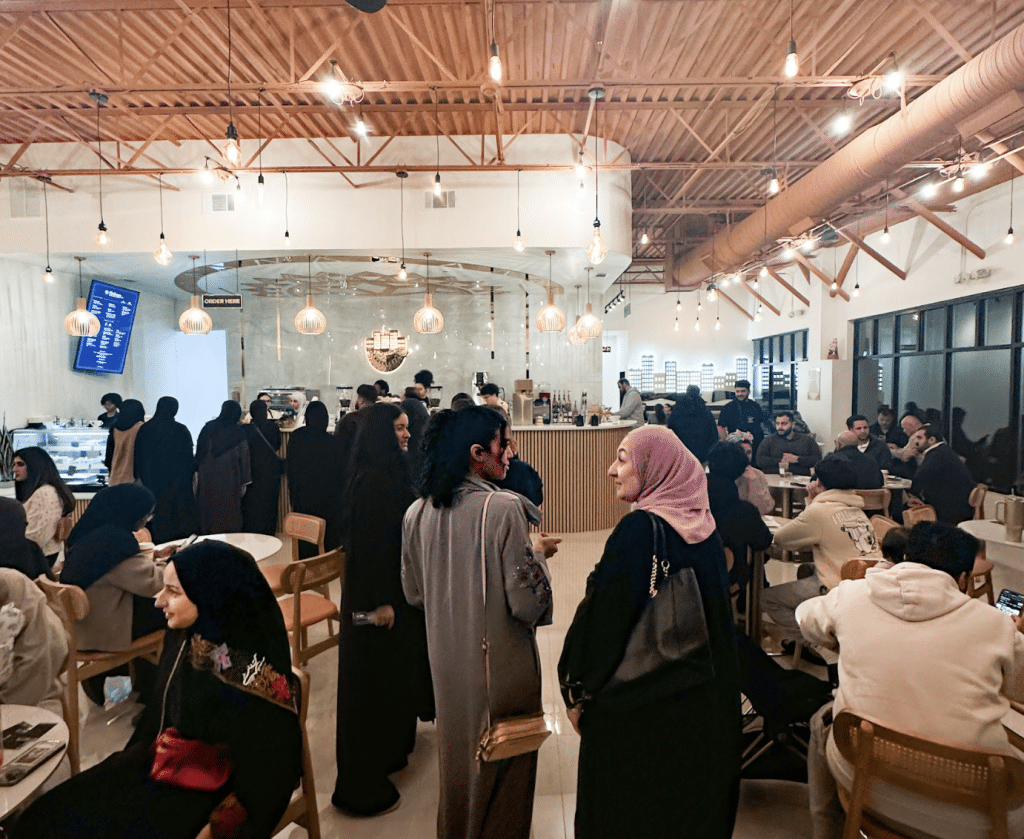
Stumbling into Alpharetta’s posh Shibam Coffee after 9 p.m. during the Holy Month of Ramadan feels a lot like discovering a buzzing speakeasy—albeit a sober one—in an unlikely place: a suburban strip mall of closed shops with chairs long flipped atop their corresponding tables. Yet on a recent night, not two weeks after the cafe opened, the parking lot was so full of Shibam patrons that it took us multiple laps around the strip to find an open spot.
My friends and I had driven 45 minutes from the city after breaking our fast, eager to be surrounded by fellow Ramadan observers—an experience none of us really grew up with, despite our Muslim backgrounds. I decided to fast this year in solidarity with Muslims in Palestine and Sudan, many of whom are being deprived of food. As we walked into Shibam, we felt immediately welcomed in the space that felt both familiar, and fresh.
Inside the shop, bright glass lanterns hung from tall, wood-beam ceilings. Backlit logos and towering wood carvings nodded to the cafe’s namesake: With seven-story structures dating to the 16th century, the Yemeni city of Shibam is known as “the oldest skyscraper city in the world.” Around the corner, a hallway led to a private multifaith prayer room. The aroma of Yemeni coffee and cardamom-spiced desserts competed with the hum of conversations among patrons, happily drowsy from evening worship and another long day of fasting.
For the past year or so, metro Atlanta has welcomed a constellation of cafes like this, specializing in Yemeni coffee beans and treats from Syria, Pakistan, Palestine, and beyond. Shibam Coffee is the latest to join the scene, providing an alternative to alcohol-centric bar culture while giving local customers a taste of a coffeehouse culture that originates halfway around the globe. “Because alcohol isn’t as widely consumed among Muslims, coffee shops and cafes are notoriously common across the Middle East,” Shibam Alpharetta co-owner Wasim Nasir said. Atlanta isn’t the only city enjoying the new wave of cafes: From New York to California, younger Muslims and others seeking quieter, more sober social environments are driving a boom in such spaces.
From Tucker to Alpharetta and beyond
In August, Syrian founders Ahmad and Marianna Alzoukani brought Mint Coffeehouse to Tucker—where it joined fellow newcomer Mokhaport, known for its smoothies and organic Ethiopian and Yemeni coffee beans. Last month, Alpharetta saw the opening of highly anticipated MOTW Coffee and Pastries from Pakistani-American owners Sajjad and Fatimah Shah. In Roswell, Yemeni shop 967 Coffee opened its doors for Ramadan a few short weeks ago. Haraz Coffee House, a popular national franchise from Yemeni-American Hamzah Nasser, is slated to open its first Georgia location this year in Midtown. The list goes on: Persian delicacies at Johns Creek’s Rose Valley Sweets, Palestinian and Emirati treats (and brutally long lines) at Duluth’s Wowbooza, even roving pop-ups from Majlis Mocha, a mobile cart that’s become a staple at Palestine solidarity events across Atlanta.
Shibam itself hails from Dearborn, Michigan, the first Arab-majority city in the country. “A year and a half ago, 80 to 90 percent of Yemeni coffee shops in the U.S. would have been easily traced back to my neighborhood in Dearborn,” Wasim Nasir told 285 South. Dearborn’s Yemeni community blossomed in a small area known as South End, a wellspring of entrepreneurial first-generation immigrants who, for years, were already importing honey, coffee beans, and tea grown in their home countries and largely ignored in the West.
“We had these very interesting flavors like cardamom, ginger, or cinnamon that were just hanging out in this little corner of the U.S.,” Wasim said. “And those flavors are very much home to a lot of us. Yes, there’s uniqueness within specific countries. But when you’re looking at that part of the world as a whole, there was so much back and forth among our lands and ancestries. There’s already a sense of kinship there, which is why I believe the Yemeni coffee train has been so successful. People will often say, like, ‘I’m not Yemeni, but you know, I’m Pakistani or I’m Syrian, and this tastes like home.’”

Ramadan specials and a thriving, diverse customer base
For Ramadan this year, some of these cafes have adjusted their evening hours to accommodate fasting Muslim patrons, establishing alcohol-free third places open through midnight and later—not just for observing customers but for anyone who might be craving a place to unwind with a warm cup after a long day.
Roswell-based self-proclaimed Yemeni chai (known as adani chai) superfans Asim and Yasmeen Fareeduddin make it a point to visit coffeehouses that serve the tea any time they’re in a new city. They told us they felt that metro Atlanta had been lacking in spaces where nondrinkers of all ages can hang out late into the night. In recent weeks, the couple said they’ve tried nearly every new cafe, sampling chais, cakes, savory snacks, and the scene.
“The last time I went to MOTW,” Yasmeen said, “there were high school students doing homework and hanging out together. Other kids were playing board games. Families came in after taraweeh prayer to enjoy some dessert. Anytime you go, there’ll be people ranging from six months of age to 80.”
I had a similar experience during my own single-night coffee-hopping stint: I noticed birthday celebrations, young couples on dates, two college-aged students working on deadline for a presentation with iced coffee in tow, new mothers enjoying the company of their newborns with a warm cup of Arabic coffee, and grandparents feeding each other spoonfuls of ras malai cake and traditional Khaliat Nahal—or Yemeni honeycomb bread.
Qahwah and the traditional Middle Eastern coffeehouse
Coffee—derived from the Arabic qahwah with ties to the Ethiopian region of Kaffa, where the coffee plant was first discovered—has for centuries been a staple in Middle Eastern and North African households, where you’ll commonly find either dark-roast, finely ground Turkish coffee or lighter, spice-infused Arabic or Yemeni coffee, all typically served in delicate four-ounce cups. While Americans rely on coffee for a morning energy boost, qahwah is best sipped leisurely after supper, and is often served alongside sweets and dates as a welcome gift for visiting houseguests.
At Shibam, classic Yemeni coffee is part of a menu with other specialty drinks—like a pistachio iced latte—as well as treats like ras malai cake and honeycomb bread sourced from local home bakers and cooks. MOTW has been adding savory items like empanadas to its menu, but the Yemeni chai remains a favorite, according to Yasmeen, a frequent patron who recommends pairing a cup with either the Kinder milk cake or Dubai chocolate cake, a layered, fudge-topped treat with crunchy pistachio cream filling.
Though each region of the Middle East has its qahwah differences, Yemen’s highlands remain the premier site of harvest for coffee beans used in Arab and South Asian-owned coffee shops both here and around the globe. The war in Yemen and subsequent economic fallout have made life especially challenging for the region’s coffee farmers. But burgeoning cafe franchises like Shibam, which currently supports more than 29 farmers and donates a portion of profits to fund education, health, and development projects in Yemen, are breathing new life into the industry.
Building community at late-night cafes
In the Middle East, coffeehouses have long served as lifelines for communities living under fraught governments. “These spaces have historically been a hub for people to gather and talk about politics, and governments didn’t really like that,” said Shibam Coffee’s Wasim Nasir.
Government leaders would often ban the cafes, making the emergence of such third places symbols of resistance on their own. During the Ottoman Empire, as coffee expanded from the Arabian Peninsula in the 16th century, coffeehouses became hubs for both laymen and high-status poets and scholars to gather and recite literature that often reflected critiques of social and political dynamics, according to coffee history expert Kurniawan Arif Maspul. This exchange of ideas in an otherwise heavily censored environment made coffeehouses neutral meeting grounds and “unofficial political salons” for all strata of society.
Despite an infiltration of government spies monitoring the spaces and subsequent crackdowns—most famously by Ottoman Sultan Murad IV—the coffeehouse as a site of political engagement, dissent, and community-building persisted.
When I asked whether Shibam would continue that legacy of serving as a space for community-building and activism, Wasim enthusiastically said he already had ideas brewing in his head. Later this month, the shop is hosting one of its first such events: a tatreez workshop led by Atlanta for Palestine, part of a worldwide fundraiser for the Middle East Children’s Alliance.
“I’m very big on community,” Wasim says. “I already do a lot of activism in the Michigan area, where I’ve been a part of organizations dedicated to creating third places for Muslim young professionals. Coffee shops felt like a natural extension.”
For Indiana-based MOTW Coffee, coffee shops are a recent project of founder Sajjad Shah’s viral 2014 Instagram account-turned-book, Muslims of the World, an archive of Muslim storytelling born to combat growing anti-Islam rhetoric in the West. Inspired by Brandon Stanton’s popular Humans of New York series and book, MOTW has since evolved into a registered charity that’s raised $30 million for various humanitarian causes, most recently for Gazans amid Israel’s U.S.-armed war in Palestine.
Sajjad, who hails from Pakistan, was moved to create a tangible space for this budding digital community while sipping his wife’s Yemeni chai, a recipe passed down in the family for generations. “People used to come to our house all the time just to get a taste of this chai,” he said. The flagship cafe opened in 2021 in Indianapolis and quickly became a community hub. Two years later, the pair decided to franchise—and within the first month, MOTW closed ten deals, with 30 or 40 more underway.
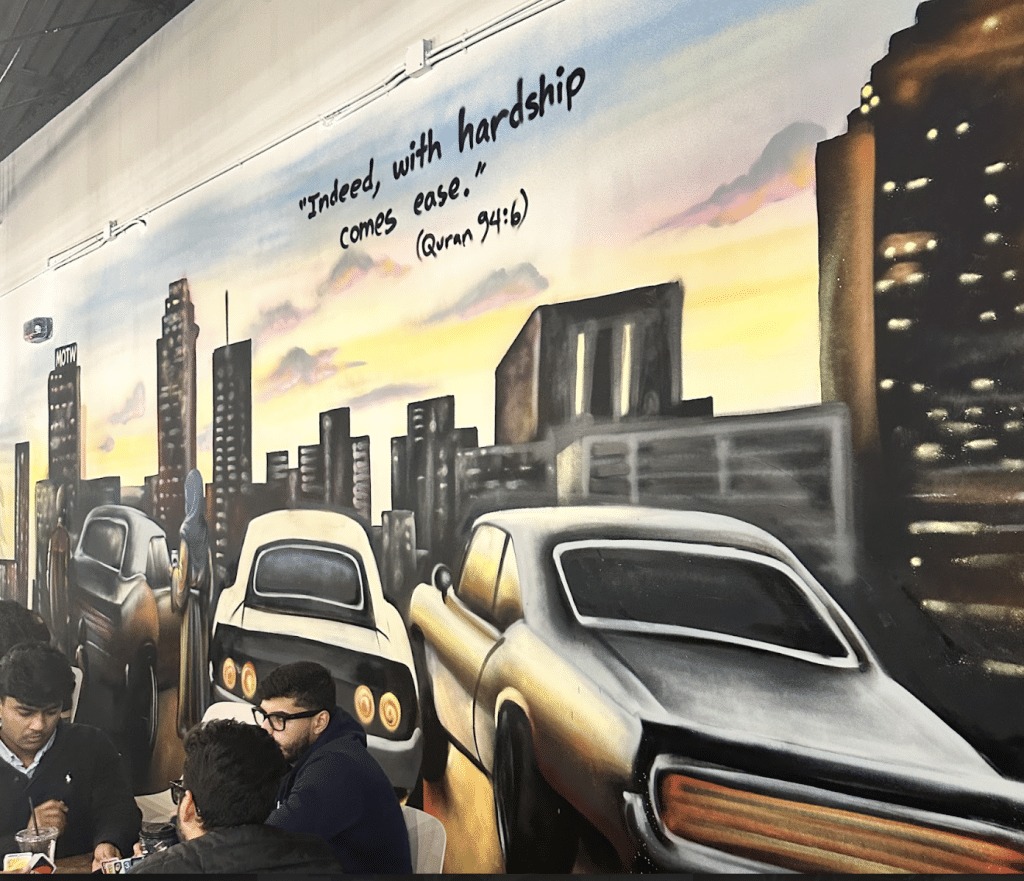
MOTW’s Alpharetta location, which opened last month, is tucked into an unassuming strip mall on McGinnis Ferry Road. Entering the cafe, though, you’re transported to an inviting, plant-lined space featuring a mural of hijabi women with classic cars (a nod to Georgia’s “muscle car” culture, according to Shah) and the Quranic verse “Indeed, with hardship comes ease.” Arched booths with rises of South Asian– and Middle Eastern–inspired tilework are meant to invoke a sense of overlap and connection among diverse Muslim cultures across the globe—remnants of the Ottoman Empire here, Pakistani spherical tessellations there. At 10 p.m. on a recent Ramadan weeknight, the space was packed with mostly twenty- and thirty-somethings. And when that Yemeni chai finally touched my lips, I realized that I, too, would drive many miles along I-285 for a second cup.

Though attendance has been heavy during Ramadan, when many of these late-night shops first “soft-opened” their doors, the clientele has already varied beyond practicing Muslims—and Asim and Yasmeen Fareeduddin are optimistic they’ll continue to be popular even after the holy month.
“We’re big foodies, but not really coffee shop people,” Yasmeen jokes. “But having a space like this, where you can socialize with friends and family after hours, fills such a huge gap for Atlanta.”
To see these third places open up for Ramadan-observing patrons and witness the rapid emergence of so many late-night Middle Eastern and South Asian cafes has been fascinating; the culture of communal gathering into the night feels reminiscent of many immigrant homelands, including my mother’s Pakistan, where a post prayer cup of chai with friends, and gabbing until your eyes got tired, was the beautiful norm. Considering how packed the new metro Atlanta cafes already are—and what feels like a national yearning for community during these uncertain times—it’s clear the demand for such comforts transcends even a single ethnic background. And it’s safe to say we’ll be seeing more of them soon.
Middle Eastern/South Asian cafes in metro Atlanta:
The local Atlanta-area resource Atlanta Coffee Shops has been on location at several of these cafes; where available, the landing pages of these cafes are linked separately below.
MOTW Coffee (Alpharetta), 5202 McGinnis Ferry Road; Mon-Fri: 7 a.m.-5 p.m. Sat-Sun: 9 a.m.-6 p.m.*Ramadan hours: Mon-Fri: 7 a.m.-1 a.m., Sat-Sun: 9 a.m.-2 a.m.
Shibam Coffee (Alpharetta), (Instagram | Atlanta Coffee Shops) 4000 North Point Parkway, Mon-Thu: 10 a.m.-10 p.m., Fri-Sat: 10 a.m.-midnight, Sun: 10 a.m.-10 p.m., *Ramadan hours: Sun-Thurs: 10 a.m.-midnight, Fri-Sat: 10 a.m.-2 a.m. (Closed daily 7-8:30 p.m. to allow observing employees to break their fasts)
967 Coffee Co. (Roswell), 11235 Alpharetta Highway #136, Sun-Thurs: 9 p.m.-2 a.m., Fri-Sat: 9 p.m.-4 a.m.
Wowbooza (Duluth), (Instagram | Atlanta Coffee Shops) 1630 Pleasant Hill Road, #170, Fri-Sun: Noon-midnight. Mon: Closed. Tues-Thu: 1-11 p.m.
Baladi Coffee (Kennesaw), (Instagram | Atlanta Coffee Shops) 3061 George Busbee Pkwy NW #2000, 7 a.m. to 10 p.m. daily, *Ramadan hours: 7 a.m.-12 a.m. daily
Rose Valley Sweets (Johns Creek), (Instagram | Atlanta Coffee Shops) 6000 Medlock Bridge Parkway, #B100, Mon-Sun: 11 a.m.-8 p.m.
Mokhaport Yemeni Coffee (Tucker), 1861 Mountain Industrial Boulevard, #106A, Fri: 6:30 a.m.-1 p.m. | 3-6 p.m., Sat-Sun: 9 a.m.-6 p.m., Mon-Thu: 6:30 a.m.-5 p.m.
Mint Coffeehouse (Tucker), (Instagram | Atlanta Coffee Shops) 3926 Lawrenceville Highway, Mon-Fri: 7:30 a.m.-5 p.m. Sat: 8 a.m.-5 p.m. Sun: Closed
Author

Related Articles
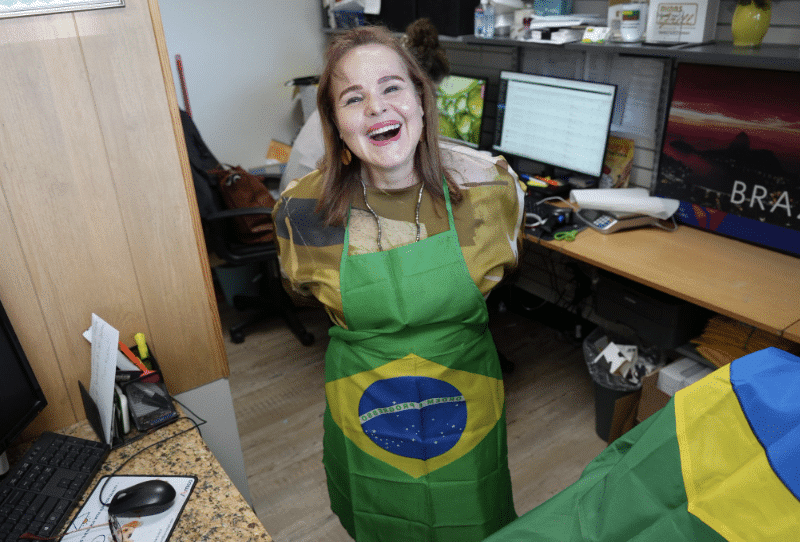
From dawn till dusk, Minas Grill & Emporium stays open to meet the needs of Atlanta’s Brazilian community
For decades, the Marietta hot spot has screened World Cup matches for fans of the Brazilian team. With the games coming to Atlanta this summer, they’re getting ready to party once again.
Andres Carrillo, founder of the pop-up Cocina Pachuco, is using his cuisine to fundraise for immigrants in detention
Born and raised in El Paso, the recently arrived chef is strengthening ties with his new home. One way he’s doing that: supporting the state’s immigrant communities.