“I couldn’t pass. It’s just a new language.” Afghan Women Seek Permit Tests in Pashto
Local group advocates for language support at Georgia’s Department of Driver Services.
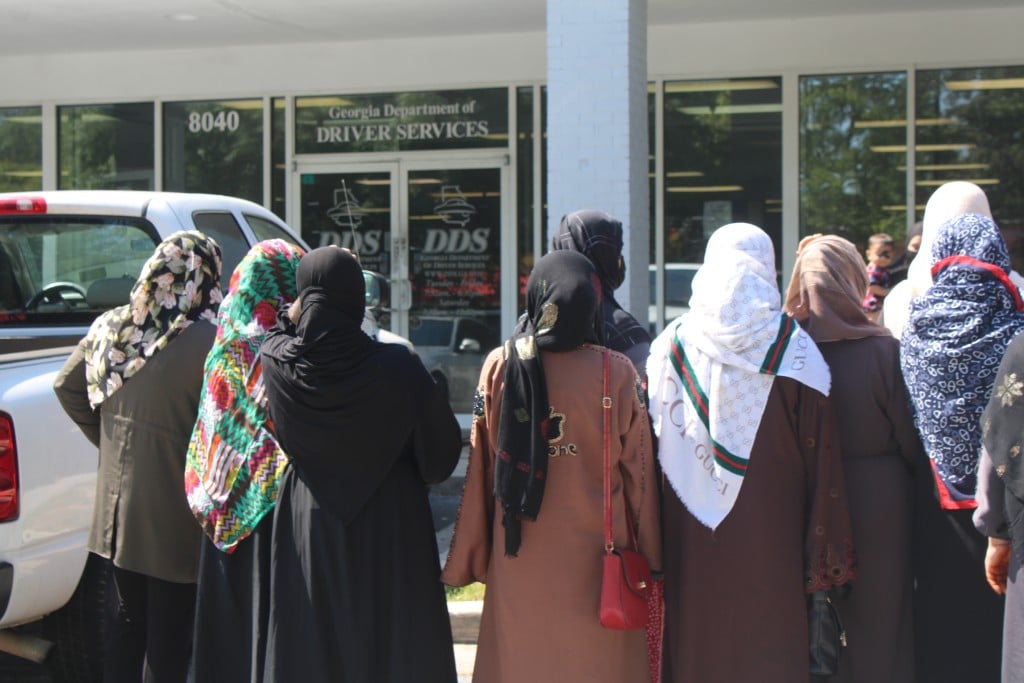
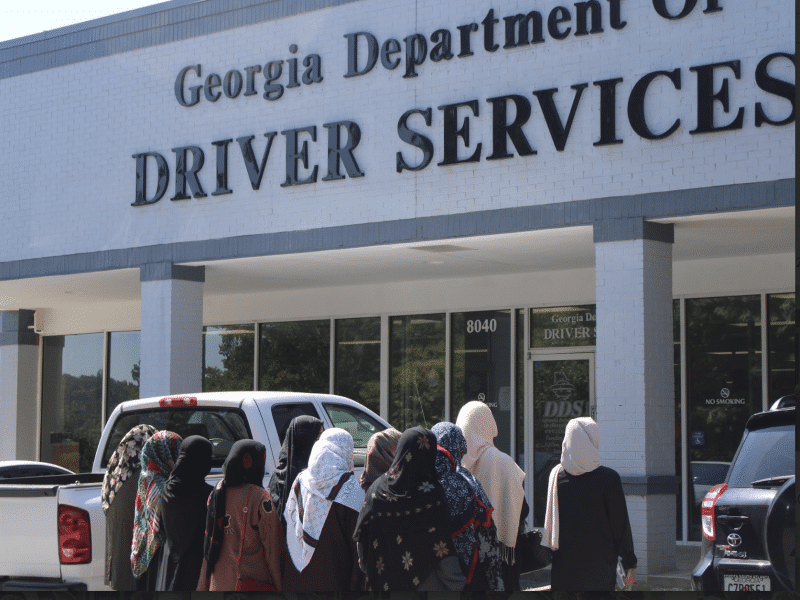
Around a dozen women gathered under a tree in a parking lot between a Waffle House and a half empty strip mall in Lithonia on Tuesday. They stood in the partial shade, trying to hide from the July heat bouncing off the cracked concrete, until all 15 in their group had arrived.
Then, with a couple of toddlers in tow, they headed to their destination: the Georgia Department of Driver Services.
They were led by Shaista Amani of the Afghan American Alliance of Georgia (AAGA).
When the GDDS representative at the entrance asked her what she was doing, Shaista explained she had brought the women to make appointments for their driver’s permit tests. And they needed to take the exam with a Pashto interpreter.
“So they all have the documents you’re supposed to have?” asked the GDDS officer. “Proof of identity and two pieces of mail? You wanna come up to counter 13? Have them sit in the front row for me please…”
“Proof of identity and two pieces of mail?”
Georgia Department of Driver Services employee
The women took their seats, alongside dozens of others waiting for their numbers to be called.
Originally having fled Afghanistan, the women only speak Pashto and are students in the AAGA’s driving permit class. The nonprofit was founded in the wake of the Taliban takeover in 2021, and helps Afghans who have been arriving here with everything from booking a doctor’s appointment to teaching them how to pay their utility bills online.
For the last month, they’ve been logging onto zoom three days a week to learn Georgia’s road rules from AAGA’s Pashto-speaking case manager, Fareed.
One of the women patiently waited with her 20-year-old daughter. Ms. Ahmadi had arrived in the U.S. four years ago, she said, and was desperate to learn to drive. The AAGA classes have been a lifeline. “We had never even heard about anyone that was willing to help us with the permit.”
In a metro region where access to public transportation is hard to navigate at best, or almost nonexistent at worst, learning to drive is essential to integrating into life. It’s also very different from Afghanistan, where they were used to getting around with ease.
“We can literally just take a taxi wherever,” said Ms. Monsef, with Shaista interpreting for her. She moved to Georgia more than two years ago and lives in Clarkston with her husband and four children.
Here, she explained, she was dependent on her husband for transportation, inhibiting her ability to go to English classes, get a job, and drive her children to doctor’s appointments. The only days her husband does not work is on the weekends. “When we have doctor’s appointments, then [he] has to take a day off. He does not get paid for that.”
“Right now all the responsibilities are on the man’s shoulder, because we literally feel like we cannot do anything,” said Ms. Ahmadi, chiming in. She said driving would not only make it possible for her to take on more responsibilities, but that it was also vital for emergency situations. When her son was bitten by a dog, she said, “there was no one to help me. I had to knock on the doors of the neighbors and then one of the Afghan neighbors took my son to the emergency room.”
“There was no one to help me. I had to knock on the doors of the neighbors and then one of the Afghan neighbors took my son to the emergency room.”
Ms. Ahmadi, Clarkston resident
Driving, Ms. Ahmadi added, isn’t only important for basic necessities, but also for their mental health. “All week, I literally am at home all day long…when our children want to go to the park or if they want to go outside, then we really need to have some kind of transportation to take them.”
Back at counter number 13, Shaista stood with about a dozen social security cards and IDs scattered in front of her. She was told GDDS could help with providing a Pashto interpreter.
They would just have to wait months for their appointments. “October. We are booked all the way to October.” For the next 30 minutes, GDDS officers filled out small white forms with the appointment information for all the women.
Shaista, along with two case managers from AAGA, passed the appointment forms out to everyone, and they filed out of the building.
The permit test, officially called the “Knowledge Exam,” is offered in 13 languages, including Arabic, Chinese, Farsi, French, German, Hindi, Japanese, Korean, Russian, Spanish, Turkish, and Vietnamese. In the past, the DDS has been responsive to adding languages spoken by incoming refugees. After reporting from 285 South, and Shaista’s continued advocacy, Dari was added in 2023.
The AAGA sees an urgent need for Pashto to be included. When Shaista conducted an online survey asking whether Pashto was a language option that was needed, nearly 100 people responded that it was.
One woman, wearing a navy blue and white hijab, said that she had taken the test four times in English. “I couldn’t pass. I have learned for months and months but it’s just a new language.” Every time she failed, she said, laughing, her husband teased her, saying “I knew you were going to fail!” She’s hoping taking the test in Pashto will mean she will finally pass.
“I couldn’t pass. I have learned for months and months but it’s just a new language.”
AAGA client
285 South reached out to the GDDS to ask if the agency had plans to add Pashto to the list of language options. “DDS will monitor the foreign language tests requested and make any language additions upon that data,” replied a GDDS spokesperson in an email. In a follow up email she said the agency “will consider Pashto if things change.”
But while the outcome of that decision may take some time, there was good news for the 15 women who showed up in Lithonia. The GDDS representative said that they would help them get earlier appointments. “We hope to make arrangements for the customers that visited the Lithonia Center to be tested (with the interpreter) well in advance of the October time frame that they were initially given.”
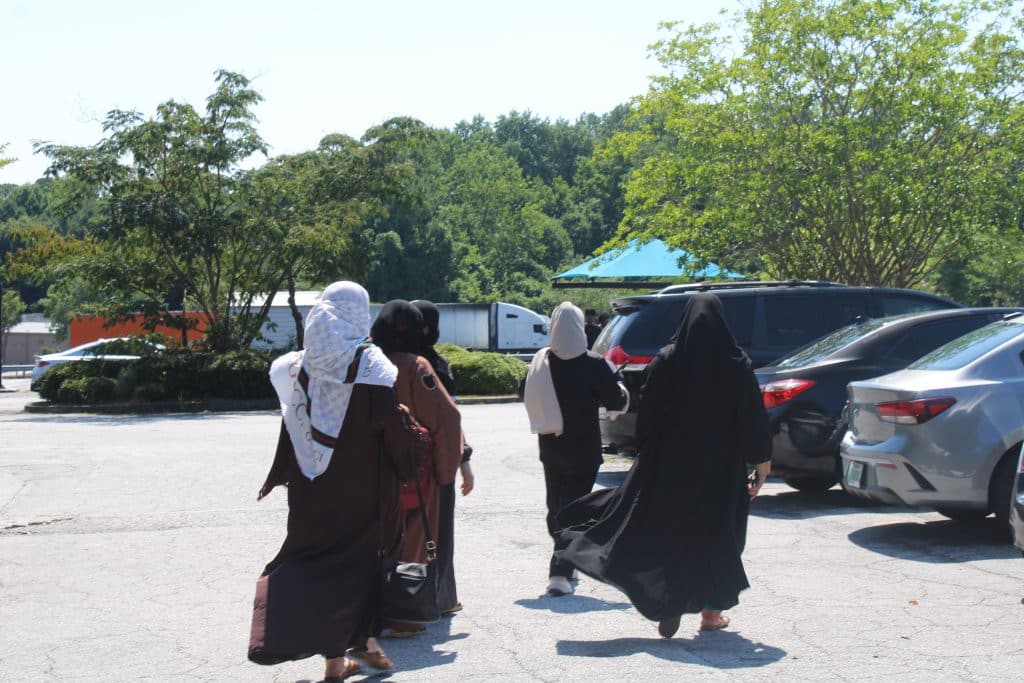
Appointments in hand, the women streamed out of the DDS office, hitting the wall of heat of the parking lot. They were upbeat, and already dreaming of a future where they might be mobile. Ms. Ahmadi talked of her hopes of driving her daughter to GED classes. Her daughter finished high school in Afghanistan, but her education has stalled since arriving in Atlanta.
Before getting back into cars driven by Shaista and two AAGA case workers, the women clustered together, chatting, an island of excitement in a sea of gray concrete. One lady, dressed in a red and white dress, said that just by coming, she felt like they had already gotten their permits. The others burst into laughter.
Shaista laughed too. “They’re saying we haven’t done anything but at least we’re happy we took a step.”
Author

Comments (2)
Leave a comment
Related Articles
Delight among community members as 12 more languages are added to the Georgia driving permit test
“We’ve been waiting and anticipating this”: Now beginning drivers can take the test in Haitian Creole, Rohingya, Pashto, Yoruba, and more.

The roadblock facing seniors in Gwinnett County
Norcross-based nonprofits say community gatherings are a lifeline for seniors, but limited transportation options are keeping many from coming together.

UPDATE: Driving program to resume after uptick in donations after 285 South story
‘Women Behind the Wheel’ program, which provides free driving classes to refugee and immigrant women, was on hold because of a lack of donations
I’m glad you continue to reveal these friction points that people experience trying to restart their lives here, which is already hard enough. These are folks we should be caring for deeply. I am grateful for organizations that fill in the gaps, but I want out local governments to see and feel this need, to step up.
This has me thinking about our process for getting new drivers safely integrated on the road. It’s a risky activity most of us do a lot! But with instruction in their language, probably more thorough than I got as a teenager, and the physical driver’s test, this paper exam language barrier feels extra frustrating. It feels like the least essential step and yet the hardest.
Raihananoor9@gmail.com