
Georgia Tech alumni continue to demand that the University System of Georgia divest from Israel’s war on Gaza
The group wants “to ensure that we don’t have our tuition and our legacies at our schools connected to something that is hurting so many people,” one alum said.
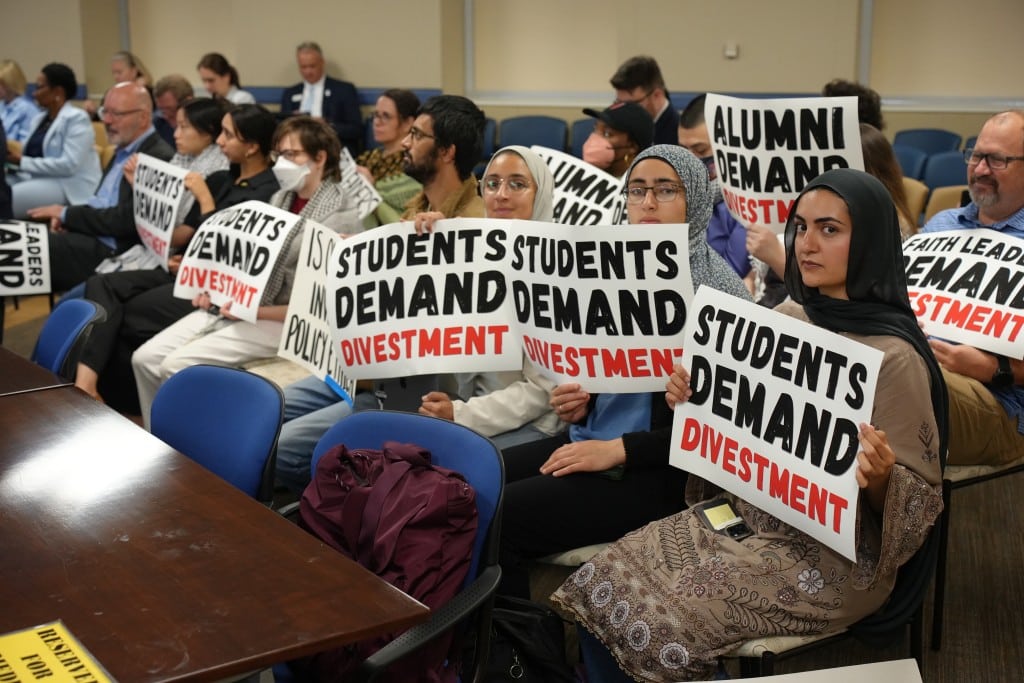
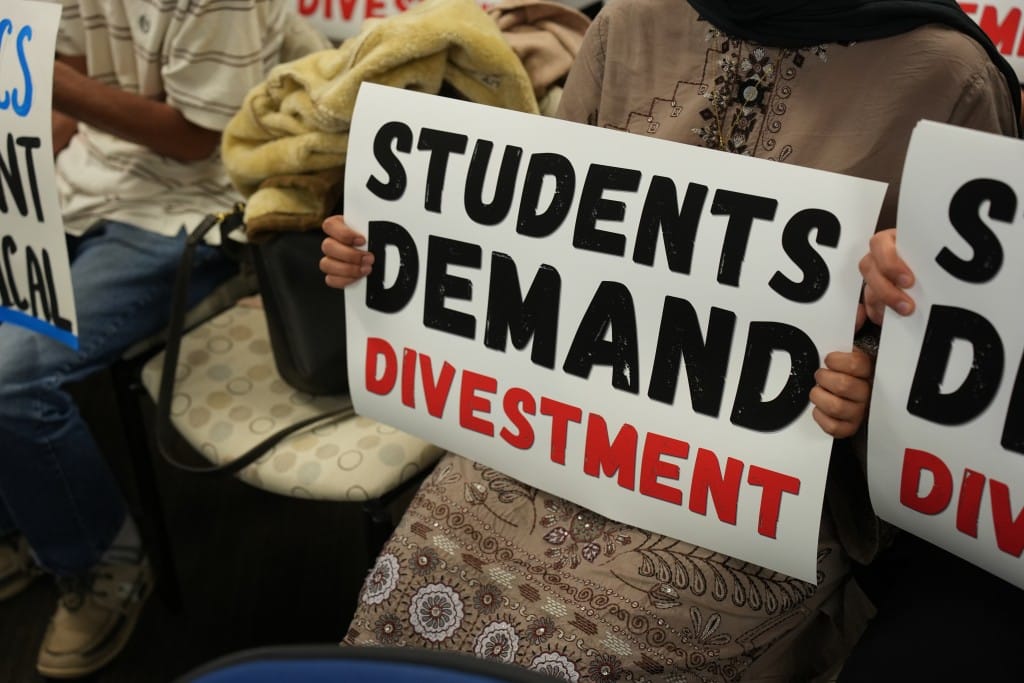
On Tuesday, a group of about 20 Georgia Tech alumni, advocates, and faith leaders gathered at a meeting of the Board of Regents for the University System of Georgia—which oversees 25 institutions including Georgia Tech, Georgia State, and the University of Georgia—to demand divestment from companies profiting from Israel’s war on Gaza. While the 19-member board conducted its business, the activists sat silently holding signs that read “Students Demand Divestment” and “Faith Leaders Demand Divestment.”
“We want to hold our universities to a higher ethical standard to ensure that we don’t have our tuition and our legacies at our schools connected to something that is hurting so many people,” said Dania, a member of the coalition, Georgia Tech Alumni for Palestine, who asked to be identified only by her first name.
Renee Alnoubani, a Georgia Tech student, said the group surveyed students on campus earlier this year and found the majority of those polled think the university should divest from companies linked to human rights violations in international conflicts. They plan to gather more responses and eventually share the findings with the board, she said.
Renee explained that one of the coalition’s proposals, which it has previously pitched to the board, is the implementation of a comprehensive protocol for considering geopolitical events before making investments, including a regular assessment of investments by a committee made up of students, community members, and financial and human rights experts.
“We made it clear to the Board of Regents and the Chancellor that we’re willing to work with them to find a solution that makes sense, that is feasible, but ultimately that is ethical,” Renee said. Last year, Dania said, they met with Chancellor Sonny Purdue, who was willing to hear them out. Nonetheless, the board has not made a commitment to divest.
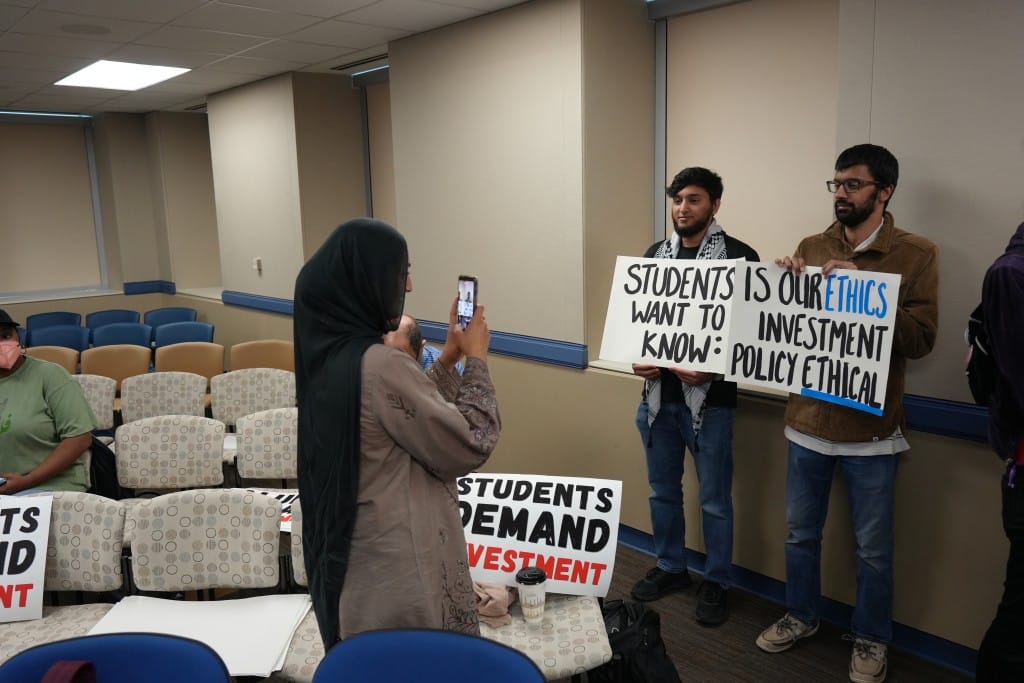
The group has also presented the Board with research showing specific partnerships between institutions that are part of the university system and companies that have benefited from Israel’s war on Gaza, including Lockheed Martin, BAE Systems, Boeing, and General Electric.
Last year, Renee addressed the Board of Regents to urge divestment from Israel and companies involved in the war in Gaza, and spoke on behalf of students in Gaza who have been affected by the conflict. She cited United Nations human rights experts who’ve argued that, with the destruction of over 80 percent of Gaza’s schools, Israel’s actions constitute scholasticide—the systemic obliteration of education through the destruction of its infrastructure.
This year, Georgia Tech Alumni for Palestine sent Chancellor Purdue a request to speak at Tuesday’s regular meetings on April 6—a request that was ultimately denied, according to the alumni group. In response to 285 South’s request for comment, a spokesperson wrote that the University System of Georgia “encourages free expression and respectful civil discourse. Following an opportunity to address the Board of Regents at a previous meeting, we continue to support the right to peaceably assemble and appreciate the group expressing their views as provided by the First Amendment.”
“We’re teaching students to be change makers. Our school always emphasizes innovation and bettering the world and being the change,” Dania said. “What do our universities tell us as students as a whole if they make it impossible for us to better our institutions?”
Author
Related Articles

“I didn’t expect it to happen in my family.”
A flurry of homemade videos points to a summer uptick in immigration arrests in the Atlanta area
Venezuelan man dies in immigration custody in Georgia
45-year-old Jesus Manuel Arenas-Silvia is the third person to die in ICE custody in Georgia this year.
“The side of hope”: Following tragedy back home, Atlanta-area Venezuelans find strength in one another
On a recent Sunday, nearly 100 volunteers gathered in Norcross to send supplies to the earthquake-ravaged country—and deepen ties in the diaspora.