Inside Atlanta’s “mega master” immigration hearings
Advocates warn of a concerning trend inside Atlanta’s immigration courthouse: hearings that resemble an “assembly line . . . rushing people into a mass deportation process.”
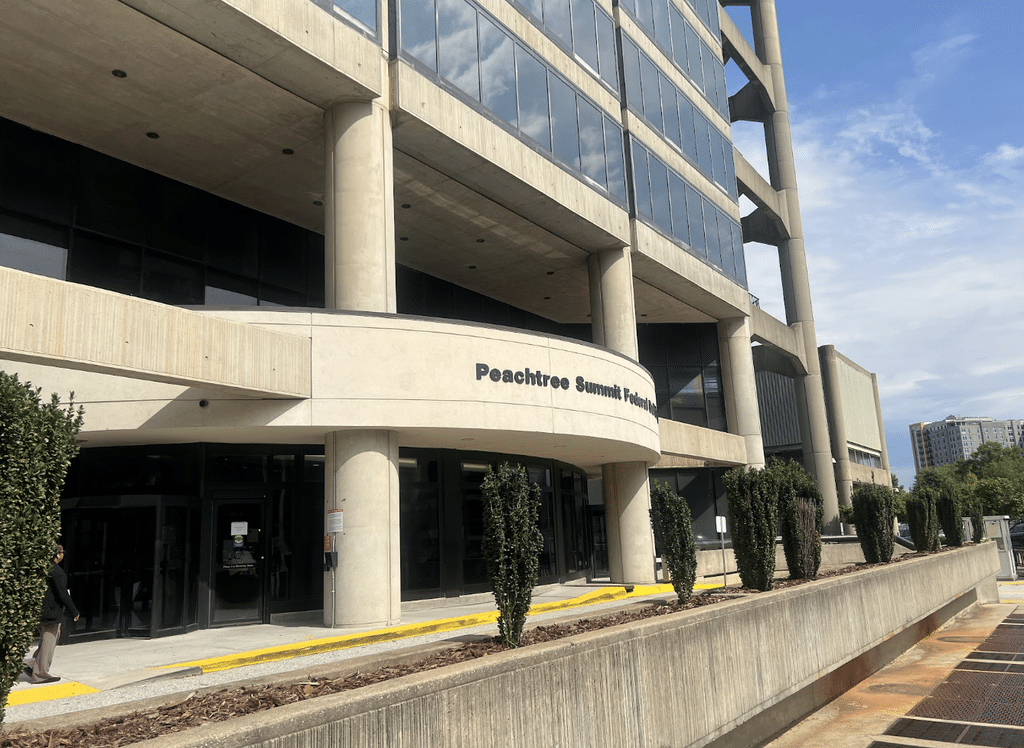
On a recent Tuesday morning, people spilled out of Judge Amy Fairchild Haer’s immigration courtroom and into the hallways. Benches inside the room could seat only a couple dozen; the rest of the people on the docket that morning—around 70 in all, as well as any children they had in tow—were left to either stand in the back of the room or squeeze into a small space in the doorway, hoping they’d be close enough to hear it when the judge called their name. Two other hearing rooms in the same building—401 West Peachtree, one of two immigration court locations in downtown Atlanta—also had dockets of close to 100 people that day.
It used to be that these immigration courts only saw around 20 or 40 people per day. But, as the Trump administration has pushed deportation numbers to record levels, immigration courts have been increasing the size and speed of their own dockets as well.
Since May, advocates around the country, including here in Atlanta, have increasingly noticed these “mega master” calendar hearings, in which groups of almost 100 people at a time appear in front of one immigration judge for administrative check-ins. It’s amounting to what one attorney described as “an assembly line that is rushing people into a mass deportation process.”
The worry, advocates say, is that hurrying this many people through the system when the stakes are so high will inevitably lead to more removal orders. “This is going to be a group of people without attorneys, that they’re not going to have gotten proper notice,” Vanessa Dojaquez-Torres with the American Immigration Lawyers Association (AILA) told NPR in May. They might not be prepared and there aren’t enough seats in courtrooms, “so it’s almost like they are being designed to increase” how many people get deportation orders automatically, she said.
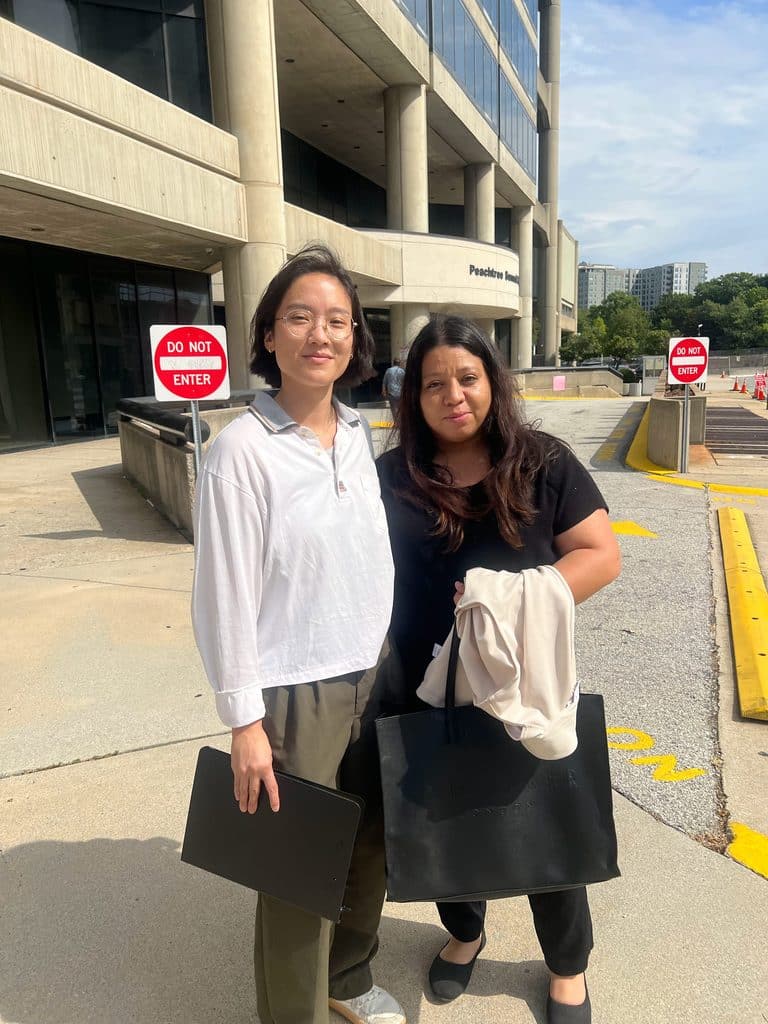
“There’s almost like a time pressure to get all these people in and out of this pipeline,” said Sonia Otero, standing outside the West Peachtree building after observing a morning hearing. She’s a paralegal with AAAJ-Atlanta who’s been tracking the hearings for over a year through the organization’s Court Watch program. “At one point, the security guard had to come out and say, ‘We need the hallway free.’ But then, how do people hear when to come in?”
“If someone misses a number, misses a person, didn’t understand what a judge was saying,” she continued, the impact could lead to an immediate removal order, “affect[ing] someone’s life, someone’s livelihood.”
Under the fluorescent lights of the courtroom, Judge Haer went through a handful of individual cases. One respondent had not paid a filing fee; she rescheduled their hearing. Next up was a young girl who appeared to be around middle-school age. She and her mom were informed they would have to reschedule, too, because juvenile cases were only heard at the other downtown Atlanta courthouse on Ted Turner Drive. A few respondents were on Webex, a video conferencing software, with their attorneys, who were also dialed in. One attorney who hadn’t been able to locate his client—not showing up for a hearing can lead to a removal order for being “in absentia”—pleaded with the judge for more time. On several occasions, she instructed the Department of Homeland Security (DHS) representative on Webex to file a Form I-213, a “Record of Deportable/Inadmissible Alien”—essentially DHS’s charging document that a person should be removed.
On the wall was a broken analog clock, the time stuck at 4:35 p.m. An infant sitting in the lap of a woman in a wheelchair eventually fell asleep. A young girl of no more than ten sat patiently in the back row, swinging her feet, which barely touched the ground. Outside the doorway of the courtroom, a toddler clutched her mother’s hands; they had been standing for nearly two hours.
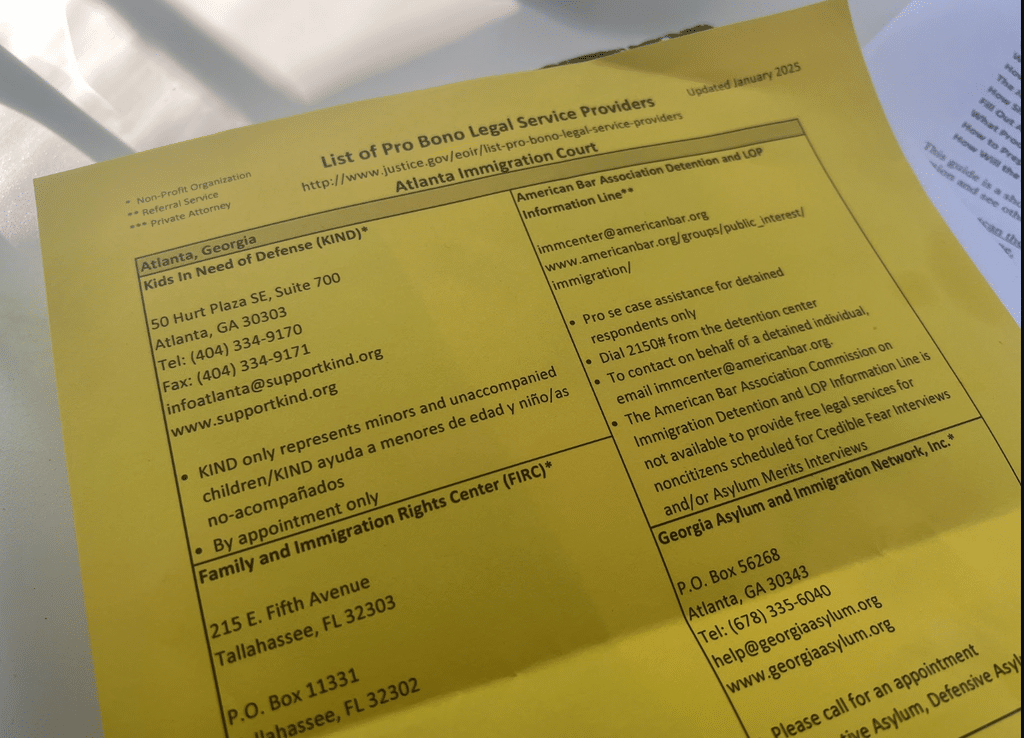
At least twice, the judge read out a list of names in roll-call fashion, and people raised their hands if they were present. If they didn’t have lawyers (most didn’t), they were told they could come to the front to pick up packets of information- that included a list of pro bono attorneys in the area- and then leave. Those who wanted more time to find a lawyer were told to return to court in exactly one month, on October 21.
Immigration court is a fact of life for many people in the U.S. who were born in another country. The courts have become crucial—and increasingly contentious—components of the Trump administration’s efforts to remove immigrants from the country. Despite their name, immigration courts aren’t independent judicial courts; instead, they’re part of the Department of Justice, which is under the executive branch, and which can hire and fire judges at will.
The courts themselves are problematic, vulnerable to the political goals of each administration, says Gregory Chen with the AILA, a national nonprofit that has been tracking the mega master hearings. In this case, the goal is mass deportation: “Mega masters are a significant, major contributing factor to the erosion of the fair legal process that the courts follow to make sure that people have a clear understanding of their rights before their cases move forward,” he said. “Legal rights should not be decided based on a hand-raising exercise with mass numbers of people.”
The Department of Justice responded to 285 South’s request for comment about the large numbers at master calendar hearings, writing: “The Justice Department is restoring integrity to our immigration system by hearing cases fairly, expeditiously, and uniformly, in accordance with the law.” The Executive Office for Immigration Review also sent a statement: “Unnecessary delay hurts both aliens with meritorious claims and the American public who wish to see aliens with non-meritorious claims removed as quickly as possible. As it continues to add new immigration judges, EOIR will continue to make scheduling adjustments to ensure all cases are handled in a timely and lawful manner.”
Isabel, a Lawrenceville resident who came to the U.S. five years ago from Nicaragua, was among those who raised their hands in Judge Haer’s courtroom. Standing outside the West Peachtree Street building after the hearing, she held the packet of information the judge had given her with the list of pro bono legal providers. She had to be back here in one month, with an attorney. “Que nos dieron poco tiempo,” she felt: They gave us too little time.
On the list provided by the court were two organizations (KIND and FIRC) that exclusively represent unaccompanied minors – not relevant for anyone at the hearings in the West Peachtree building, since juvenile cases are at the courthouse on Ted Turner Drive. Another organization listed was a hotline for people in detention—also not relevant for those who were at the hearings. The fourth, the Georgia Asylum and Immigration Network (GAIN), told 285 South in an email: “GAIN is closed to new client intakes, and we do not have a realistic timeline for when we will be able to reopen.” (KIND and FIRC didn’t respond to 285 South’s request for comment about their capacity to take new clients.)
Isabel, who works as a home health aide and didn’t want her real name shared, was worried about the cost of a private attorney (having an attorney can more than double the chances of a judge granting immigration relief, according to the American Immigration Council) on top of her other expenses: “renta, comida, todo este.” She’d need to have $3,000 to start with to secure a good lawyer, she said. Total, she’s expecting legal representation to cost her $12,000.
She is seeking asylum, she said, because back in Nicaragua, “tengo la problema de persecucion.” I have the problem of persecution. If she’s ordered deported, she said, she’ll have to find another country to go to, because there’s no way she can return to Nicaragua.
Her plan had been to bring mother and brother here too. The system in the U.S. “es bueno, pero es duro a la vez por este mismo proceso.” It’s good, but at the same time, it’s tough because of this very process.
“Hay veces me siento como que . . .,” she said, struggling to find the right words. Finally she does: “como que so delincuenta.” There are times when I feel like . . . like I’m a criminal.
Sonia, who’d also come back outside, took out a card and handed it to Isabel. Though AAAJ-Atlanta doesn’t have the capacity to take on clients at the moment, she told her they can provide her with a list of trusted private attorneys. Isabel smiled, embraced Sonia, and then walked toward the parking lot.
Author

Related Articles
After her brother’s death in ICE custody, a Georgia woman is left with unanswered questions, the logistics of his burial—and deep grief
On July 13, Jesus Manuel Arenas-Silva became the 22nd person this year to die in ICE custody. Advocates say the government isn’t providing the medical care detainees need.
“You’re not supposed to shy away from that”: At a weekend vigil, people remember immigrants whose lives were cut short
The service doubled as a fundraiser for the family of Jesus Manuel Arenas-Silva, who died in ICE custody in Georgia in July.