
Men in Folkston ICE facility end hunger strike after 30 days
“His arms and legs were shaking, and he felt sick,” said wife of hunger striker.
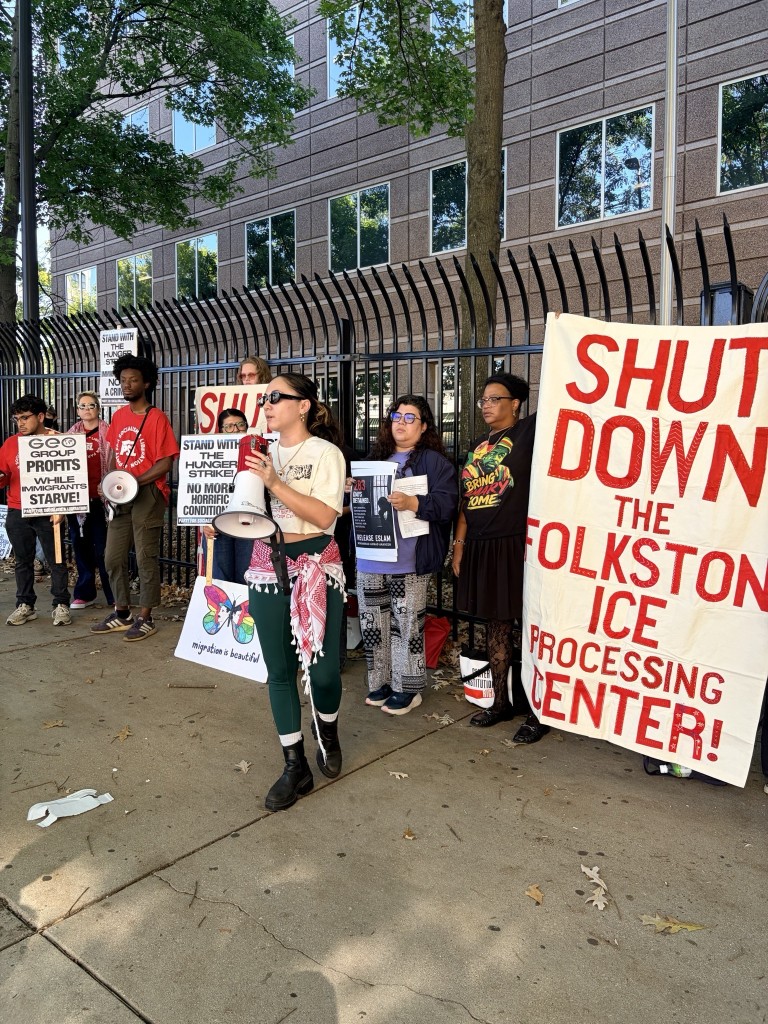
After nearly 30 days, a group of men detained in the Folkston ICE Processing Center, a detention facility about 130 miles south of Atlanta, have ended their hunger strike. Initially, over 500 men were on the strike, which began on October 6. A dozen of them persisted on the strike for nearly a month, before ending the strike on November 4, according to immigrant rights advocates and the relatives of the detainees.
The men were protesting their prolonged detention and the conditions at the facility, and demanding that they be released while they continue to pursue their asylum and immigration cases.
“Slowly, everyone started giving up,” said Hajar Alhayazei. Her fiancé Eslam Mohammad Ahmad Ananzeh, who is from Jordan and seeking asylum, kept up the hunger strike for a month. “During that time, the officers would take them to rooms, [and] they brought them chicken, fries, pizza,” in an effort to get the men to eat.
“They saw there was no chance of staying on a hunger strike,” said Hajar. Eslam was arrested and detained in December of 2025, a month before he and Hajar had hoped to have their wedding.
Though the strike is over, Immigration and Customs Enforcement (ICE) officials did respond to one of the protestors’ demands: transferring some of them out of the Folkston facility. Four of the men who had been on hunger strike for a month have been transferred to the Robert A. Deyton Detention facility, about 30 miles away from Atlanta, according to Samantha Hamilton, an attorney with Asian Americans Advancing Justice-Atlanta, an organization that has been advocating for the protestors.
45 of the detainees who had initially been on hunger strike – representing a range of countries including Russia, Pakistan, Nepal, Afghanistan, and Sudan – had sent an open letter in October, detailing conditions in the facility, and asking whoever reads it “simply not to ignore it.”
In their letter, the men described facing multiple issues at the facility, including “property confiscations during searches, arbitrariness and impunity of guards, occasional failures of air conditioning, plumbing and all other systems, regular collective punishments affecting many detainees because of the actions of one person, poor food, extremely limited medical care, and many others.”
Several of the men were placed in solitary confinement at Folkston, including Eslam, said Hajar, and Andrei Gerdiukov, an asylum seeker from Russia, his wife Polina Chertushkina, told 285 South.
The Folkston hunger strike made national headlines, and drew the attention of elected officials like Georgia Senator Raphael Warnock. Staff from the senator’s office visited the detention facility and met with some of the men, said Jozsef Papp, press secretary for the senator. Eslam was one of the men who met with his staff and gave them his A-number so that they could monitor his immigration case, Hajar said.
Senator Warnock and Senator Jon Ossoff have asked federal officials to determine whether officers at the detention retaliated against hunger strikers at the sprawling facility, including placing some of the protesters into solitary confinement, according to reporting from The Current.
Eslam was among the four people who were transferred to the Deyton facility, but others, like Andrei, remain at Folkston. His wife Polina lives in New York, and they’re hoping he’ll be transferred to a facility there soon.

Andrei lost a lot of weight and is still recovering from the hunger strike, Polina told 285 South. “They had breakfast last Wednesday [Nov. 4], and he said he was shaking, his arms and legs were shaking, and he felt sick,” she said. “He wanted to throw up, and he said it was very terrible.”
Andrei was given painkillers and vitamins by the Folkston staff to recover after spending so long without food, Polina said.
“I felt a relief because after 30 days without food, I started worrying about his health, about his stomach, and I know that it’s very dangerous,” she said. She’s not sure what the long term impact will be on his physical, mental, and emotional health, but, she said, “of course, he will face consequences in the future.”

Author

Related Articles

Just days after sending their team to the nationals, Gwinnett soccer twins held by ICE
“They’re like brothers to us”: Family and community members advocate for the release of 19-year-olds Luis and Carlos Orta-Santoro

100-year-old Korean grandma joins Georgia’s AAPI voter surge
This would be the last ballot the Suwanee senior ever cast, she told Election Day volunteer Xavier Kim.

“They Cannot Break Us”: Lawmakers make history as a blue wave crashes over Georgia
Fueled by anger over ICE, gas prices, and war – immigrant voters came out, and immigrant candidates win