“Our greatest wish is to return home”
At a rally on the Beltline, coordinated by the Venezuelan opposition party, Venezuelans celebrated the capture of Nicolás Maduro—and expressed hope for the future of democracy.
Around 2 a.m. on Saturday, Jesus Colmenares was woken by the sound of his phone buzzing. A native Venezuelan living in Lawrenceville, Jesus was getting calls and texts from friends and family back home, letting him know: They’d been hearing explosions in the capital, Caracas. Venezuelan leader Nicolás Maduro—who’d been in power for the last dozen years—had been taken into custody by U.S. forces.
“Esa noticia fue impactante,” Jesus said. “Al momento no sabía cómo reaccionar, pero después, ver que era cierto fue duro porque al haber emigrado no fue fácil.” That news was shocking. At the time I didn’t know how to react, but later, seeing that it was true was difficult, because having emigrated wasn’t easy.
As he cried, he explained that he left his home country 11 years ago—one of millions who’ve fled Venezuela in the wake of rising political repression, a collapsing economy, and widespread gang violence. Today, Jesus works for a food company in Georgia—and felt hope, he said, after seeing the news of Maduro’s capture. “Ver que sea el principio de un fin que hemos deseado con el corazón, no tiene nombre.” Seeing that this is the beginning of an end that we have longed for with all our hearts is beyond words.
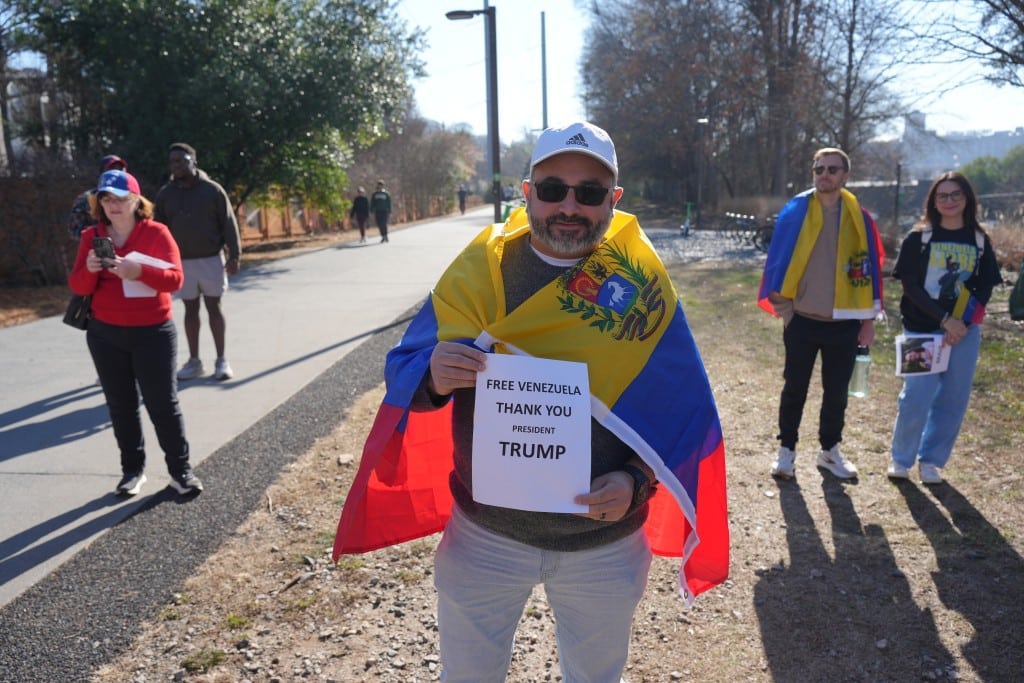
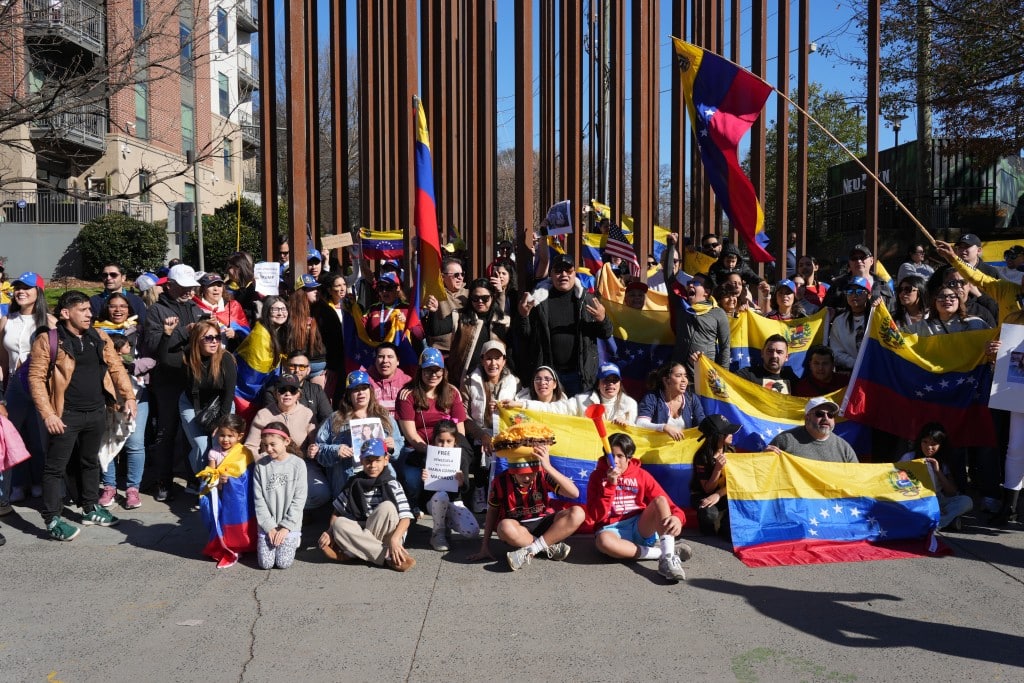
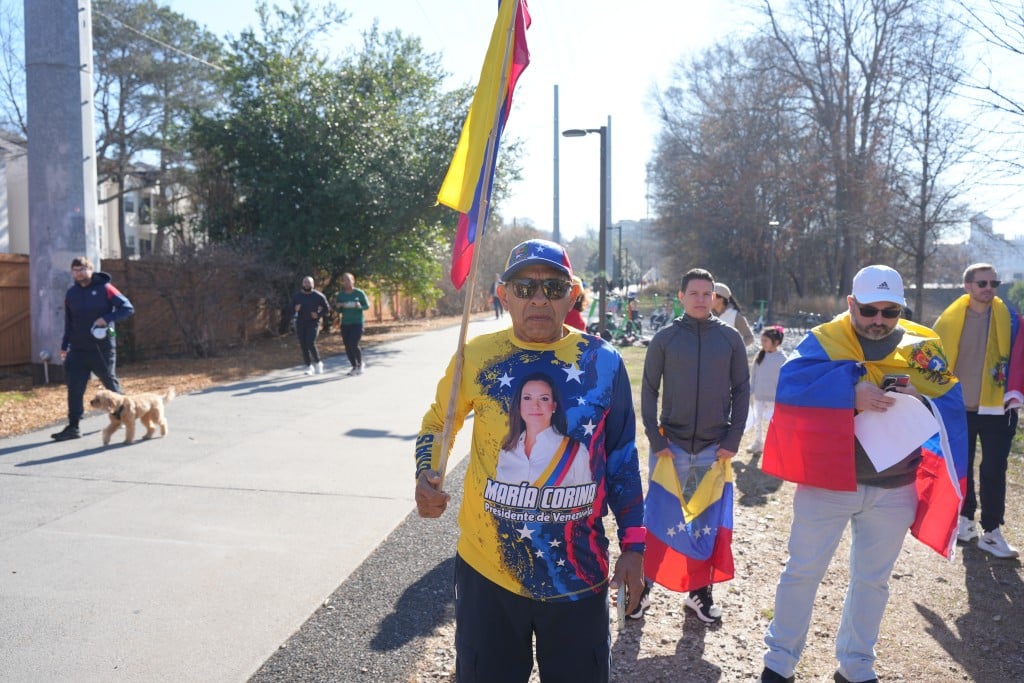
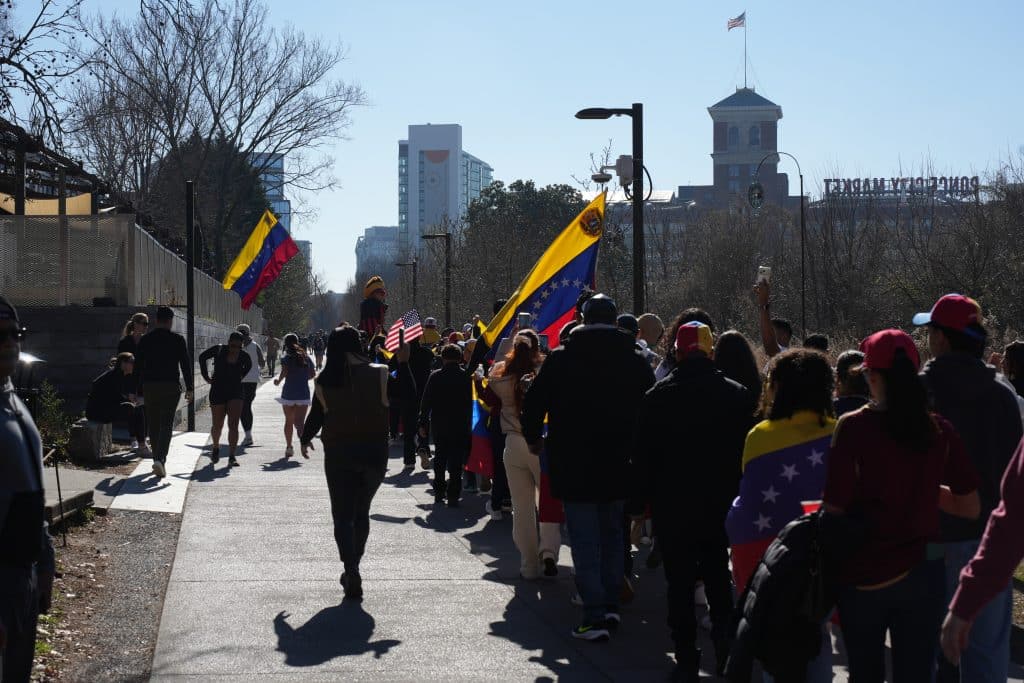
On Sunday, he joined about a hundred other Venezuelans who gathered on the Atlanta Beltline to celebrate what they see as the first step toward the end of authoritarian rule in their country. Just a day before, the United States had bombed military bases and communication antennas in Venezuela, and captured Maduro and his wife, Cilia Flores, who are being charged in New York federal court with drug trafficking, “narco-terrorism conspiracies,” and other crimes. In a press conference over the weekend, President Donald Trump said the U.S. was now running the country and will fix the country’s oil infrastructure. At least 40 people in Venezuela were killed in the operation, according to a New York Times report.
Sunday’s rally was convened by Comando con Vzla Atlanta, an informal political organization that supports the efforts of opposition leaders María Corina Machado and Edmundo González Urrutia—who faced Maduro in a 2024 election widely thought to be rigged, and who is considered the country’s legitimate president-elect by countries including the U.S. 285 South spoke on the sidelines with Iris, a 30-year-old Venezuelan woman who lives in Decatur and works as a cleaning lady in a school. She said she was awakened by her husband in the middle of the night by the news that Maduro was no longer in power. She didn’t want to share her last name because her family is still in Venezuela and worries about their safety.
“Son muchos sentimientos encontrados. Es ya mucho tiempo sin ver a mi mamá, mi papá y volver a tener esa esperanza de que podemos volver a regresar es algo muy grande. Eso no se explica en realidad,” Iris said as tears streamed down her face. (There are so many mixed feelings. It’s been a long time since I’ve seen my mom and dad, and having that hope again that we can go back is something huge. It’s really indescribable.)
Back in Venezuela, Iris worked as a nail technician—and, before she left, found herself struggling to find basic amenities like diapers and food items like rice. Pregnant between 2013 and 2014, when Venezuela faced a severe economic crisis and food shortage, Iris said she waited in hourlong lines for whatever groceries she could afford, as well as what could be sold to her—as markets were rationing their supplies. After years of struggling, Iris fled to Colombia in 2015 and later to the U.S., finally settling in Atlanta.
“Yo tengo una casa en Maracaibo y fíjate que eso ya tiene tres años, que no le llega el agua. ¿Tú crees que eso es posible? Imagínate tres años que no hay agua en ese, en ese lugar,” Iris said. I have a house in Maracaibo, and you know, it’s been three years since they’ve had water there. Do you think that’s possible? Imagine, three years without water in that place.
Iris’s parents are still in Venezuela, and she sends them money for food and medicine. Though the dollar isn’t Venezuela’s currency, she said, it’s how everything is priced: “If you don’t have dollars, you’re nobody.”
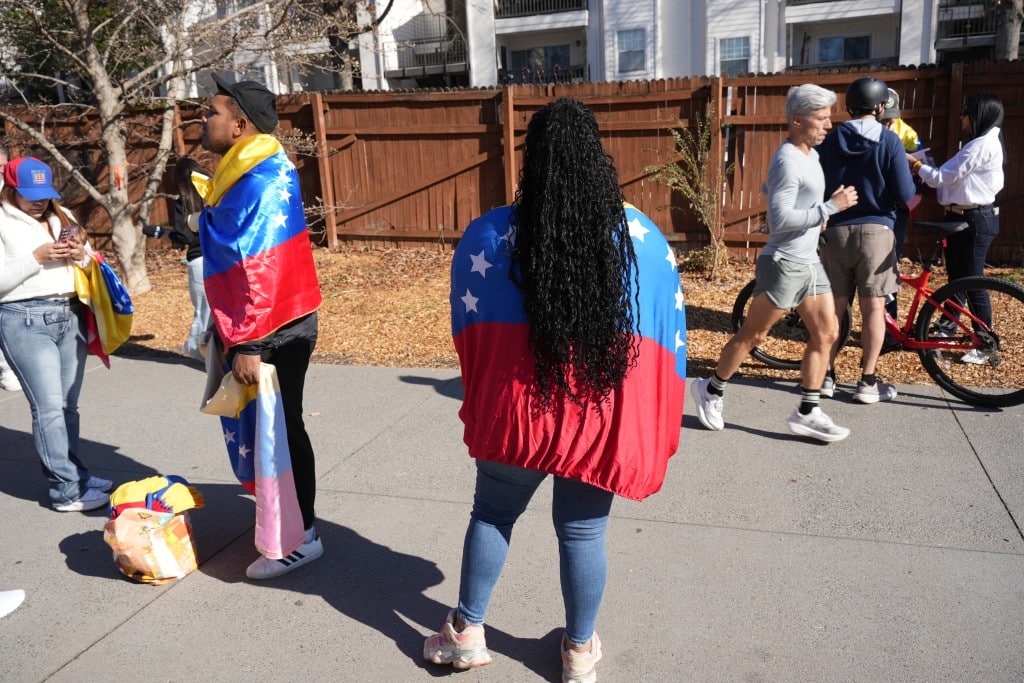
Some at the rally were directly coordinating with opposition leaders back in Venezuela. Pedro Fuentes, one of the event organizers and a coordinator for Comando con Vzla Atlanta, said he expects to organize more rallies in the upcoming months as he receives instructions from the Venezuelan political party Vente Venezuela, led by the main opposition leader and Nobel Peace Prize winner Maria Corina Machado. “We’re ready here to keep supporting Venezuela, we’re here to keep working for Venezuela and one day will be back in Venezuela,” he said.
While many have sought refuge in Latin America and the Caribbean, it’s estimated that almost 25,000 Venezuelans live in metro Atlanta—making them the fastest-growing Hispanic group in Georgia since 2010, according to the Latino Community Fund. Around 600,000 Venezuelans nationwide were beneficiaries of Temporary Protected Status until the Trump administration ended that immigration protection in 2025.
Venezuela is currently facing one of the biggest displacement crises in the world, with over 8 million people fleeing since 2014 due to economic instability, triple-digit inflation, violence, food and medicine shortages, and a collapse of basic services such as water and electricity. Maduro and his regime have been accused of arresting over 15,000 political prisoners between 2015 and 2019, with 863 remaining in detention as of Monday, January 5, 2026, according to the human rights organization Foro Penal. Since 2016, Venezuela has been governed under a “state of exception” that grants unusually broad powers to federal authorities, and detainees have reported being tortured.
While the Venezuelan crowd on the Beltline chanted “Freedom, freedom” and “The dictatorship has already fallen,” others gathered over the weekend to denounce U.S. involvement in the South American country—where the Trump administration’s actions have been seen as a continuation of a long history of U.S. meddling in the region. Members of the Party for Socialism and Liberation organized a rally on Saturday opposing the intervention and arguing that it was a pretense to gain control of Venezuela’s vast oil reserves; at a second protest at Piedmont Park on Sunday morning, organized by the Democratic Socialists of America and the 50501 Movement, protesters criticized the Trump administration’s involvement in another foreign nation and lack of congressional approval.
Akbar Ali, a newly elected Democratic state representative from Gwinnett County, was at the Beltline rally. He told 285 South he was happy for the Venezuelan community who celebrated the capture of Maduro—but, at the same time, worried about how the Trump administration conducted it. Georgia lawmakers have joined other American politicians in expressing concerns over the lack of congressional approval for the military action. Also, critics have claimed that the capture of Maduro, undertaken without approval from the United Nations Security Council, may have violated international law.
“I’m here to support the Venezuelan people, because although I do have concerns about how it was done, I’m glad that a dictator was taken out,” Akbar said. “You see the environment here, everyone’s happy, everyone’s prideful, they’re just elated. And I think that, whether it be left-wing or right-wing, oppression is oppression, and I’m glad that that’s gone.”
Iris said she isn’t going to leave the U.S. for now. Delcy Rodriguez, Maduro’s appointed vice president, still runs the country, and many of his allies retain military control.
“Sabemos que hay otras personas en ese poder que han hecho muchísimo daño y hay que esperar que que toda esa gente salga,” Iris said. We know that there are other people in that position of power who have done a great deal of harm, and we have to hope that all those people will leave.
She remains hopeful that she’ll eventually reunite with her family. “Uno está aquí en Estados Unidos, luchando para poder sobrevivir, ayudar a sus familiares y el saber que hay una esperanza de regresar a su país es muy grande,” she said. Being here in the United States, struggling to survive and help our families, and knowing that there is hope of returning to our country is a huge thing.
Author
Related Articles
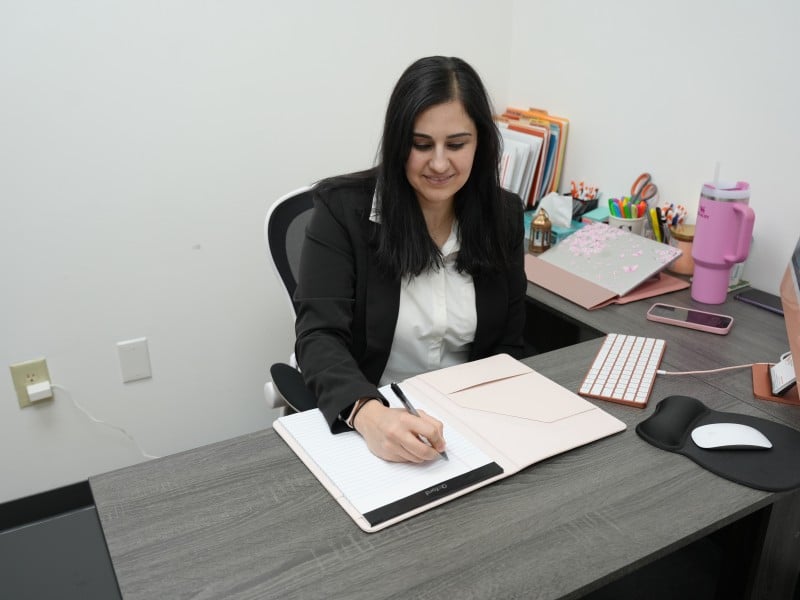
“The work has become three times harder”
We speak to pro bono immigration attorney Serene Hawasli-Kashlan, legal director of Asian Americans Advancing Justice–Atlanta, about what it’s like to do her job right now.
“We are stuck”: With SNAP and Medicaid benefits cuts, refugee families in Clarkston on edge
Following legislation passed last year, almost all immigrants and refugees in the U.S. lost access to crucial food and healthcare support. Here’s how two families are coping.
Refugee, Muslim, and Latino organizations push for laws to improve immigrants’ quality of life in Georgia
Among them: increased opportunities for foreign medical graduates to expanding language access in schools to repealing immigration enforcement bills