
He drove for the U.S. Embassy in Kabul. Now Georgia cut his family’s food stamps.
“I’m lost,” said Zar Alam Obaidi, after learning of SNAP terminations.
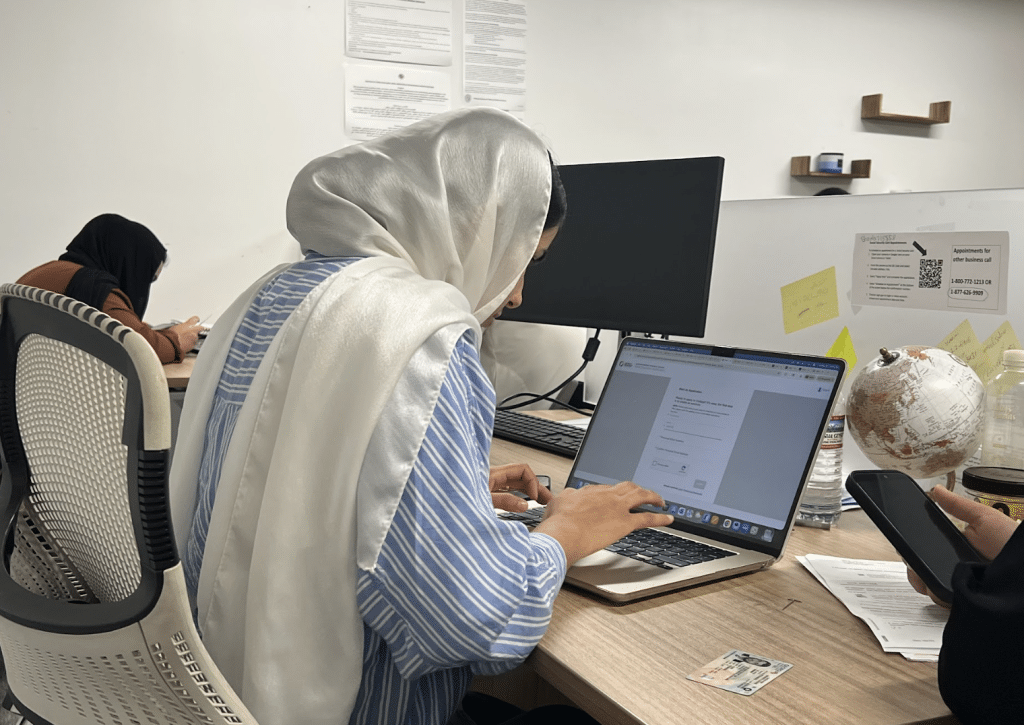
On the morning of May 22, Zar Alam Obaidi walked into the Clarkston office of the Afghan American Alliance of Georgia (AAAGA). He was there to look for help: Zar Alam had received a notice in the mail notifying him that his family’s SNAP benefits—also known as food stamps—had been terminated. The reason listed on the notice: “You do not meet immigration eligibility requirements.”
For Zar Alam, who lives in Tucker with his wife and their seven kids, and is the sole earner in the family, the loss of benefits was a major blow. He makes just over $17 an hour working at a Marshalls warehouse in Lithonia, and lately, he’s had his hours reduced. “I don’t know what to do,” he said, speaking to 285 South through an interpreter.
Before immigrating to the U.S. from Afghanistan, Zar Alam worked as a procurement driver for the U.S. Embassy in Kabul, delivering everything from refrigerators to televisions. Zar Alam and his family arrived in the U.S in December 2023 on Special Immigrant Visas (SIV). Granted to people who have assisted U.S. forces, and who are likely in danger because of that work, SIVs typically receive green cards shortly after arriving in the U.S. Three months after landing in Atlanta, the Obaidis got their green cards.
The Obaidi family’s immigration status meant that the family should have been eligible to continue receiving SNAP. That’s despite the passage last year of the One Big Beautiful Bill Act (OBBBA), which has meant that over a million noncitizen households who were previously eligible for food stamps are at risk of losing their benefits or have become ineligible. In Georgia, the Department of Human Services terminated SNAP for over 7,000 noncitizens in 2026 alone, according to data 285 South obtained through an open records request.
But many noncitizens should still be able to access SNAP benefits. Those who’ve held a green card for more than 5 years are still eligible. And, according to a letter the U.S. Department of Agriculture (USDA) sent to state agencies dated December 9, 2025, people who came to the U.S. for humanitarian reasons and have green cards (refugees, asylees, and those with special immigrant visas, among other categories), are not subject to the 5 year waiting period, as long as they meet the state’s other requirements.
After hearing about the Obaidi family’s troubles, AAAGA caseworker Sheela Poya put in a call to Georgia’s Department of Human Services, the agency that administers SNAP benefits through the Division of Family and Children’s Services (DFCS). It went to voicemail, so she left a message with the family’s details. Another family, she said, came to the U.S. on SIVs around the same time as the Obaidis, and who also had green cards, received a notice from the state with the opposite news: Their SNAP benefits were approved.
“We’re so confused,” Sheela said last Friday afternoon, sitting at her desk. More than a dozen people filled her office, which she shares with two other case workers. They waited patiently for her help with everything from lost social security cards to Medicaid termination to signing up for ESL classes.
Shelby Gonzales, a policy expert who researches immigrant families’ access to public benefits at the Center for Budget and Policy Priorities, isn’t surprised about the confusion, given the complexity of the new laws. Eligibility for immigrants is generally determined after the state submits data to an online interface called Systematic Alien Verification for Entitlements (SAVE), operated by the U.S. Department of Homeland Security. “I’ve been working on benefits for a long time, and SAVE has always had limitations,” Shelby said. “Even in the best of times …we are not in the best of times,” she added. “My hypothesis is that the Department of Homeland Security is not doing heavy lifting to make sure that they get this 100 percent right.”
Attorneys general from 19 states including California, Colorado, New York, and Maryland sent a letter to the USDA late last year, saying the confusion around the law could lead to many residents losing food aid; they later filed a lawsuit challenging the benefit cuts to immigrants and refugees.
285 South reached out to Georgia’s Department of Human Services to ask why the Obaidi family’s benefits have been terminated despite them appearing to have eligible status. A representative said the agency would be “glad to look into it further.” As of publication, we had not received an update.
When Zar got home from the AAAGA that Friday, he received a call from an agent of the Department of Human Services. It was a virtual interview, he said, with an interpreter also on the line. He explained his immigration status but, he said, the representative didn’t seem to believe him. “They told us to go to court,” he said, with Ahmad Farid Sultani, a case worker at AAAGA, interpreting. “I’m so busy, I don’t have time,” he said. “And I don’t know how to go to the court.”
At the Marshalls warehouse in Lithonia, where he prepares orders of shoe shipments, Zar Alam earns around $3,200 in a good month. That’s only if his hours haven’t been reduced: On the day he spoke to 285 South, he said, he’d shown up at work at 5 a.m., but his supervisor sent him home after only five hours. There wasn’t enough work that day, and there wasn’t last week either.
Zar Alam’s rent alone is $1,850 and his power bill is around $250, he said. Though some of his kids are teenagers and could potentially earn income for the family, he doesn’t want them to, because “they will be prevented from going to school,” he said, with Ahmad interpreting. “It’s not good for their future.” He’s not sure what he’ll do. “I’m lost,” he said.

Author

Related Articles

Five Years After Atlanta Spa Shooting, AAPI Community Faces Stalled Trial, Fading Support
On the final day of January this year, Kim sat stoically in a Fulton County courtroom, watching Robert Aaron Long and his legal team.

After 15 months in immigrant detention, Rodney Taylor is back home—but is still fighting for those left behind
“The Lord has for me what he has for me. He put it in my heart, in my spirit to continue this fight, so I’m not fearful of anything,” Rodney said.
ICE has two offices in downtown Atlanta. Amary Sall arrived for an appointment at the wrong one—and was deported
Amary and his wife, Gail, had recently opened a restaurant in Decatur. Now she’s left to pick up the pieces of their life.