
Georgia passed a law targeting undocumented immigrants who commit crimes, after a high-profile 2024 murder. It may not be doing much for public safety.
In diverse Gwinnett County, HB1105 has become a quiet tool for the Trump administration to advance its immigration crackdown.

Around 10:30 p.m. in early March 2025, Cristhian Martinez Gallardo was driving home in Norcross with his girlfriend—they’d tried to make a deposit at a bank, only to realize it was closed after hours—when he was stopped by police for not having his headlights on. When the officer asked Cristhian for his driver’s license, he had nothing to give: Born in Mexico, Cristhian was in the U.S. without legal status, so by Georgia law he’s barred from obtaining a license.
He was arrested, taken to the Gwinnett County jail, and held until the next morning, when he paid for his traffic ticket—driving without a license, a misdemeanor—and expected to be released.
But Cristhian wasn’t released that morning, or the next one. Speaking to 285 South over a WhatsApp call from Oaxaca, Mexico, where he now lives, he recalls spending about 72 hours locked up in Gwinnett County. It felt like the jail staff were stalling: “Me dijeron que todavía no pasaba el pago,” he said. “Ya cuando empecé a preguntar y a presionarlos, justamente cuando iba yo casi de salida me cerraron la puerta.” They told me the payment hadn’t gone through yet. Then, just as I began asking questions and pressuring them—right as I was practically on my way out—they shut the door on me. Soon, federal agents showed up to take him into custody.
Cristhian said he was transferred to two prisons and finally Stewart Detention Center, a U.S. Immigration and Customs Enforcement (ICE) facility in Lumpkin, where he spent about three months. In May 2025, he was deported to Mexico.
The reason for Cristhian’s extended stay in the Gwinnett County jail was an ICE detainer—a written request from federal authorities for local law enforcement to hold people suspected of lacking legal status in the U.S. Once ICE issues a detainer request, according to federal regulations, local jails can confine people up to an additional 48 hours past the time they otherwise would have been released, to give immigration authorities the opportunity to assume custody of them.
Detainer requests are nothing new. But their use in Georgia was supercharged by House Bill 1105, a 2024 measure requiring law enforcement agencies to honor such requests, which previously had been voluntary. Now, with HB 1105, if they don’t comply, they risk losing state funding or state-administered federal funding.
The law was passed by the Republican-led legislature following the arrest of an undocumented immigrant from Venezuela in connection with the February 2024 murder of Laken Riley on the University of Georgia campus in Athens. The bill’s sponsor, Rep. Jesse Petrea, argued the measure would bolster public safety. So did other supporters: “In Georgia we will do everything in our power to ensure criminals are not allowed to walk free and terrorize communities,” said Gov. Brian Kemp, who signed the measure.
285 South filed an open records request with Gwinnett County, the second-most populous county in the state as well as the most diverse, to find out how many people have had ICE detainer requests since the law went into effect in May 2024, who they were, and under what circumstances they were first arrested. HB1105 took effect in May 2024, and federal immigration enforcement intensified nationally in 2025. The data we analyzed shows what changed after the law, but it’s not clear to what extent the escalation in enforcement is because of the broader federal crackdown.
We learned that Cristhian is one of about 1,900 people booked into the Gwinnett County jail who received detainer requests between January 2023 and February 2026. Comparing equal time periods before and after the law was enacted in May 2024, the number of detainer requests in Gwinnett rose by roughly two-thirds — about 68 percent. Detentions have overwhelmingly increased for traffic violations and other low-level misdemeanors, while the share of those charged with more severe crimes has declined .
Since HB1105, the share of detainer requests for people booked for theft, burglary, robbery and other property charges declined, from around 12 percent to about 9 percent, and for those with drug charges, it dropped from about 14 percent to around 11 percent. Domestic and family violence fell from almost 7 percent to about 5 percent of all charges tied to these detainers. Sex-offense charges held roughly flat, at about 6 percent before and after the law.
Meanwhile, the numbers in Gwinnett County show that HB 1105 has led to the increased detention—and referral to federal authorities—of people who, like Cristhian, have come into contact with local law enforcement for minor infractions. ICE detainers for people charged with traffic-related offenses grew from almost 17 percent to about 24 percent of all charges tied to these detainers.
The vast majority of those people have been Latino. More than a quarter of Gwinnett County residents were born in another country, according to data from the Atlanta Regional Commission. Of this foreign-born population, nearly half come from Latin American countries. People from Latin American countries, though, accounted for nearly all—about 94 percent—of the detainer requests that 285 South analyzed, with Mexico representing about a third of people with detainers, followed by people from Guatemala, Honduras, Venezuela, and El Salvador.
In May of this year, 285 South went out to Plaza Las Americas—a shopping center in Gwinnett County with a mostly Hispanic clientele—to speak with shop tenants or employees. Out of 15 people we asked, nine said they knew of someone who had been detained and deported following a traffic violation. Most of those detained were Latino people from countries like Colombia, Honduras, El Salvador, and Venezuela.
In response to a request for comment, the Gwinnett County Sheriff’s Office sent an email: “House Bill 1105 is a Georgia law that the Gwinnett County Sheriff’s Office is required to follow. The Sheriff’s Office is in compliance with HB-1105 and honors immigration detainer requests as required by law.” Rep. Petrea, the bill’s sponsor, didn’t respond to a request for comment.
“The numbers tell a very chilling story that minor traffic violations have led to a disproportionate amount of undocumented people being rounded up in Georgia,” said Jerry Gonzalez, executive director of GALEO, a nonprofit organization working to increase civic participation among Latinos.
Legislatures in Texas and Florida have also passed laws requiring local law enforcement agencies to honor detainer requests, while other states—including California, Oregon, and Illinois—have moved to restrict local law enforcement from honoring detainer requests unless they’re accompanied by a judicial warrant.
One of the most outspoken critics of the increased use of ICE detainers has been Rep. Marvin Lim, of Georgia House District 98, which includes parts of Lilburn, Tucker, and Norcross that are home to many undocumented people. “There are significant concerns that there are more people who were perhaps ultimately deported, or more people ensnared in the system that wouldn’t have otherwise been ensnared for such minor charges,” Marvin said. “Once you’re in the system for an ICE hold, it doesn’t matter whether or not that charge was ultimately dropped, We know specific cases where charges were dropped and yet, because they were in an ICE hold, that person ultimately was detained” by ICE.
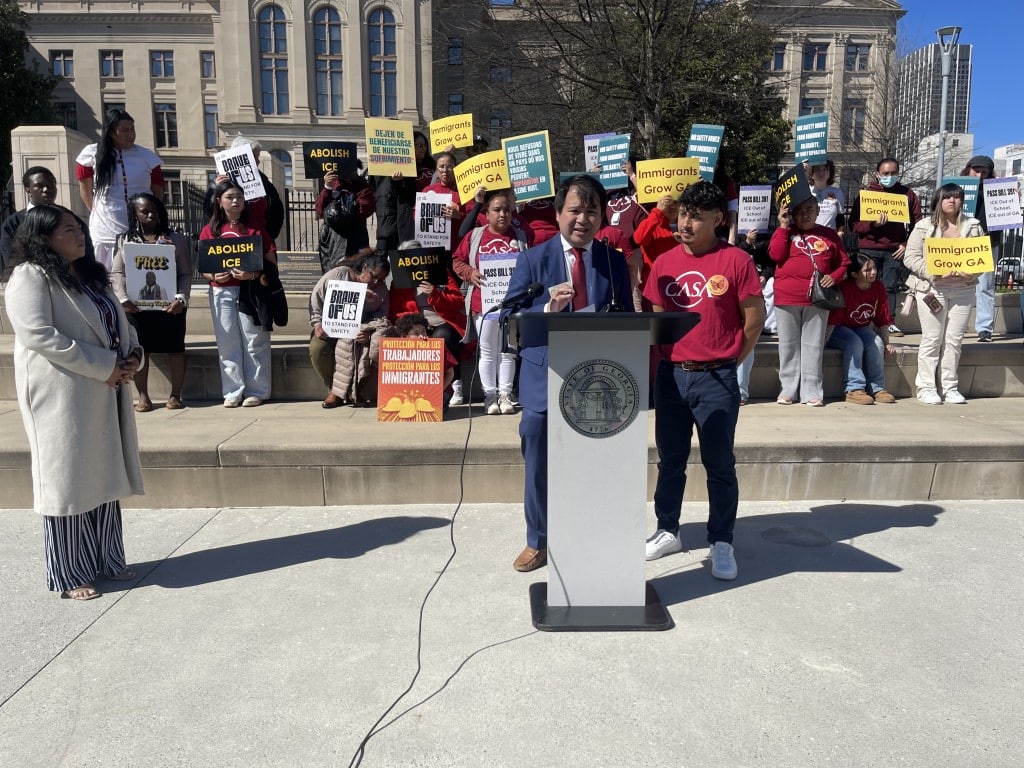
The costs of HB 1105
Prior to the passage of HB 1105, local law enforcement agencies could choose whether to honor detainer requests or not. If local jurisdictions wanted to increase their participation in immigration enforcement, they could join the 287(g) program, which enables partnerships with the Department of Homeland Security in which local officers are deputized to perform some immigration enforcement functions. Under certain 287(g) agreements, deputized officers can issue ICE detainers.
When HB 1105 passed in 2024, critics worried about what would happen when local agencies took on greater responsibility for enforcing federal immigration law. “HB 1105 effectively turns the entire state into a 287(g) jurisdiction,” David Schaefer, the Georgia Budget & Policy Institute’s (GBPI) vice president of research and policy, said at the time.
Schaefer also said HB 1105 was “expensive and strips scarce resources from local governments,” citing previous GBPI research that found that, between 2008 and 2017, honoring federal immigration detainers cost Georgia’s local governments an estimated $88 million—an annual statewide average of about $9 million. “Georgia’s local governments only recovered an estimated 12 percent of the cost of imposing detainers over a nine-year span from 2008 to 2016,” the report notes. Counties with actual 287(g) agreements took an even greater hit, with Gwinnett County losing at least $9.8 million over an eight-year period, or an average of $1.2 million a year.
In response to our inquiry, a spokesperson for the Gwinnett County Sheriff’s Office wrote: “The cost to house an inmate is the same regardless of whether that individual is the subject of an immigration detainer.”
“HB 1105 almost makes those 287(g) [agreements] superfluous,” said Adam Sawyer, the director of the data analysis company Relevant Research, who regularly analyzes data from ICE. During the second Trump administration, he noted, public attention has often been consumed by scenes of raids, violent traffic stops, and sometimes lethal shootings by ICE officers. The detainers procedure, Adam said, tends to be overlooked—but tracking it helps us understand the scale of the impact of immigration enforcement in local communities.
Because of ICE detainers, the federal government’s immigration goals are receiving crucial support from the State of Georgia—and, in this case, from Gwinnett County. “Between 287(g) and detainers, [Georgia is] covered,” Adam said. “I will say this puts Georgia, and Gwinnett County, in that number of states where you’re going to see local law enforcement agencies doing the work of the federal government, so that the federal government can work elsewhere in the country.”
Gwinnett County Sheriff Keybo Taylor ran for his position in 2020 on promises to limit county cooperation with federal immigration authorities—and, shortly after taking office, canceled the county’s 287(g) program. 285 South requested an interview with Sheriff Taylor to ask him about how his office has been complying with the requirements of HB 1105 and ICE detainer requests, but his office declined, asking us to email questions instead.

Cristhian, the man deported following the Gwinnett County traffic stop, had moved to Georgia about eight months prior to his arrest. He found a job moving furniture in a storage facility about six days a week. On his only day off, he mostly stayed home doing laundry, cleaning up, and watching movies. He was saving money and sending some to his daughter, who remained in Mexico. While in detention, he wasn’t able to provide for her for a while.
After being deported, Cristhian broke up with his girlfriend. Keeping up with a long-distance relationship didn’t work out, and he doesn’t have any plans to return to the U.S. He lost all his belongings, including his car and clothes.
Speaking from Mexico, he said he was having trouble adapting to his new life. “Había noches que uno no podía dormir. Caminaba yo en las madrugadas; hasta que fui asimilando todo,” he said. There were nights when I couldn’t sleep. I would walk in the early hours of the morning—until I gradually came to terms with everything.
*This project was made possible through partnership with the Ida B. Wells Society for Investigative Reporting Fellowship.
How we analyzed the data: 285 South used Claude Code to help us analyze the four years of data covering detainer requests on individuals in Gwinnett County jail custody that we obtained via an open records request. We had a human fact-check Claude Code’s work to ensure it met our standards for publication. Using AI in this story allowed us to provide more accurate and robust information to our audience on a faster timeline than would otherwise be possible, including forthcoming stories on the impact of HB 1105 and ICE detainers in other Metro Atlanta counties.
Author

Related Articles
Inside Atlanta’s “mega master” immigration hearings
Advocates warn of a concerning trend inside Atlanta’s immigration courthouse: hearings that resemble an “assembly line . . . rushing people into a mass deportation process.”
After her brother’s death in ICE custody, a Georgia woman is left with unanswered questions, the logistics of his burial—and deep grief
On July 13, Jesus Manuel Arenas-Silva became the 22nd person this year to die in ICE custody. Advocates say the government isn’t providing the medical care detainees need.